Quick Take
- Narration: Lydia Sanders gives Reese a distinct voice that carries the right mix of modern-girl-out-of-time bewilderment and stubborn determination, and manages the Fae court scenes with appropriate gravity.
- Themes: Human-Fae forbidden romance, identity and lineage, loyalty under pressure
- Mood: Romantic and fast-paced, with just enough tension to keep the pages turning
- Verdict: Solid paranormal romance for listeners who enjoy Fae world-building with a contemporary female lead and a slow-burn enemies-to-more dynamic.
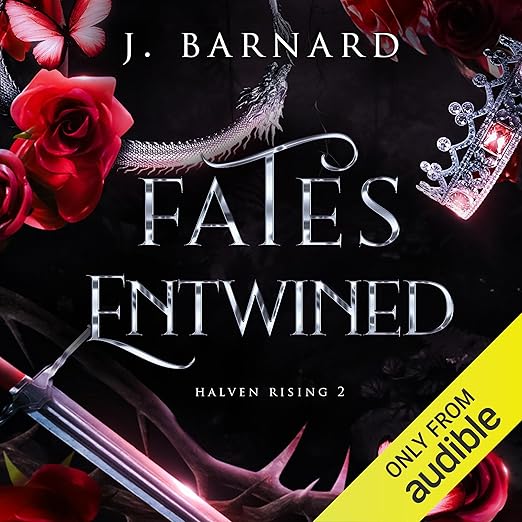
I listened to the opening chapters of Fates Entwined on a Tuesday evening when I had about an hour before I needed to sleep and absolutely no intention of using it wisely. I finished it two nights later, having made approximately the same bad decision twice more. That is not a literary assessment. That is a data point about pacing and readability, which are the metrics that matter most for a book in this genre and which J. Barnard handles competently throughout.
Fates Entwined is the second book in the Halven Rising series. Reese Fisher is a contemporary college student who, on the night of her eighteenth birthday, finds herself pulled into a Fae dungeon rather than the fraternity party she was planning to attend. The Fae, it turns out, are not mythology. They are a parallel civilization with their own politics, and Reese is significant to them: she is a Halven of royal blood, a half-human, half-Fae hybrid whose existence complicates the already fractious relationship between the New and Old Kingdoms. Her reluctant protector is Keen Albrecht, her roommate’s arrogant bodyguard, who is sent to find her and discovers more than he was looking for.
Our Take on Fates Entwined
The enemies-to-lovers dynamic between Reese and Keen is the book’s engine, and Barnard runs it with the specific kind of patience the structure requires. These are two characters who are both right about each other’s flaws and wrong about each other’s depths, and the gradual correction of those mutual misreadings is where the book does its best character work. A reviewer described being wound up and at times frustrated by the romance side, which is exactly the intended effect. Barnard is withholding resolution at the right moments and delivering it at others, and that calibration is harder to achieve than it looks. The world-building, which involves angel-derived magic, a half-breed problem that functions as a stand-in for various forms of social prejudice, and a political situation between competing Fae courts, is introduced at a pace that stays interesting without becoming overwhelming.
Why Listen to Fates Entwined
Lydia Sanders’ narration is one of the audiobook’s consistent strengths. Reese is written as a character who uses humor to manage fear and sarcasm to manage attraction, and Sanders finds that register without making it grating. The Fae court scenes, which require a different tonal register than the contemporary-girl-out-of-water sections, are handled with appropriate gravity. The audiobook runs just under nine and a half hours, which is a comfortable length for this kind of read: substantial enough that the world and characters have room to develop, compact enough that the pacing does not have time to drag. A reviewer who read all three books in rapid succession, lamenting the end of the last, described the series as so fresh and engaging. That enthusiasm reads as genuine rather than generic, and it matches the experience of listening.
What to Watch For in Fates Entwined
This is the second book in a series, and it functions as such. Listeners who have not read Halven Rising book one may find themselves catching up on significant context through exposition rather than experience, which is workable but not ideal. The synopsis, which focuses heavily on Reese and Keen, slightly undersells the broader political stakes that occupy much of the first half of the book. Listeners who come primarily for the romance should be prepared for a fair amount of world-building and court politics before the central relationship gets its most interesting scenes. That structural balance becomes more rewarding in retrospect than it sometimes feels in the middle chapters.
Who Should Listen to Fates Entwined
Listeners who enjoy paranormal romance with Fae world-building, a contemporary fish-out-of-water protagonist, and an enemies-to-lovers arc will find this a reliable and engaging choice. It works best as the second entry in a series commitment rather than a standalone dip into the genre. Those who want their romantic payoffs front-loaded should start with book one. Readers of authors like Sarah J. Maas or Stephanie Hudson who want something in a similar vein but shorter and more accessible will find Barnard’s series a satisfying alternative.
Frequently Asked Questions
Can Fates Entwined be listened to without having read the first Halven Rising book?
It is possible but not ideal. Significant character relationships and political backstory are carried over from the first book, and starting here means encountering them through recap rather than experience.
How does the Halven Rising world-building handle the concept of half-breed Fae, and is it explored with nuance?
Barnard uses the half-breed tension as both a plot driver and a metaphor for belonging and prejudice. The treatment is not deeply analytical but it gives the conflict moral weight beyond simple romantic obstacle.
Is Fates Entwined suitable for listeners who prefer their Fae romance with more contemporary or lighthearted elements than traditional high fantasy?
Yes. The contemporary-girl-transported-to-Fae-world setup gives the book a self-aware, lighter tone than high fantasy proper, and Reese’s voice is consistently modern and often funny.
How long is the Halven Rising series, and does Fates Entwined end on a cliffhanger?
Based on reviewer comments referencing at least three and possibly four books, the series is ongoing or recently concluded. Fates Entwined appears to resolve its central arc while leaving larger series questions open.