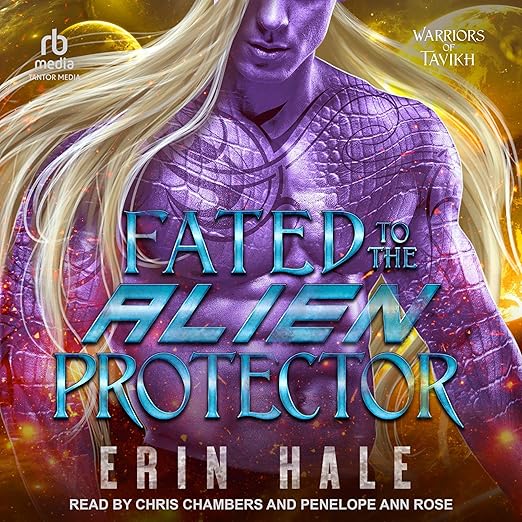
Quick Take
- Narration: Chris Chambers handles the dual-POV structure cleanly, differentiating Abby’s wariness from Rojtar’s measured patience without making either feel like a performance.
- Themes: Trust rebuilt after trauma, fated mate dynamics, found family on an alien world
- Mood: Warm and tension-forward, with a slow burn that is the point rather than a detour
- Verdict: A competent and emotionally satisfying entry in the Warriors of Tavikh series that delivers exactly what alien romance readers come for, without the pacing problems that sometimes plague the middle books of long series.
I came to Fated to the Alien Protector during a week where I wanted something that would move quickly and resolve cleanly. Book six in Erin Hale’s Warriors of Tavikh series, published by Tantor Media in mid-2025, had a rating of 4.5 from 600 listeners, which for this genre is a meaningful sample size. I listened during two evenings of domestic tasks and found, as I often do with the better examples of alien romance, that the genre’s apparent simplicity conceals a fair amount of structural discipline.
The series follows the Tavikhi people, native warriors on an alien planet that has become home to a human settlement, and each book pairs one warrior with one human woman through the fated mate framework. The mating marks, triggered by physical contact with a destined partner, provide the series with its romantic mechanism. Rojtar, who has watched five tribe brothers find their keeshla before him, is the focus of this installment. Abby, orphaned and raising her younger brother on a planet where she has learned to trust no one, is his.
Our Take on Fated to the Alien Protector
The setup is efficient and the central conflict is real rather than manufactured. Abby’s distrust of men is established not as a quirk but as the product of specific losses and specific betrayals, and Murphy is careful to let Rojtar’s patience be tested by that history rather than simply overcome it. The stalker subplot, involving a human man who has been targeting Abby and who refuses to accept her rejections, grounds the romantic tension in a genuine threat that the fated mate narrative must work around rather than simply absorb.
One reviewer described it as a tad predictable but such a great slow burn, which captures the book’s tonal contract accurately. The predictability is structural: in fated mate romance, the endpoint is known from the opening pages. The question is never whether but how, and the how here is handled with more emotional specificity than the average entry in the genre. Rojtar’s restraint, his deliberate choice not to trigger the mating marks until Abby can make an informed decision, is characterized as genuine respect rather than a performative delay, and it lands as such.
Why Listen to Fated to the Alien Protector
Chris Chambers narrates both perspectives in this dual-POV structure, which requires maintaining two distinct emotional registers across the same voice. Chambers handles Abby’s defensive wariness and Rojtar’s patient certainty without the tonal blur that can flatten dual-POV audio. The switching between perspectives is clean, and the production’s pacing reflects the slow-burn quality of the source material: there is no urgency to rush through the uncertainty toward the resolution.
The series format also works in the book’s favor. By Book 6, Hale has established the Tavikhi world thoroughly enough that the romantic conflict can carry the full weight of the narrative without needing extensive exposition. Listeners new to the series will follow the book without difficulty, but readers who have tracked the five previous pairings will find the broader community context and the appearances of familiar characters from earlier books rewarding.
What to Watch For in Fated to the Alien Protector
The book contains mature themes, as the listing notes, and while this is standard genre disclosure, alien romance readers will know what that means in practice. The content is not explicit by the standards of adult romance, but it is adult-oriented. Readers who prefer heat levels at the sweeter end of the romance spectrum may find some scenes more detailed than they prefer.
At five hours and thirteen minutes, the book is on the shorter end for a full romance arc. Some readers may find the resolution feels slightly compressed in the final third, particularly the handling of the antagonist subplot. The review that describes the story as good but notes a lot of info crammed in the last chapter is pointing at a real structural choice: Hale prioritizes the romantic development throughout and accelerates the threat resolution at the end, which is a reasonable decision for the genre but worth knowing in advance.
Who Should Listen to Fated to the Alien Protector
Readers of the Warriors of Tavikh series who have been following along will find this a satisfying entry, and the specific pairing of a trauma-informed protagonist with a patient, demonstrably respectful love interest gives the book more emotional texture than some of the earlier installments. New listeners can enter at Book 6 without difficulty, but the series rewards sequential reading for the community development. Those looking for alien romance that takes its heroine’s psychological history seriously rather than resolving it as a genre inconvenience will find Abby’s arc more carefully handled than the genre average.
Frequently Asked Questions
Can Fated to the Alien Protector be read as a standalone, or do I need to have followed the Warriors of Tavikh series?
It functions as a standalone romance with its own complete arc. New listeners will follow the story without prior context. Series readers will additionally enjoy the community continuity and appearances of characters from earlier pairings, but those are supplementary rather than required.
How does Chris Chambers handle the dual-POV narration between Abby and Rojtar?
Chambers maintains distinct registers for the two perspectives without overcorrecting into caricature. Abby’s wariness and Rojtar’s measured patience come through as genuinely different emotional textures rather than the same baseline voice with different labels.
What exactly are the mating marks, and how do they function in the romance plot?
The mating marks are a physical manifestation of the fated mate bond in Tavikhi biology, triggered by touch with a destined partner. Rojtar deliberately chooses not to initiate that contact until Abby has enough trust and information to make a real decision, which becomes the central tension of the novel’s slow burn.
Is the stalker subplot resolved satisfyingly, or does it feel like a secondary concern?
Multiple reviewers indicate it is resolved, and one specifically noted that when Louis gets what is coming to him, it really is great. However, the resolution is compressed into the final section of the book, so listeners who want that storyline developed at the same pace as the romance may find it abrupt.