Quick Take
- Narration: Chris Chambers handles the dual POV structure competently, maintaining distinct tonal registers for Evren’s patient certainty and Astrid’s more guarded interiority.
- Themes: Survival of domestic violence, healing through trust, fated mate bonds
- Mood: Protective and tender with a genuine dark undertow
- Verdict: Readers following Warriors of Tavikh will find book seven emotionally rewarding, though the domestic violence content requires careful listener awareness going in.
Book seven of the Warriors of Tavikh series came to me on a Thursday night when I needed something warm and uncomplicated. Fated to the Alien Hero is neither of those things exactly, though it very much wants to be. Erin Hale is working in a corner of the alien romance genre that has found a substantial audience precisely because it pairs wish-fulfillment with emotional weight, and this book does not shy away from the difficulty required to make that weight meaningful.
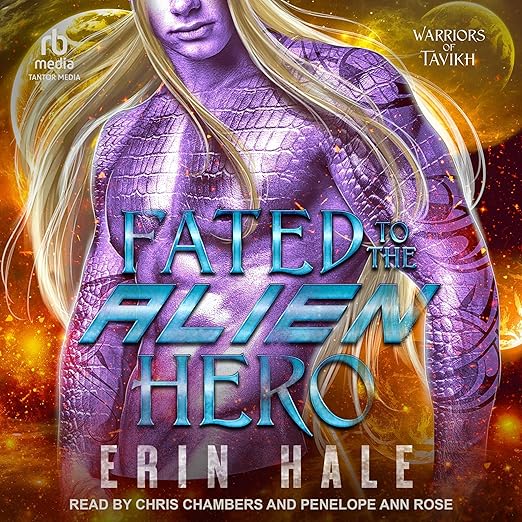
Astrid is not a stock heroine waiting for rescue. She has survived three years of escalating abuse, and the book opens with her husband leaving her for dead in a forest. Evren, a Tavikh warrior who finds her, is the archetypal protective alien mate: seven feet tall, lavender, patient almost to the point of impossibility. The contrast is deliberate. Hale wants readers to feel what genuine care looks like when it follows genuine cruelty, and for the most part she succeeds at that difficult task.
Our Take on Fated to the Alien Hero
The dual POV structure, alternating between Evren and Astrid, is where the book does its most interesting work. Evren’s chapters are suffused with wonder: he has found his keeshla, his fated mate, and his only concern is earning her trust slowly enough that she actually gets to choose him freely. Astrid’s chapters are harder. She is not ready to trust, and Hale does not rush her toward readiness. The pace of the romance is dictated by Astrid’s capacity to heal rather than the plot’s desire to arrive at a happy ending on schedule. Reviewers who have followed the series note that this entry deals with domestic violence more directly than previous books, and that is accurate. The synopsis flags mature themes; the reality is that the abuse is not background detail but foundational to everything that follows. One reviewer noted that the story gives hope from terrible circumstances, while another praised how the Tavikh warrior shows Astrid what it means to be genuinely cherished. Both observations capture something real about what Hale is attempting here.
Why Listen to Fated to the Alien Hero
Chris Chambers narrates both POVs and maintains distinct tonal registers for each, which is the essential task. Evren’s patient certainty and Astrid’s more fractured inner monologue need to feel genuinely different, and they do. The alien romance genre is well suited to audio because so much of its appeal is in the emotional interiority of the characters, and Chambers gives both leads sufficient space. At under five hours, this is also one of the more compact entries in the series, which suits the more intimate focus of this particular installment. Hale is not building a new corner of the world here so much as going deep on one specific healing relationship, and the length matches that ambition.
What to Watch For in Fated to the Alien Hero
One reviewer raised a pointed concern: Astrid’s instinct is to walk away from the situation rather than find a way to stop her abuser from harming someone else. This tension is not entirely resolved in the narrative. Hale makes the understandable choice of prioritizing Astrid’s personal healing over broader accountability, which is emotionally coherent but narratively convenient. Readers who want the story to reckon more fully with what happens to the next woman in Grady’s path may find the ending unsatisfying. Additionally, those new to the series will lack context for the Bohnari healers and the broader Tavikh world, though the book is readable as a standalone if you are willing to accept some unexplained worldbuilding as background texture rather than gap.
Who Should Listen to Fated to the Alien Hero
Series readers who have come this far will find book seven emotionally fulfilling and worth the time. For new listeners, this works as an entry point only if you are comfortable with domestic violence as a central narrative element and do not require prior series context. Skip it if you are sensitive to depictions of abuse or if you prefer your alien romance lighter in tone. If you are specifically looking for a story about healing and the slow reconstruction of trust, Hale handles that subject with more care than the genre average generally offers.
Frequently Asked Questions
Do I need to have read the previous six Warriors of Tavikh books before this one?
The romance itself works as a standalone, but certain elements, particularly the Bohnari healers and the broader world structure, carry more meaning with prior context. Series readers will get significantly more out of it.
How explicit is the domestic violence content in Fated to the Alien Hero?
It is present and direct rather than merely suggested. The opening establishes that Astrid has suffered broken bones and been left for dead. The abuse is not depicted in extended graphic scenes but is central to the character arc throughout the book.
Does Chris Chambers differentiate the dual POV effectively in narration?
Yes. The tonal registers for Evren and Astrid are distinct enough that listeners always know whose perspective they are in. Evren’s sections carry calm warmth and Astrid’s are more anxious and guarded, which serves the healing arc well.
Is the romance in this book slow-burn given the short runtime?
Relatively slow-burn for the genre, even at under five hours. Hale prioritizes Astrid’s emotional readiness over pacing, which means the romantic resolution comes late and feels earned rather than assumed or rushed.