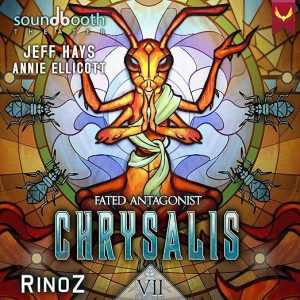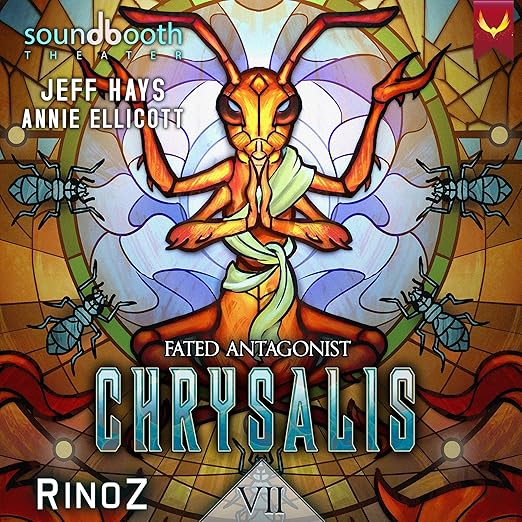
Seven books into the Chrysalis series, RinoZ has accomplished something genuinely difficult: making an ant protagonist not just tolerable but actively beloved across nearly thirty million views on Royal Road and a long-running audiobook series. Fated Antagonist is the entry where the accumulated weight of that investment pays off most clearly. Jeff Hays returns as narrator for a runtime that exceeds twenty hours, and both author and narrator earn it rather than pad it.
Our Take on Fated Antagonist
Anthony the ant - now a Colony leader, mentor, Champion trainer, and reluctant political actor - has what the series has always given him: too many problems competing for his attention simultaneously. The book's structure is familiar in the best sense. Territory needs claiming. Brilliant, Anthony's new protege, requires patient instruction in skills that Anthony himself learned through combat and evolution rather than pedagogy. A simmering war with the ka'armodo faction demands constant monitoring. Then the Mother Tree calls in a favor, and Anthony finds himself facing termites - the ancient nemesis of all ant-kind - which allows RinoZ to play the evolutionary biology angle for both genuine danger and the series' characteristic comedy.
What book seven does particularly well is the mentorship thread. Brilliant is a different kind of student than anyone Anthony has encountered before, with a learning pace and method genuinely alien to Anthony's own combat-shaped development. Watching Anthony navigate this - trying to teach someone whose intelligence operates on entirely different axes than his own while still being responsible for that student's survival - is among the book's more interesting complications. RinoZ does not make it easy on either of them, and the relationship develops with the friction and genuine affection that makes long-running series relationships feel earned rather than maintained out of narrative obligation.
Reviewer Elain, who read straight through all seven books and described waiting for book eight as genuinely difficult, captures the series' hold on its audience: the accumulation of character and world detail across the run makes each new entry carry more emotional weight than the last. This is a compound interest kind of series, and Fated Antagonist benefits fully from everything the first six books deposited.
Why Listen to Fated Antagonist
Jeff Hays is the definitive voice for this series, and that is not a small claim given the scope of what he has been asked to maintain. His Anthony has accumulated texture across hundreds of hours of series audio - the voice carries history, carries the specific mix of tactical clarity and occasional genuine bewilderment that defines the character, and carries the series' humor in the particular register that makes the comedy land rather than interrupt. The Colony's supporting cast, each with distinct vocal identities that Hays has maintained from book one, feel like characters with their own interior lives rather than plot functions with distinct accents.
The comedy in this entry deserves specific mention. The termite arc lends itself to a dry, evolutionary absurdity that Hays delivers with excellent timing - he has always been skilled at the moments where RinoZ needs the narration to carry both the genuine danger and the irony simultaneously, and book seven has more of those moments than most prior entries. Reviewer R. Schaefer noted the darkness near the book's end, which also lands with real weight precisely because Hays has never played the emotional low points cheap across the series. That tonal consistency across a long serialized run is harder to achieve than it appears, and it is one of the reasons listeners who start the Chrysalis audiobooks tend to finish them in their entirety rather than dropping out mid-series.
What to Watch For in Fated Antagonist
The war-with-ka'armodo conflict is present throughout book seven but does not resolve in this volume. Readers of LitRPG serialized fiction will recognize the pattern of sustained geopolitical tension that pays off across multiple books rather than within a single entry. This is a middle-chapter installment in the full sense: it deepens the world, advances several character arcs meaningfully, and ends at a point of genuine stakes rather than a clean resolution. That is not a criticism - it is an honest description of what book seven is designed to do within the larger series architecture.
The LitRPG mechanics in Chrysalis - skill notifications, evolution choices, stat progressions - are woven into the narrative rather than foregrounded as interruptions, which is one of the series' consistent strengths and one of the reasons it has found readers outside the core LitRPG audience. New listeners who are open to the genre but unfamiliar with it should find Chrysalis more accessible than most LitRPG titles, but they should start at book one. The emotional payoffs in Fated Antagonist are entirely contingent on the investment the first six books built.
The Right Listener for Fated Antagonist
Series readers who have reached book seven already know what they are getting, and this entry delivers it with full confidence and considerable craft. New listeners should not start here under any circumstances - the character payoffs and world-building context that make Fated Antagonist land require the accumulated foundation of the first six Chrysalis books. The audiobook format with Jeff Hays is the recommended way to experience this series; his performance transforms what is already an unusually strong web serial into something that holds up to repeated listening across its entire run. At twenty hours this is an investment, but for the audience it is built for, that runtime is a feature.
Is Jeff Hays's narration consistent with earlier Chrysalis audiobooks in terms of voice and quality?
Yes, and notably so. Hays has maintained the full cast of voice identities across the series without drift, which is a significant achievement given the scope. His Anthony voice has deepened with the character's development, and his handling of the new mentorship dynamic with Brilliant in this entry is one of the audiobook's particular strengths.
Does this audiobook resolve the ka'armodo conflict, or does it leave major threads open at the end?
The ka'armodo conflict is an ongoing tension throughout but does not resolve in this volume. This is consistent with the series' serialized structure, in which major geopolitical threads develop across multiple books. Fated Antagonist ends at a point of genuine stakes rather than a clean resolution, which is by design rather than oversight.