The Short Version
- Narrator: Edoardo Ballerini is exceptional here, modulating between the glamour of prewar European racing circuits and the grinding dread of Nazi spectacle with a precision that genuinely elevates the material.
- Subjects: Resistance and defiance through sport, the instrumentalization of athleticism by fascism, unlikely alliances under impossible odds
- Tone: Taut and cinematic, with long stretches of gasoline and grief
- Bottom line: Neal Bascomb has written the kind of narrative history that makes you forget you are listening to nonfiction.
I finished the final hour of Faster on a Saturday morning, parked in my driveway because I could not make myself go inside until it was over. That does not happen often. There is a particular kind of narrative nonfiction that operates at the pace of a novel without sacrificing the weight of real events, and Neal Bascomb has been refining that form across several books now. With Faster, he may have produced his best work. Five reviewers averaging 4.8 stars across nearly a thousand ratings confirms this is not a niche discovery.
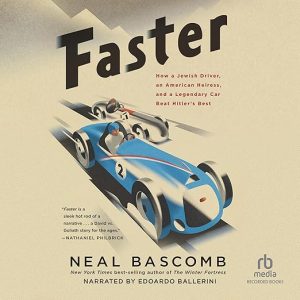
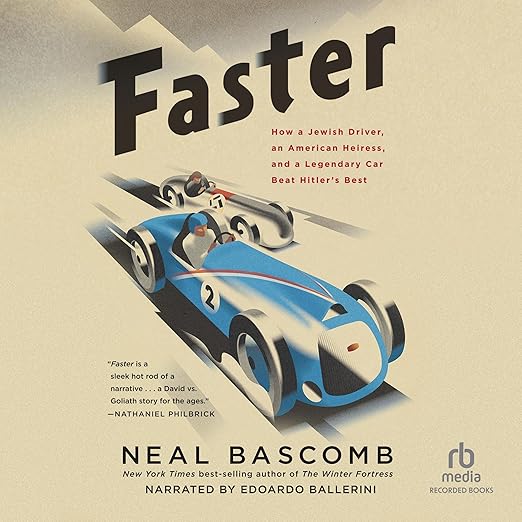
The setup sounds almost schematic: a Jewish driver banned from elite teams by mid-1930s Europe's accelerating antisemitism, a struggling automaker desperate to survive, and an adventurous American heiress who bankrolls their audacious challenge to Hitler's purpose-built racing machines, the Silver Arrows. But the execution refuses to let any of these characters stay schematic for long. Bascomb knows that what makes real stories compelling is not the shape of events but the texture of the people living through them, and he stays in that texture relentlessly.
The most affecting thread in this book is Dreyfus himself. Bascomb opens with him already sidelined, watching from the edges of a sport he had once competed at its highest levels. The racism that pushed him out is not portrayed as an abstract political force. It operates through specific decisions made by specific people, through the polite withdrawal of sponsorship, through the sudden unavailability of the fastest machines. By the time Bascomb brings Charles Weiffenbach and Lucy Schell into contact with Dreyfus, you understand exactly what is at stake for him beyond the race itself. This is not a story about athletic glory. It is a story about what it means to be allowed to exist on the same ground as everyone else.
Edoardo Ballerini handles Dreyfus's interior life with notable delicacy. There is a restraint to his performance in these passages that keeps the emotion from tipping into sentimentality. You feel the weight without being asked to weep on cue. That calibration is harder to achieve than it looks, and Ballerini manages it across nearly ten hours without a single moment of overreach. He is one of the few narrators who can modulate between European glamour and mortal dread without the transition feeling jarring.
Why Listen to Faster
Several reviewers noted that this book functions as both racing history and social history, and that dual register is part of what makes it so effective. Bascomb is thorough about explaining why the Silver Arrows mattered to the Nazi regime beyond pure sport. The machines were national symbols, funded by the state, staffed by drivers whose victories were processed as racial propaganda. When Weiffenbach's underfunded Delahaye team decided to challenge them directly, they were not just entering a motor race. They were making a statement about what effort and ingenuity could accomplish outside the machinery of fascist subsidy. That statement carries meaning whether or not the listener knows anything about pre-war Grand Prix rules.
The book handles this context without turning into a lecture. Bascomb embeds the politics in action and consequence rather than explanation. You understand the ideological stakes through what the characters choose to do and what it costs them, not through interpolated history lessons. One reviewer described it as vividly bringing each scene to life and painting a clear picture of intense, captivating events. That reader intuition is correct: this is cinematic nonfiction in the best sense, where you see it as well as understand it.
What to Watch For in Faster
One of the genuine pleasures of this book is how much space Bascomb gives to Lucy Schell, who might easily have been a footnote in another writer's hands. The daughter of an American millionaire, a rally driver in her own right, she bankrolled the Delahaye challenge and drove the team's strategy with a combination of wealth, stubbornness, and genuine mechanical knowledge. Bascomb treats her as a full protagonist rather than a colorful supporting character, and the book is richer for it. One reviewer specifically noted that readers would love Lucy, and that response is earned on every page she occupies. Her presence is what makes this story feel like an ensemble rather than a solo character study.
At under ten hours of runtime, Faster does not overstay its welcome. Some might wish for more depth on the postwar careers of the principals, or a fuller account of what the race's erasure from German historical record says about the limits of propaganda. But these feel like desires generated by engagement rather than complaints about absence. The book ends having said what it came to say, and having said it with considerable and well-earned force.
Who Should Listen to Faster
This is an ideal listen for anyone who responded to The Boys in the Boat or Erik Larson's narrative nonfiction and wants that same combination of human stakes and historical texture applied to motorsport. You do not need any interest in racing going in. The cars are rendered viscerally and the danger is real, but what Bascomb is ultimately writing about is people refusing to accept the terms of a world that wants to diminish them. Racing enthusiasts will find plenty of technical and historical detail to satisfy that specific appetite. Everyone else will find a story about courage that does not require a checkered flag to understand. Ballerini makes the whole thing move at exactly the right speed from start to finish.
Do you need to know anything about 1930s motorsport to follow this book?
No prior knowledge of racing is required. Bascomb explains the technical and competitive context as he goes, and the human drama is accessible regardless of familiarity with the sport.
How does Edoardo Ballerini handle the European names and multilingual material?
Ballerini handles French and German names with confidence and natural inflection. His range is well suited to the European setting, and the distinction between characters feels consistent throughout.
Is Faster part of a series, or does it stand alone?
It is a standalone narrative history. No prior knowledge of Bascomb's other books is required, and the story is fully self-contained within these roughly ten hours.
How much of the book covers the Nazis' response to losing the race?
Bascomb addresses the erasure of the race from German historical record and gives it appropriate weight. It is not a major section by page count, but it lands as one of the book's most pointed moments.