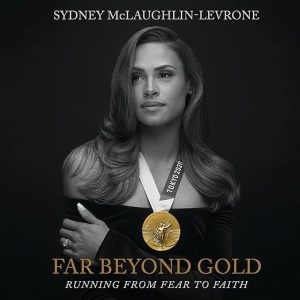
Sydney McLaughlin holds the 400-meter hurdles world record, won gold at the Tokyo and Paris Olympics, and has spent years projecting what looked from the outside like an almost serene competitive confidence. The audiobook of Far Beyond Gold, which she narrates herself in just over six hours, begins in a different register entirely: with the anxiety, perfectionism, and identity crises that track times and medal counts never showed. McLaughlin's decision to narrate her own memoir was not a vanity casting choice. The difference between hearing her describe her faith transformation in her own voice versus a voice actor's is the difference between confession and performance.
McLaughlin is clear about what this book is and isn't. It is not primarily a training manual or a competitive diary, though she describes specific races and training periods in meaningful detail. It is a memoir about identity: the long, painful process of building a sense of self that is not contingent on whether you crossed the finish line first. For an athlete who has broken the 400-meter hurdles world record multiple times, the claim that she spent years unable to feel "enough" regardless of performance is not a narrative device. The specificity with which she describes her battles with perfectionism and the relentlessness of people-pleasing suggests someone who has done real work to understand those patterns rather than simply acknowledging them for the sake of a relatable book.
The faith dimension is central, not incidental. McLaughlin's account of her religious transformation is the structural spine of the memoir, and she does not soften or universalize it for a broader audience. She is writing from within a specific Christian framework, and the language of grace, identity in Christ, and prayer appears throughout. Readers who resist explicitly faith-forward memoirs will find this challenging. But the memoir is not a conversion narrative aimed at the unconverted, it's a personal account of how a specific belief system functioned as an actual psychological resource for someone under extreme competitive pressure, and that specificity gives it credibility regardless of where you stand on the theology.
One reviewer described this as "the best autobiography that I and my kids have ever read," noting that the book reached family members across a wide age range. That response points to something real in McLaughlin's writing: she does not condescend to younger readers or perform vulnerability for an adult audience. The emotional honesty is consistent throughout, and the voice she brings to the audiobook makes that consistency audible.
Why Far Beyond Gold Works as an Audiobook
McLaughlin's self-narration contains moments that no professional narrator could have manufactured. When she describes the Olympic hurdles race in Tokyo, the race itself, what she was thinking mid-flight over each hurdle, what she felt crossing the line, the athlete's relationship with her own body is present in her delivery in a way that makes the scene physical rather than descriptive. And when she shifts to the chapters about anxiety, about the years of feeling inadequate despite objective achievement, the same voice that sounds so controlled during race recaps becomes noticeably more hesitant. That hesitation is authentic. It's not a performance of vulnerability; it's what actual vulnerability sounds like from someone who isn't accustomed to it.
The audiobook also benefits from McLaughlin's disclosure that some of what she shares has never been made public before. She means it. The sections about her private struggles with identity and perfectionism are not the cleaned-up version you'd find in a magazine profile. They're the harder version, the one where the internal voice telling her she isn't enough is quoted directly. Hearing her read those passages in her own voice adds a dimension of trust to the listening experience that the book's high rating of 4.8 across 621 reviews reflects.
One reviewer who described the book as "the best autobiography I and my kids have ever read" noted that his daughter had already read it three times and that his sons became fans of McLaughlin's husband through the book. That level of cross-audience resonance, an adult man, teenage girls, teenage boys, is unusual for a sports memoir and points to something the book achieves beyond its intended audience. McLaughlin's language is concrete enough to reach younger readers without being simplified, and the faith framework she uses to organize her experiences is accessible even to readers who don't share her specific tradition. The audiobook version of this particular reach is worth considering: her own narration gives teenagers hearing it in the car a direct connection to an athlete who is close to their own age rather than a remote icon.
Weak Spots in Far Beyond Gold
Listeners approaching this as a sports memoir focused on training, competition, and athletic strategy should adjust their expectations. McLaughlin provides enough athletic context to anchor the narrative, including specific race recollections and honest assessments of her competitive mindset, but the majority of the book's six hours is devoted to the psychological and spiritual terrain. The hurdles are present, but they serve as a frame for the interior story rather than the subject itself.
The faith-forward content is more pervasive than the cover might indicate. McLaughlin does not bracket her religious framework as a personal preference among many, it is her framework, and she writes from inside it consistently. This is honesty, not proselytizing, but listeners who prefer memoirs that hold their spiritual content lightly will find this one does not.
The Right Listener for Far Beyond Gold
This audiobook works well for listeners who already follow McLaughlin's athletic career and want to understand the person behind the record-breaking performances. It's equally strong for readers interested in faith-integrated sports memoir as a genre, and for anyone who has experienced the particular dissonance of objective success coexisting with subjective inadequacy. Parents who want to share an athlete's memoir with teenagers will find the book accessible across ages, as reviewers have confirmed.
Skip this if you're primarily interested in athletic methodology, training philosophy, or competitive strategy. The book doesn't position itself as a performance guide, and it doesn't function as one. It's a memoir about what happens to a person's sense of self under elite competition, and the athletic achievements are the context rather than the content.
Before You Listen
Does Sydney McLaughlin's self-narration of the audiobook add anything a professional narrator couldn't provide?
Considerably. The emotional register of the audiobook shifts in ways that feel involuntary rather than performed, particularly in the sections about anxiety, perfectionism, and religious transformation. Her voice during the race recollections has a physical precision that reflects her actual relationship with her body as an athlete, and her voice during the more vulnerable confessional sections carries a hesitance that a professional narrator would likely smooth over.
How much of this audiobook is about athletics versus faith and personal development?
The balance tilts clearly toward faith and personal development. McLaughlin includes enough athletic content to ground the memoir in her career, including specific race accounts and training reflections, but the majority of the six hours addresses identity, perfectionism, anxiety, and her religious transformation. If you're primarily interested in the sport, the ratio may surprise you.
Does the audiobook address the specific hurdles McLaughlin faced in qualifying and competing at the highest level?
Yes, though with more emphasis on psychological than physical challenge. She discusses the pressure of being a frontrunner, the experience of racing against her own previous world records, and the mental labor of competing under intense public expectation. The physical training and technique are present but not the focus.