Quick Take
- Narration: Stephanie Racine brings warm, unhurried energy to Polly’s fish-out-of-water arc, letting the cozy farm setting breathe without overselling the sentiment.
- Themes: City vs. country identity, grumpy-sunshine romance, community rebuilding
- Mood: Warm and light, like a sunny afternoon in a petting zoo
- Verdict: A genuinely pleasant listen for readers who want romance without angst, though those craving heat or complexity will want to look elsewhere.
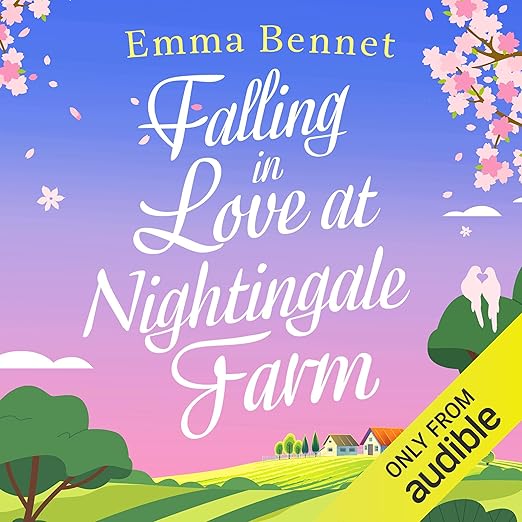
I finished this one on a rainy Wednesday afternoon, the kind of day when you want something that asks very little of you and delivers warmth in return. I had been cycling through heavier fiction for weeks and needed the equivalent of a palate cleanser, which is almost exactly how one reviewer described it. That word kept surfacing in my notes too: cleanser. There is something deliberately uncomplicated about Falling in Love at Nightingale Farm, and I mean that as a description rather than a criticism.
Emma Bennet’s novel drops Polly Pressman, a London businesswoman in sky-high stilettos, into a struggling family farm belonging to an old friend of her mother. The setup is familiar: urban outsider, suspicious rural community, gruff but handsome local. Bennet knows exactly what genre she is working in and makes no apologies for delivering on every expected beat. The petting zoo, the coffee shop, the strawberry picking, the cider-fueled revelation by the fire, all of it arrives on schedule. What keeps the novel from feeling stale is how genuinely Bennet seems to like her characters. Polly is not a fish out of water played for laughs. She is competent, earnest, and actually useful to the farm. The business revival subplot has enough texture to feel grounded rather than decorative, and that competence earns her a more interesting dynamic with Mark than the usual helpless-city-girl version of this story would allow.
What Stephanie Racine Does with Polly
Narrator Stephanie Racine is a smart casting choice here. Her voice has the kind of crisp, London-inflected warmth that suits a character who is trying very hard not to show how much she is falling in love with a life she did not expect. Racine differentiates well between Polly’s internal vulnerability and her outward competence, and she handles the supporting cast with easy clarity. Mark, the grumpy son, could easily become a cartoon in lesser hands, but Racine finds the moments where his defenses slip and lets those land without underlining them. At five hours and thirty-nine minutes, the pacing feels right for the content. Nothing overstays its welcome, and nothing is rushed through before it has earned its effect. The farm itself is rendered with real audio texture, not through sound design but through Racine’s unhurried attention to Bennet’s descriptive passages.
The Grump-Sunshine Mechanic, Used Honestly
Reviewers consistently flag this as a grump-sunshine romance, and that framing is accurate, but Bennet does something slightly more interesting than the trope usually allows. Mark’s resistance to Polly is not just protectiveness or wounded pride. It is tied to a specific anxiety about the farm’s survival and what outside help might mean for his father’s legacy. That motivation gives the romantic friction a little more weight than a standard cold-shoulder dynamic. When Mark finally softens, the shift feels earned rather than simply timed. Bennet is also honest about Polly’s hidden conflict, the secret hinted at in the synopsis, which provides a second emotional register beyond the romance. It is not a twist that will floor anyone, but it gives Polly something private to carry that grounds her beyond her role as the love interest’s foil. That distinction between a character who has interiority and one who merely reacts matters more in audio form than in print, because the narrator has to sustain you through long passages of quiet feeling.
The Hallmark Question and What It Reveals
Several reviewers invoke Hallmark, and that comparison is worth sitting with rather than deflecting. The novel has Hallmark’s genuine strengths: clean emotional stakes, likable protagonists, a community that feels warmly rendered, and a resolution that satisfies without ambiguity. It also has some of Hallmark’s limitations: secondary characters exist primarily to reflect the protagonist’s growth back at her, and the London life Polly is supposedly leaving behind never quite materializes as a real counterweight. The choice she faces at the novel’s end, city career versus country life, needs a more vivid version of the first option to feel like a genuine dilemma rather than an obvious answer. This is not a fatal flaw, but it is the place where the novel’s commitment to lightness costs it a small amount of emotional stakes. Readers who come to this expecting that kind of trade-off built into the genre contract will not find it a problem. Readers who come to it expecting any darker register will leave slightly surprised by how little tension the story is willing to sustain. Both responses are completely reasonable given what Bennet has written, which is a book that knows its purpose and executes it faithfully.
Who Should Listen and Who Should Skip
This audiobook is well suited to listeners who enjoy low-stakes contemporary romance, the cottage-and-countryside subgenre in particular, and who want a story with a competent, warm-hearted protagonist. It works beautifully during commutes, domestic tasks, or any listening session where you want easy company. Readers looking for heat, moral complexity, or an emotionally demanding narrative will find it too gentle. The free audiobook is a fine introduction to Bennet’s work, and series readers should note it is part of her Cozy Romances line with more to follow in the same register. If this one lands well, the promise of more is a genuine pleasure rather than a commercial obligation.
Frequently Asked Questions
Is there any romantic heat in Falling in Love at Nightingale Farm, or is it entirely clean?
It is solidly on the sweet end of the spectrum. The physical relationship between Polly and Mark is strongly implied rather than depicted, and the novel’s one pivotal romantic moment involves homemade cider and an evening alone rather than anything explicit. One reviewer described it as cute romance, no spice, which is accurate.
Does the farm business subplot feel realistic, or is it window dressing for the romance?
It is more grounded than most. Polly’s efforts to bring in revenue through the petting zoo, coffee shop, and pick-your-own fruit have enough practical detail to feel plausible. The business arc does not dominate, but it gives Polly purpose and competence that the romance alone could not establish.
Can this be listened to as a standalone or does it require reading the series in order?
Fully standalone. It is listed as part of Bennet’s Cozy Romances series but each book features a different couple and a complete story arc. No prior reading is required to follow or enjoy Polly and Mark’s story.
How does Stephanie Racine handle the British setting and the rural supporting characters?
Cleanly and without affectation. Racine’s London-adjacent warmth suits Polly, and she handles the rural characters with enough regional color to distinguish them without slipping into caricature. The overall effect is relaxed and easy to spend several hours with.