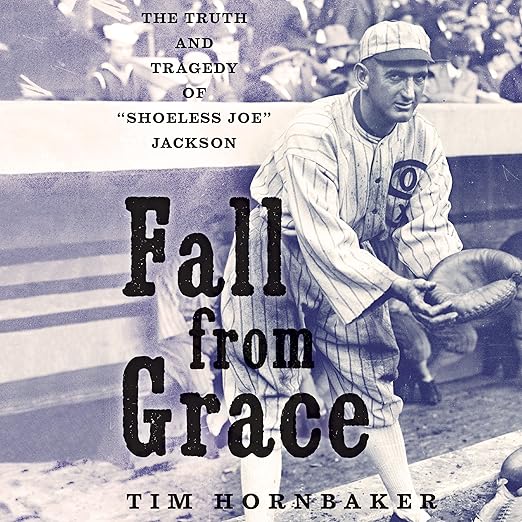
Quick Take
- Narration: Malcolm Hillgartner delivers the biography with appropriate gravity and good pacing, he suits the measured, research-driven tone of Tim Hornbaker’s approach.
- Themes: Baseball’s Deadball Era, the Black Sox scandal and its ambiguities, the gap between reputation and evidence
- Mood: Methodical and absorbing, with the texture of rigorous sports history rather than sensationalism
- Verdict: The most thorough account of Shoeless Joe Jackson’s life available in audio, essential for baseball history readers, and genuinely engaging for anyone drawn to stories where the truth remains permanently contested.
I finished Fall from Grace on a gray October afternoon, appropriately enough, there is something about the story of Shoeless Joe Jackson that belongs to autumn, to the specific melancholy of the season when baseball ends and the question of what might have been starts to feel particularly heavy. I came to this book already knowing the broad outlines: the 1919 World Series, the fix, the ban, the perpetual Hall of Fame debate. What Tim Hornbaker gave me over ten hours was the specificity that transforms a legend into a person.
Hornbaker is a sports historian who has written major biographies of Charles Comiskey and Ty Cobb, and Jackson is his third major figure from the same era. He brings the same research discipline to this book as to those, extensive archival work, contemporary press accounts, legal documents, and a willingness to sit with ambiguity rather than manufacture certainty. The result is the most complete account of Jackson’s life currently available in audio: from the South Carolina mill towns where he grew up, through his extraordinary rise to major league stardom, to the scandal that defined everything after.
Our Take on Fall from Grace
The book’s real subject is the gap between what we know and what we have decided to believe. Hornbaker does not exonerate Jackson, the evidence that he accepted money from the fixers is documented, but he also doesn’t reduce him to a simple villain. Jackson’s situation was shaped by his limited education, his complicated relationship with the men who organized the fix, and his own ever-shifting public statements that made coherent defense impossible over the decades. One reviewer noted that Hornbaker gives you information but not definitive conclusions, and this is accurate. It’s also the intellectually honest choice for a historical question that has no clean answer.
The Deadball Era context is where the book earns its historical weight. Hornbaker places Jackson’s career within the specific economic and social conditions of early professional baseball, a world where players had minimal power, owners were openly venal, and the relationship between the sport and gambling was substantially more complicated than the sanitized version taught in Hall of Fame narratives. Understanding that context doesn’t excuse what happened in 1919, but it makes it comprehensible in a way that myths of innocent corruption don’t.
Why Listen to This Rather Than Read It
Malcolm Hillgartner brings a quality that suits biographical history in audio: he reads with steady engagement rather than performative excitement. The book is dense with names, dates, statistics, and evidentiary argument, the kind of material that can become numbing when pushed too hard. Hillgartner paces it well, giving the evidentiary sections room to breathe and the narrative sections genuine momentum. The ten hours feel appropriately substantial without becoming exhausting.
The audio format is particularly good for the sections tracing Jackson’s post-ban years. His life after baseball, running a dry-cleaning business, playing semi-pro ball under assumed names, dealing with the endless reinvestigation of his case, unfolds with something close to the texture of lived experience when Hillgartner is reading it aloud, which print sometimes flattens into mere chronology.
What to Watch For in Fall from Grace
One reviewer noted the risk of getting bogged down in detail, and it’s a fair observation. Hornbaker is a researcher first, and there are passages, particularly in the sections covering the legal proceedings and their various appeals, where the evidentiary density can slow momentum. Listeners who want the story of Shoeless Joe without the full institutional context will occasionally find the book testing their patience.
The Hall of Fame question, whether Jackson deserves posthumous induction given his lifetime ban, is addressed but not resolved, because the answer genuinely depends on how you weigh the available evidence. Hornbaker is not an advocate; he is a historian presenting a case. If you’re listening hoping to have your position confirmed, you’ll find the book refuses that comfort.
Who Should Listen to Fall from Grace
Baseball history readers who want the most documented, least mythologized account of Jackson’s life will find this is the book they’ve been waiting for. Listeners interested in the broader history of the Deadball Era, in Charles Comiskey, in the dynamics of early professional baseball, in the specific criminal ecology that made the 1919 fix possible, will find rich material here, particularly if they’ve read Hornbaker’s other work.
Casual baseball fans looking for a narrative that reads like a thriller, or for a definitive verdict on Jackson’s guilt or innocence, will find the book’s measured approach less satisfying. It is sports history in the rigorous sense, thorough, documented, and honest about what it doesn’t know, rather than sports biography in the dramatic sense.
Frequently Asked Questions
Does Hornbaker conclude that Shoeless Joe Jackson was guilty or innocent of throwing the 1919 World Series?
He does not render a clear verdict, which is the intellectually honest position. The book documents that Jackson accepted money from the conspirators and that his public statements were contradictory across decades. What it declines to do is resolve the question of his intent or awareness definitively, because the evidence genuinely doesn’t support certainty in either direction.
Is this book accessible to listeners who don’t know much about baseball’s Deadball Era?
Yes, Hornbaker provides sufficient context about the period, the economic conditions of early professional baseball, and the specific dynamics of the White Sox organization that the story is comprehensible without specialized prior knowledge. Some familiarity with baseball’s basic history helps, but it isn’t required.
How does this compare to the film ‘Field of Dreams’ or other cultural treatments of Shoeless Joe?
Very differently. The romantic, mythologized version of Jackson in ‘Field of Dreams’ is a cultural artifact that Hornbaker essentially dismantles by providing the documented historical record. The real Jackson, complicated, limited by his education, caught between competing loyalties, is more interesting and less comfortable than the film’s idealized version.
Does Malcolm Hillgartner’s narration handle the statistical and evidentiary sections well?
Yes. Hillgartner paces the denser sections with enough care that the statistics and legal argument don’t become numbing. He reads as someone who finds the material genuinely interesting, which translates into audio that stays engaging even during the passages where the book is most deeply in research mode.