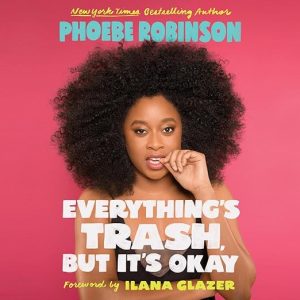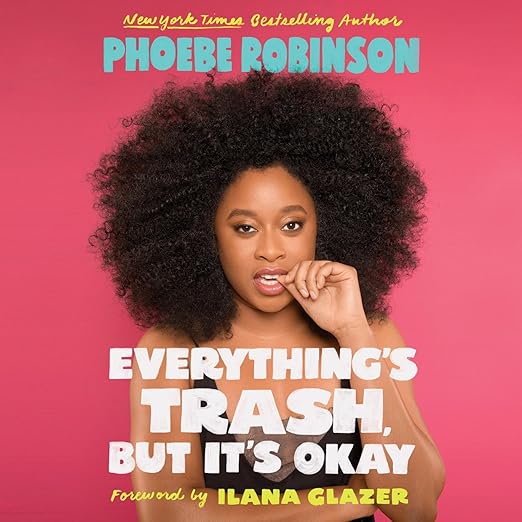
- Voice: Phoebe Robinson narrating her own essays is not a nice-to-have, it is the only version that makes sense. Her comedic timing, her tangents, the hashtag-laden rants all require the author's voice to land properly.
- Big ideas: Intersectional feminism, race and beauty standards in America, money anxiety and the labor of being a woman in public life
- Atmosphere: Loud, funny, and unexpectedly cutting, the laughter is load-bearing
- Worth it?: A sharp, self-aware essay collection that works best in audio, where Robinson's stand-up instincts can do what the page cannot fully contain.
I listened to Everything's Trash, But It's Okay on a cross-country flight, which turned out to be the ideal venue. At some point over the Midwest I laughed audibly, startled the person in the window seat, and then spent the rest of the flight with one earbud removed as a concession to airplane decorum. Phoebe Robinson is funny the way very few writers are funny, not the kind of funny that reads well on the page and falls flat spoken aloud, but the kind that requires a performer, timing, and the specific energy of someone who knows exactly what they are doing with their voice.
This is Robinson's second essay collection, following You Can't Touch My Hair, and it arrives from the perspective of someone who has by this point built a career out of being both entertaining and serious about things that matter. The New York Times bestselling author and 2 Dope Queens co-host has a platform, and she uses this book to talk about feminism, race, dating, money, beauty standards, work culture, and Bono, meeting him twice, without ranking these topics in an order of importance that separates the profound from the trivial. That refusal to hierarchize is itself the argument. The world is trash; you document all of it with equal attention.
What We Made of It
The essays move between confessional and political with an ease that is harder to pull off than it appears. When Robinson writes about the money problems she hid from her parents, she is making a point about financial vulnerability and class anxiety that lands because it is personal first and analytical second. When she gives feminism a "tough-love talk on intersectionality," as the synopsis describes it, she is doing it from inside the subject rather than above it. She is not explaining intersectionality to readers who have never heard of it; she is engaging with the ways feminism as a movement has failed to fully reckon with its own blind spots.
One reviewer noted that the book touches on many sensitive issues, feminism, BLM, without being depressing or preachy. That is the essential trick. Robinson is not trying to make you feel guilty or congratulate yourself. She is trying to make you laugh and think at the same time, and she mostly succeeds. The same reviewer mentioned that occasional tangents can dilute the point being made, and that is fair. Robinson's discursive style is part of her voice, but it does sometimes meander.
Why Everything's Trash, But It's Okay Works as an Audiobook
The audiobook is the definitive version of this collection. Robinson narrating her own work activates things that print cannot. The hashtags that appear throughout the essays, long, compound, increasingly absurd, are genuinely funny when she reads them aloud in a particular way and merely interesting on the page. Her timing on jokes is her own; no other narrator could reproduce it. She knows when to punch and when to let something land quietly, and she does it with the confidence of someone who has spent years performing live comedy.
Penguin Audio made the obvious call by recording the author performance, and the eight hours and fifty-five minutes go quickly. This is not a book that requires effort to listen to. It rewards active listening when Robinson is working through a complex political argument, but it also functions as engaged company during a commute or a household task in a way that more demanding books do not.
What Might Not Land
The essays are loosely organized by subject but do not build toward a unified argument in the way a standard nonfiction book does. This is a collection, and it reads like one, you can enter it at different points without losing thread, though Robinson's voice and sensibility create coherence that makes the whole feel greater than the sum of its parts. Listeners looking for a structured argument about feminism or race should look elsewhere; Robinson is not writing a manifesto but a series of dispatches from her own life and the culture around it.
The pop culture references are dense and occasionally dateable. The Bono anecdote will mean more to some listeners than others. Michael B. Jordan appears in the opening as shorthand for something aspirational and unattainable. These references are of the moment in the best way but also anchor the book to a specific cultural moment that has already shifted somewhat since 2018.
Who Should Listen to Everything's Trash, But It's Okay
This is for listeners who want their essay collections to be genuinely funny as well as substantive, and who are not bothered by a writer who moves between the personal and the political without always making that transition clean. It will particularly resonate with Black women and with anyone who has thought seriously about intersectionality and found most public discourse on the subject lacking. It will appeal to fans of Roxane Gay's Bad Feminist and Samantha Irby's essays, though Robinson's voice is more explicitly comedic than either. Listen to it in audio. There is no competing version.