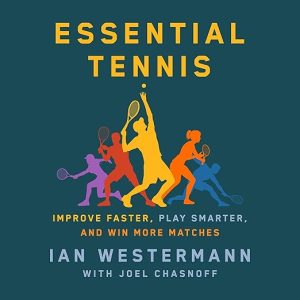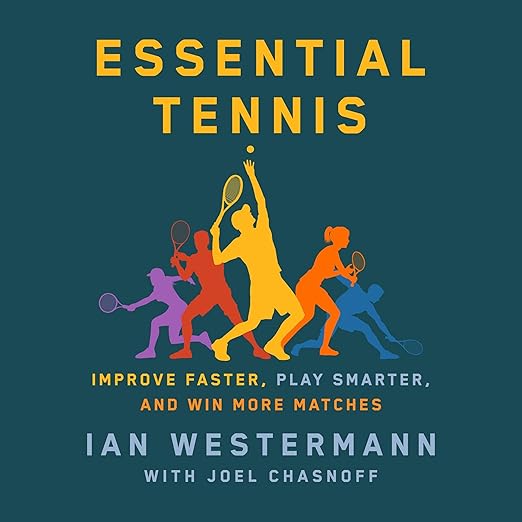
- Narration: Ian Westermann narrates his own book, and the result is an exceptionally natural listen, the voice of someone who has genuinely coached thousands of players rather than performed a manuscript.
- Themes: Process-over-outcome thinking, stroke mechanics and deliberate practice, sports psychology applied to club-level tennis
- Mood: Practical and encouraging, with the feel of a one-on-one coaching session
- Verdict: The most coherent distillation of Westermann's instructional philosophy in any format; serious recreational players who have plateaued will find specific, actionable frameworks here.
I was never a competitive tennis player, but I spent enough years on court as a recreational player to know the specific frustration of working hard at something and watching your game stagnate anyway. I picked up Essential Tennis partly out of curiosity about Ian Westermann, whose EssentialTennis.com has been a significant presence in online tennis instruction for well over a decade, and partly because the book's central premise caught my attention immediately. Westermann's claim is that the ball itself is the primary obstacle to improvement, not in any mystical sense, but in a precise psychological one: the desire to hit a good shot prevents you from striking the ball the way you should. That inversion took me a few minutes of walking to fully process, and once it landed it reframed a lot of my court experience in useful ways.
Six hours narrated by the author himself, published through Macmillan Audio in 2022. Westermann's voice is instantly recognizable to anyone who has spent time with his podcast or YouTube content, which makes this an unusually natural listen for existing fans and an equally accessible entry point for newcomers. He does not read the way a narrator performs a manuscript. He talks the way he coaches, and that tonal authenticity is audible from the first chapter.
The book's structural contribution is in reframing what improvement actually requires at the recreational level. Westermann is direct about this: most players focus on outcomes, on where the ball lands, how hard they hit it, whether they won the point, and that outcome focus actively interferes with the physical learning process that would make better shots possible. This is not a new insight in sports psychology broadly, but Westermann applies it with granular specificity to tennis mechanics in a way that feels fresh and practically useful.
His technique-based instruction covers groundstrokes, volleys, and serves in sequence, but the structure never becomes a dry mechanics manual. Each section is grounded in the why behind the technique, which is what makes the audio format work. You cannot see diagrams in an audiobook, but you can follow reasoning, and Westermann's reasoning is consistently clear. One reviewer, a former student of Westermann's other formats, described this as the best packaging of his message yet, noting that the book benefits from years of refinement across video, podcast, and live instruction. That accumulated clarity is audible throughout the six-hour listen.
What Stands Out
One reviewer put the book's practical orientation precisely: it is not a book simply about shot technique and form, which by themselves will not make you a winning player. The advice is practical, based on statistics and certain realities about how to improve efficiently and improve your odds of winning. That last phrase matters. Westermann is not writing for people who want to feel better about losing close matches. He is writing for people who want to win more of them, through deliberate practice of specific skills rather than through inspiration or willpower alone.
The progressions and drills described throughout the book are implementable without a coach present, which is a genuine design feature for the audience Westermann is addressing. Recreational players who take lessons occasionally but spend most of their time playing with peers will find material here that translates directly to self-directed practice. One reviewer specifically noted the QR codes linking to short video demonstrations, which give the audio listener a supplementary visual resource for the stroke descriptions. The audiobook is complete without them, but they add a useful layer for listeners who want to see a technique before attempting it on court.
What to Watch For in Essential Tennis
Westermann is explicit throughout the book that there is no magical shortcut, and that the changes players hope to make in their game require time, deliberate effort, and a willingness to prioritize process over immediate results during practice. That honesty is one of the book's real virtues. It does not promise what coaching cannot deliver. As one international reviewer noted, be ready to spend time and effort on the changes you are hoping to make, because there is no shortcut. That sentence functions as both a warning and an invitation: this is a book for players who are serious enough to accept that reality and curious enough to pursue improvement anyway.
Essential Tennis is built for adult recreational players who have some foundation and feel stuck. If that describes you, Westermann's six hours offer a clear, specific, and remarkably well-organized framework for understanding why your game has plateaued and what a path through that plateau actually looks like. The author narration makes it feel less like reading a manual and more like sitting down with someone who has coached thousands of players through the exact problem you are experiencing, and who genuinely knows the way forward.
Best Suited For
If you have been playing recreational tennis for several years and feel genuinely stuck, this is the book most likely to explain why in terms you can act on. Players who have never had a coach, or who have had coaches focused on technique rather than process, will find the framework particularly reorienting. Coaches looking for a coherent instructional philosophy that they can articulate clearly to students will find Westermann's approach well-organized enough to adapt. The 4.8 rating across 729 listeners reflects consistent satisfaction from a specific audience, and that audience is serious recreational players who came in willing to have their assumptions challenged. Westermann asks you to prioritize process over results during practice, which requires a kind of faith that not every player is willing to extend. For those who are, the six hours are genuinely well spent.
Questions Listeners Ask
Does the audiobook version of Essential Tennis work without the QR code videos mentioned in the text?
Yes. Westermann's instruction is clear enough to follow through audio alone. The QR codes link to short video demonstrations that supplement the descriptions, but they are bonuses rather than requirements. Listeners who want the visual component can access them while reading the physical or digital edition alongside the audio.
Is Essential Tennis aimed at beginners, intermediate players, or advanced competitors?
The primary audience is serious recreational and club-level players who have some foundation and want to improve their winning percentage. Westermann draws from twenty years coaching clients across all skill levels, so the material is accessible to players with a few years of experience while still offering genuinely useful frameworks to more advanced recreational players.
Does Ian Westermann's self-narration work for listeners who are not already familiar with his online content?
Very much so. His coaching cadence, natural pacing, and absence of performance affect make the audiobook feel like a direct conversation rather than a read text. Familiarity with his videos or podcast is not required to follow or benefit from the narration.