Before You Press Play
- Narration: Claire Bocking brings authentic warmth to the New Zealand setting and handles the cultural specificity of Maori characters and Kiwi idiom with genuine care.
- Themes: Independence and trust, multicultural romance, place as emotional grounding
- Mood: Sunny, warm, and substantial, like a holiday that also changes something in you
- Verdict: An unusually rich romance boxed set where the setting functions as a genuine third character, and all three books maintain the quality the first promises.
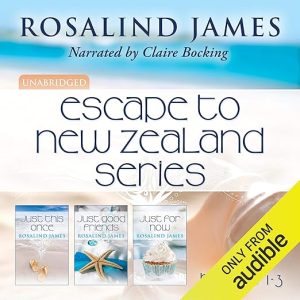
I first heard about Rosalind James's New Zealand series through a colleague at a publishing house I consulted for briefly, who described it as the romance series that ruined her for other romance series. That is a specific kind of recommendation, the kind that means something has recalibrated a reader's expectations rather than simply satisfied them. I filed it away and finally found my way to this three-book boxed set on a long weekend when I had nowhere to be. By Sunday evening I had listened to all twenty-seven hours. The colleague was right, and I resent her slightly for it, because these books have made several subsequent romances feel thin in ways they probably are not.
What Rosalind James does differently is use New Zealand not as an exotic backdrop but as a cultural and social reality with specific texture. The rugby world these characters inhabit has its own hierarchy, its own pressures, its own vocabulary. The Maori cultural presence in the second book is handled with a specificity that feels researched rather than decorative. One reviewer noted they felt they could almost hear the accents, that the dialogue felt genuine, that New Zealand itself is a person in these books. That observation points to something real about James's approach. She is writing about a place she knows well, not a place she has imagined as convenient backdrop for romantic storylines.
Is Escape to New Zealand Boxed Set, Books 1-3 Worth Your Time?
The structural decision to give each book a different emotional core rather than simply a different couple is what keeps this boxed set from feeling repetitive across twenty-seven hours. Just This Once is about a woman who has organized her life around not needing rescue learning to let someone in. Just Good Friends gives us a woman fleeing genuine danger who is trying to hide inside a bet about friendship with a man who is far too charming for anyone's good. Just for Now is the most emotionally complex of the three, featuring a woman rebuilding after betrayal who is simultaneously building something new that she refuses to trust. Each problem is distinct, each resolution earns its arrival through different emotional logic. The Audie nomination for Just This Once in Romance is earned, but in my view Just Good Friends is the most satisfying of the three, with Koti James being the most fully realized male lead in the set. The political intrigue of Kate's stalker situation, layered over the romance, gives the second book an urgency the others deliberately do not need.
The Best Parts of Escape to New Zealand Boxed Set, Books 1-3
Claire Bocking's narration is doing significant work here that is easy to take for granted. New Zealand English has specific rhythms and an inflection pattern distinct from Australian English in ways that non-New Zealanders often miss. Bocking does not miss them. The result is an audiobook that sounds like it is set where it claims to be set, rather than in a generic English-speaking everyland. The Maori pronunciation and vocabulary in the second book is handled with evident care. At twenty-seven hours, this is a substantial listening commitment, and Bocking's ability to maintain vocal clarity and emotional differentiation across the full runtime is a real technical achievement. Reviewers describe revisiting these books repeatedly, and the narration is a large part of why that repeat listening holds up. A lesser narrator would have made the familiar plot beats feel formulaic by hour twenty. Bocking keeps the warmth authentic throughout.
Before You Commit to Escape to New Zealand Boxed Set, Books 1-3
Professional rugby players as romantic leads are a genre convention that can easily tip into wish-fulfillment cliche. James is aware of this risk and makes specific choices to counter it. The male leads in all three books are physically formidable and professionally successful, but each has a clearly defined emotional vulnerability that is not simply a wound to be healed by the right woman. Dre in the first book carries quiet loneliness behind his public ease. Koti in the second has built an entire playboy persona to avoid being taken seriously. Finn in the third is a man actively trying to be a good father in circumstances that do not make that easy. One reviewer observed that although all the men were strong successful alphas, each had a very caring sensitive side. That framing is accurate, but James goes further than warmth. She gives each man a specific interior life rather than a type with softened edges, and that distinction is what makes the emotional payoffs feel earned rather than inevitable from chapter one.
Should You Listen to Escape to New Zealand Boxed Set, Books 1-3?
This boxed set is worth the commitment for anyone who enjoys contemporary romance with genuine cultural specificity and female protagonists who function as full persons. The heat level is sweet to moderately steamy, consistent across all three books. The length rewards sustained engagement rather than casual dipping in. Readers looking for faster-paced or high-angst romance may find the steady, assured pacing less satisfying, but this free audiobook set is exceptional value for the genre.
Good to Know
Is the New Zealand cultural detail accurate enough for someone who has lived there?
Multiple reviewers with New Zealand familiarity praise the accuracy of dialogue, idiom, and social texture. The Maori cultural elements in Just Good Friends are particularly noted for feeling genuine rather than superficial. James appears to have spent significant time in New Zealand and writes the setting from knowledge rather than research alone.
Does the rugby world need to be familiar territory to enjoy the books?
No prior rugby knowledge required. James provides enough context that the sport functions as setting and social structure without requiring the listener to understand game mechanics. The professional athlete world matters more as a social milieu than as a sport.
How does the narration handle Maori language and pronunciation in Just Good Friends?
Claire Bocking handles Maori vocabulary and pronunciation with evident care, and reviewers with New Zealand familiarity note the authenticity of the cultural sound. This is one of the narration's genuine strengths across the full boxed set and a key reason repeat listeners return to these audiobooks.