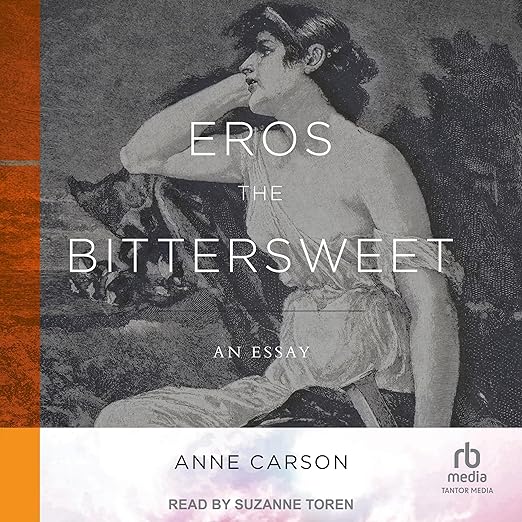
Quick Take
- Narration: Suzanne Toren brings a measured, scholarly warmth to Carson’s lyrical prose, never letting the density tip into dryness, never softening the precision into mere prettiness.
- Themes: desire as lack, the paradox of longing, eros in Greek philosophy and poetry
- Mood: Dense and hypnotic, the kind of listening that asks you to slow down and stay there
- Verdict: One of the most intellectually beautiful audiobooks currently available, essential for readers of classical literature, lyric essays, or anyone willing to be changed by close attention to language.
I first read Anne Carson in fragments, a poem here, a translated chorus there, the way you often encounter the most demanding writers before you commit to them fully. I came to Eros the Bittersweet in print years ago and returned to it in audio on a slow Sunday morning with coffee, intending to listen to maybe an hour. I listened to all of it. Suzanne Toren’s voice is exactly right for this material: precise without being cold, musical without being performative, and intelligent in the way that you can hear intelligence in a voice when it genuinely understands what it is reading.
Carson’s first book began as her doctoral dissertation at the University of Toronto and was first published in 1986. That origin is visible, the book has the architecture of scholarly argument, moving through readings of Sappho, Plato, Anacreon, and Alcman with methodical care. But it is also a lyric essay in the fullest sense, which means the argument is inseparable from its language, and the language is inseparable from Carson’s own particular way of thinking, which is like no one else’s.
Our Take on Eros the Bittersweet
The central question is Sappho’s word glukupikron, bittersweet, which Carson argues is Sappho’s own invention, a compound that captures the paradox of eros as something both pleasurable and painful, both present and fundamentally characterized by absence. From that starting point, Carson builds an argument about desire as constitutively a form of lack: we want what we do not have, and the moment of attainment is also the moment of desire’s disappearance. This is not a new idea in philosophy, but Carson arrives at it through readings of ancient Greek texts with a freshness that makes it feel newly discovered.
What separates this from academic writing is that Carson is always present in her own text. The analysis is personal in the way that the best lyric essays are personal, not confessional, but shaped by a sensibility that you come to know through the book’s accumulation of choices. One reviewer describes it as a revelation of eros that does the phenomenon justice. That is accurate. Carson does not reduce her subject to an argument; she enacts it.
Why Listen to Eros the Bittersweet
The audio format is surprisingly well-suited to this text. Carson’s sentences have a distinctive rhythm, long, associative, with sudden precision, that a skilled narrator can foreground in ways that silent reading might not. Toren’s pacing gives the subordinate clauses their full weight and arrives at the main verb without hurrying, which is exactly what this prose asks for.
At just over six hours, Eros the Bittersweet is also short enough to listen to in dedicated sessions rather than fragmentary commuting snatches, which I would strongly recommend. This is a book that rewards continuous attention. The argument builds; the texture accumulates; the references resonate differently once you have been in the book for a while.
What to Watch For in Eros the Bittersweet
This is not an accessible book in the way that term usually gets applied to audiobooks. Carson assumes some familiarity with the Greek texts she is reading, not fluency in the language, but comfort with names like Sappho, Plato’s Symposium, and Anacreon. Listeners who have no background in classical literature will find the book rewarding but may occasionally feel unmoored. That is not a reason to avoid it, but it is worth knowing in advance.
The book is also not a straightforward narrative. It moves associatively, circling its central ideas rather than marching through them linearly. Some listeners accustomed to argument-driven nonfiction may find the structure frustrating. Those who read lyric essays, poetry criticism, or philosophical writing will recognize the mode immediately.
Who Should Listen to Eros the Bittersweet
Essential for readers of Carson’s later work, Autobiography of Red, Nox, Decreation, who want to understand where her particular approach to desire and loss began. Also for classicists, students of ancient Greek literature, and anyone who reads lyric essays as a genre. More broadly, for anyone willing to spend six hours in the company of a genuinely original mind working at full intensity on a subject that has never stopped being urgent. Listeners looking for a light or narrative listen should go elsewhere; those looking for something that changes how they think about longing have found it.
Frequently Asked Questions
Do I need to read Greek or know the source texts to follow this book?
You do not need to read Greek, Carson provides her own translations and enough context for each passage. Some prior familiarity with Sappho, Plato’s Symposium, and the general landscape of archaic Greek poetry helps, but determined readers without that background have found the book navigable and rewarding.
How does Suzanne Toren’s narration handle Carson’s distinctive prose style?
Very well. Carson’s sentences are long, associative, and build toward precision in ways that require careful pacing. Toren gives the subordinate clauses full weight and resists the temptation to rush toward main verbs, which is exactly what the prose asks. The result honors the rhythm that makes Carson’s writing distinct.
Is this a good entry point for Anne Carson’s work, or should I read something else first?
It is a legitimate entry point for readers interested in Carson’s scholarly and essayistic work. If you are more drawn to her poetry, Autobiography of Red is often recommended first. But Eros the Bittersweet is where her central preoccupations, desire, absence, ancient Greek texts, appear in their most developed argumentative form.
How long has this book been in print, and why is it still being discovered?
First published in 1986 as a revision of Carson’s doctoral dissertation, it has been continuously in print and has found new audiences in each generation. Its combination of classical scholarship and lyric essay form is unusual enough that it does not date the way purely topical academic books do, and the subject, the paradox of romantic desire, has an obvious permanence.