Quick Take
- Narration: Chris Andrew Ciulla gives a confident, well-paced performance that handles the long timeline and large cast of drivers, engineers, and rivals with clarity.
- Themes: Obsession as a creative force, the ethics of racing culture, the man behind an icon
- Mood: Sweeping and occasionally scandalous, with the energy of a biography that does not flinch from its subject’s contradictions
- Verdict: Whether or not you watched Michael Mann’s film, this biography earns its near-19-hour runtime by taking Enzo Ferrari seriously on his own complicated terms.
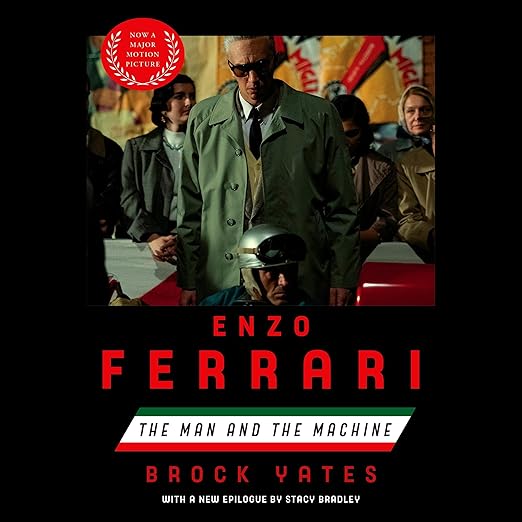
I came to this audiobook through the back door. A friend had seen the Michael Mann film, found it unsatisfying, and sent me a message that simply said: read the book instead. So on a rainy Saturday with no particular plans, I started Enzo Ferrari by Brock Yates. By Sunday evening I had listened to roughly twelve hours of it and rearranged my Monday to finish the rest. Yates had access that most biographers do not, having penetrated Ferrari’s notoriously private inner circle, and the result is a portrait dense with the kind of specific detail that takes a photograph rather than paints one.
Enzo Ferrari is not a sympathetic subject in any conventional sense. Yates does not ask us to like him. What he asks instead is that we understand how this particular combination of qualities, absolute determination, supreme manipulative intelligence, and a near-pathological relationship to loss and grief, produced something as culturally significant as the Ferrari brand. The biography earns its title by treating its subject as a force of nature that the book has a responsibility to document rather than judge.
Our Take on Enzo Ferrari
Yates structures the biography chronologically but with thematic detours that work well in audio. The early chapters on Ferrari’s youth in Modena, his first encounters with racing culture in the years before and after World War One, and his long apprenticeship at Alfa Romeo before striking out independently, are not the obligatory throat-clearing of lesser biographies. They establish the psychological architecture that the rest of the book builds on. Ferrari was shaped by losses that accumulated from early life onward, the death of his older brother, his father’s death shortly after, the loss of drivers he both employed and felt responsible for. Yates argues, persuasively, that this relationship to loss is the key to understanding Ferrari’s notorious emotional armor and his simultaneous, apparently genuine grief whenever a driver died on his cars.
The relationship with his illegitimate son Piero, who Ferrari could not publicly acknowledge while his wife Laure was alive, is handled with the particularity it deserves. It is not sensationalized. Yates presents it as one of the defining contradictions of a man full of contradictions, someone who cared fiercely for the people in his orbit and simultaneously used them without apparent compunction when the situation required it.
Why Listen to Enzo Ferrari
Chris Andrew Ciulla handles a biography of this scope with impressive consistency. At nearly 19 hours, a narrator who loses energy or becomes monotonous over long stretches will sink the experience. Ciulla does not. He manages the transitions between the high-speed drama of race scenes, the quieter passages of business maneuvering, and the more intimate sections involving Ferrari’s personal life, without a significant change in engagement level. His pacing suits Yates’s prose, which is that of a skilled magazine journalist: clean, energetic, and direct without sacrificing depth.
One reviewer who had followed Yates since reading his Pontiac versus Ferrari comparison test in Car and Driver in 1964, noted the depth of Yates’s motorsport knowledge and how it enriched the racing chapters specifically. That background is visible throughout. Yates understands what it means technically and politically for a team to have a faster chassis in 1952 or a better tire contract in 1958, and he explains those advantages in terms that communicate why they mattered without requiring the listener to already know the history of Formula One.
What to Watch For in Enzo Ferrari
The book is primarily a motorsport biography, and listeners whose interest in Ferrari is limited to the brand as a cultural artifact or to the Mann film may find certain chapters, the detailed accounts of specific race seasons, the technical debates between competing engineering philosophies, slower going. Yates knows his audience is interested in racing, and he writes accordingly. The personal and political chapters provide relief and context, but they are not the majority of the book’s weight.
The movie tie-in edition includes a new foreword and epilogue specifically addressing the Mann film, which some reviewers found a useful addition and others considered peripheral to the biography itself. The core text, Yates’s original reporting, is the reason to listen, and it stands fully on its own.
Who Should Listen to Enzo Ferrari
Motorsport enthusiasts, particularly those with interest in the pre-1970 European racing scene, will find this essential. Readers drawn to biographies of difficult, driven, morally complex figures, the kind of subject that produces great art and genuine suffering in roughly equal measure, will also find much here. Skip it if your interest in Ferrari extends only to the cars as objects or to the brand as aesthetics; this book is about the man and the sport that produced him, and both require sustained attention to appreciate. Those who were disappointed by the Mann film, as more than one reviewer mentioned, will find the book delivers what the film could not fit into two hours.
Frequently Asked Questions
Do you need to know anything about Formula One or motorsport history before listening to Enzo Ferrari?
Some background knowledge enriches the experience, but Yates explains the relevant competitive and technical context as he goes. Complete novices to motorsport may find certain chapters more absorbing than others, but the biographical and personal narrative works for any listener interested in the subject.
How does Enzo Ferrari compare to Michael Mann’s 2023 film as an account of the man?
Multiple reviewers who saw the film before or after reading found the book significantly more satisfying, noting that Yates’s depth of access and decades of motorsport knowledge produce a portrait the film’s two-hour runtime cannot match. The movie tie-in edition adds a foreword and epilogue addressing the film, but the core biography stands independently.
Is the relationship between Enzo Ferrari and his illegitimate son Piero covered in detail?
Yes. Yates covers the relationship with Piero and the situation with Ferrari’s wife Laure throughout the biography. He treats it as one of the defining personal contradictions of Ferrari’s life rather than sensationalizing it, integrating it into the broader portrait of a man whose private and public selves were in constant tension.
At nearly 19 hours, does Chris Andrew Ciulla’s narration maintain its quality throughout?
Yes. Ciulla is a consistent narrator who handles the range of material, from race sequences to political maneuvering to personal grief, without significant variation in energy or engagement. For a long-form biography of this type, that consistency is essential and he delivers it.