Quick Take
- Narration: William Martin handles the dual-perspective sci-fi romance with vocal authority, differentiating Thrace’s guarded intensity from Trin’s cultural rigidity in ways that keep the power dynamic legible.
- Themes: Power inversion and consent, cultural collision and the negotiation of intimacy, identity reshaped by unexpected connection
- Mood: Steamy and emotionally earnest, with genuine tension beneath the fantasy premise
- Verdict: Book 14 in the Brides of the Kindred series deepens a well-developed world while delivering the emotional payoff its established readership expects.
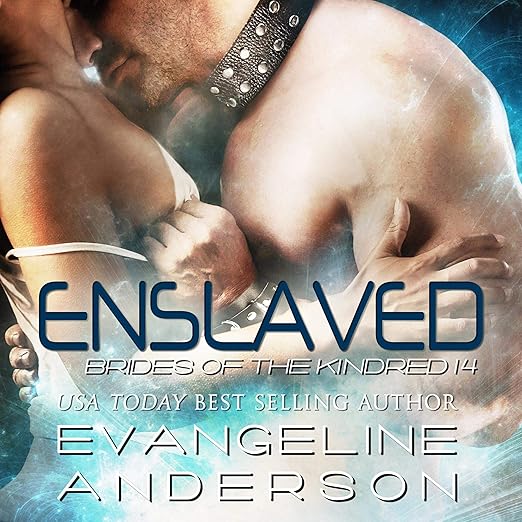
I want to be honest about my relationship with long-running sci-fi romance series before I say anything else about Enslaved: I do not typically start at Book 14. But Evangeline Anderson’s Brides of the Kindred series has a substantial readership that has been with these books across a decade and fourteen volumes, and understanding what this entry does for those readers requires taking that commitment seriously rather than evaluating it as if it were a standalone debut from a new author.
Enslaved focuses on Thrace S’ver, a Havoc, which Anderson has positioned as a cousin-species to the Kindred warriors who have anchored the series. The distinction matters narratively: Havoc do not bond with females the way Kindred do, which sets up a tension specific to this book and this pairing. The romantic premise involves Lonnara Trin, captain of a merchant vessel from the all-female planet of Zetta Prime, where any sexual or romantic relationship with a male is considered culturally unnatural and wrong. She purchases Thrace as a working slave without intending anything beyond that transaction. The escalation from that starting point is the book’s engine, and Anderson gives it enough space to build properly.
What Makes Thrace Different from the Series’ Prior Heroes
Anderson’s series has built its following partly through variety: each book introduces a new couple with dynamics specific to that pairing, and the world-building accommodates an enormous range of alien cultures and physiological difference. Thrace’s Havoc nature means he approaches captivity and bonding differently than the Kindred heroes who populate earlier volumes. His refusal to bond, his history of trauma on the auction block before this particular purchase, and his genuine intention to kill whoever buys him all establish a protagonist who arrives with more damage and more resistance than many of his predecessors. That combination of danger and damage is part of what makes this entry stand out for established series readers.
One reviewer described a complicated relationship with Trin as a heroine, noting she started strong and fierce before becoming more fraught in her guilt and emotional uncertainty. This is a fair reading of the character, though it is also an accurate representation of what happens to many people when intimacy and vulnerability arrive in a context they were not expecting. Anderson’s heroines are not uniformly easy to like, and the Kindred world is large enough to accommodate different reader responses to different pairings without any single entry defining the series.
William Martin’s Navigation of an Unusual Dynamic
The power dynamic in this book is inverted from most romance conventions: the male protagonist begins as the legally purchased property of the female lead, and the story is partly about how both characters negotiate their way to something that neither of them intended. Martin handles this with a vocal restraint that keeps Thrace’s compliance believable without flattening his agency. The scenes where Thrace is choosing to comply rather than being forced to do so have a different emotional texture from the scenes where he has no choice, and Martin sustains that distinction consistently throughout the twenty-hour runtime.
At twenty hours, this is a substantial listen even by the series’ own standards. The runtime accommodates the depth of world-building Anderson has constructed over fourteen books, and this volume assumes comfortable familiarity with the Kindred universe. New listeners who jump in here will encounter references to prior events, established characters in supporting roles, and terminology that is glossed but not explained at length. This is definitively not the place to enter the series.
The Emotional Core Under the Fantasy Architecture
The Brides of the Kindred series has maintained its readership across fourteen books because Anderson takes the emotional mechanics of her romances seriously even when the science fiction scaffolding is elaborate and the worldbuilding grows increasingly complex. In Enslaved, the central question is not really about a slave and his mistress. It is about two people who have both been shaped by worlds that taught them to distrust intimacy, being forced into proximity until proximity becomes something else entirely. The fantasy elements create permission structures that the romance genre has always used, and Anderson deploys them with enough internal consistency that the emotional logic holds across the full runtime.
Multiple reviewers described this as a favorite entry in the series, with one calling it possibly their favorite of the entire run. One reader, who described themselves as someone who normally reads crime thrillers, credited the first Kindred book with hooking them completely despite initial skepticism. For established fans, the Havoc dynamic appears to have landed as something genuinely fresh within a large world that could easily have grown repetitive at this late stage.
Something worth addressing directly for listeners new to the Kindred world: the alien biology and bonding mechanics that the series is built around are well established by Book 14, which means Enslaved can deploy them quickly without extensive explanation. This is efficient for the devoted readership, but it means new listeners will encounter references to prior worldbuilding without context. Anderson’s prose is fluent enough that the general shape of things becomes clear even without the full backstory, but the emotional weight of the bonding arc lands most fully for readers who have watched the series develop these ideas across multiple prior volumes. The series rewards sequential listening in ways that genre romance often does not bother to build.
Who Should Listen, Who Should Skip
Enslaved is written for readers who have followed the Brides of the Kindred series. Starting here without prior context is possible but not recommended, as much of the emotional weight depends on familiarity with the world Anderson has spent thirteen prior books constructing. For the existing readership, this entry delivers on both the romantic and world-building fronts across twenty substantial hours. Listeners new to alien romance who want an entry point to the series should begin with Book 1, Claimed, which is the place where this world’s particular logic becomes legible and where the investment that pays off here gets properly started.
Frequently Asked Questions
Can Enslaved work as an entry point to the Brides of the Kindred series, or is prior knowledge essential?
Prior knowledge is strongly recommended. The book assumes familiarity with the Kindred universe, established characters, and world-building accumulated over thirteen previous volumes. Book 1, Claimed, is the recommended starting point.
How does the power dynamic between Thrace and Trin affect the romantic elements? Is consent addressed?
The book engages directly with the power imbalance inherent in its premise. The progression toward the romantic relationship involves both characters moving through and beyond the transactional context in which they meet.
How does Thrace differ from other Kindred heroes in the series, and why does that matter to longtime readers?
As a Havoc rather than a Kindred warrior, Thrace does not have the biological bonding drive that characterizes the series’ standard heroes. This creates different emotional and narrative stakes that many readers find among the most distinctive pairings in the series.
Is William Martin consistent across the full twenty-hour runtime?
Martin is an experienced narrator in this genre and maintains vocal consistency across the runtime. His differentiation between the two central perspectives is clear enough to keep the dual-POV structure legible throughout.