Quick Take
- Narration: Will Patton brings his characteristic gravel and warmth to Bill Hodges one final time, and the performance feels like a proper send-off.
- Themes: revenge and obsession, the nature of evil, the strange resilience of survivors
- Mood: Unsettling and elegiac, with King’s trademark blend of dread and dark humor
- Verdict: A strong, satisfying close to the Bill Hodges trilogy that takes an unexpected supernatural turn and still earns it, especially rewarding for listeners who have followed Hodges, Holly, and Jerome from the start.
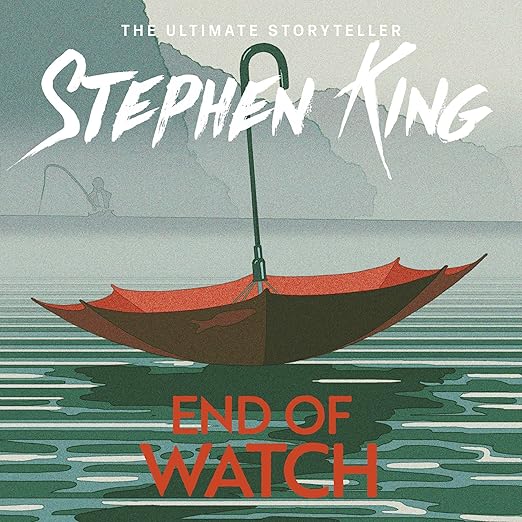
I finished End of Watch on a night when the apartment was too quiet, which turned out to be exactly the wrong conditions. Stephen King’s third Hodges novel has a particular kind of chill to it: not the loud, violent horror of his earlier work, but something quieter and more insidious. Brady Hartsfield is confined to a hospital brain-injury unit, apparently unresponsive. Apparently.
That word, apparently, is doing most of the heavy lifting in this book’s premise, and King knows it. The setup is elegantly simple and deeply unsettling: what if the most dangerous thing about a technological genius was not his hands but his mind? What if confinement was not a limitation at all?
Our Take on End of Watch
The Bill Hodges trilogy began with Mr. Mercedes as a fairly conventional detective novel, the kind of book that surprised readers who expected King to stay in his horror lane. Finders Keepers deepened the character work while Hodges himself sat slightly to the side. End of Watch brings him back to the center and, in doing so, pulls the series in a direction that will either excite or frustrate you depending on how much you wanted King to stay naturalistic.
Brady’s method of influencing the outside world from his hospital bed is unmistakably supernatural. He has developed the ability to infiltrate and control the minds of the people around him, and the mechanism is a hypnotic video game that compels users to commit suicide. It is dark, genuinely dark, and King does not soften the implications. The victims are not abstractions. They are people we have seen in prior chapters, and their fates carry weight.
One reviewer called this the best of the three books, and I understand why. The threat Brady poses in End of Watch is more diffuse and harder to neutralize than a man with a car and a grudge. Hodges cannot simply outrun this danger, and the late sections of the book put him, Holly, and Jerome in positions of genuine vulnerability rather than procedural problem-solving. The series has been building Holly in particular since the first book, and End of Watch gives her a sustained moment of centrality that one reviewer astutely identified as the launch point for her subsequent solo career in King’s fiction.
Why Listen to End of Watch
Will Patton has been with this trilogy from the start, and that continuity matters. His voice for Hodges has a lived-in quality by this point, the specific weariness of a retired detective who cannot stop being a detective, and the affection he brings to Jerome and Holly feels earned rather than performed. The performance does not grandstand; it trusts the material. At just under thirteen hours, the audiobook is a manageable sit that rewards attentive listening, particularly in the hospital scenes where what Brady is doing, and what he is becoming, unfolds gradually.
King’s prose in this trilogy has a directness that suits audio well. He is not burying his readers in subordinate clauses; he is moving them through scenes at pace, and Patton honors that rhythm without rushing.
What to Watch For in End of Watch
The supernatural pivot will land differently depending on your investment in the series. If you came to Mr. Mercedes specifically because it felt like a departure from King’s horror catalog, the direction End of Watch takes may feel like a bait-and-switch. King earns the turn through careful preparation over the prior books, but the tonal shift is real. Listeners who roll with it will find the final act genuinely suspenseful; those who resist it may feel the climax is too far from the detective-novel grounding that made Hodges appealing in the first place.
The book also does not work nearly as well without Mr. Mercedes and Finders Keepers behind it. Brady’s menace in this installment depends entirely on what you know about what he did before. Hodges’ urgency depends on what you understand about his relationship with that case. End of Watch is a culmination, not an introduction.
Who Should Listen to End of Watch
Series readers who have already spent time with Hodges, Holly, and Jerome will get the most from this. It is a satisfying conclusion to a trilogy that King wrote with evident affection for these characters. Readers who bounce off supernatural elements in their thrillers should be aware the book crosses that line clearly. For listeners new to King, this is not the place to start; begin with Mr. Mercedes and let the relationships build. And if you have been on the fence about whether the Bill Hodges series is worth the full commitment, the answer is yes, primarily because End of Watch earns the journey backward.
Frequently Asked Questions
Does End of Watch work as a standalone, or do I need to have read Mr. Mercedes and Finders Keepers first?
It does not work as a standalone. Brady Hartsfield’s menace in this book depends entirely on what he did in Mr. Mercedes, and the emotional stakes for Hodges, Holly, and Jerome are built across all three books. Start at the beginning of the trilogy for the full impact.
The trilogy is marketed as crime fiction but this book reportedly has supernatural elements, how significant are they?
They are central, not peripheral. Brady’s ability to control minds from his hospital bed is the primary threat mechanism of the plot. King prepares the ground carefully, but listeners who want a purely naturalistic thriller should know the book crosses into supernatural territory explicitly and without apology.
How does Will Patton’s narration compare to the earlier books in the trilogy?
Consistent with the earlier volumes, which is a significant strength. By book three, Patton’s voice for each character feels settled and genuinely inhabited. The performance is one of the most dependable in King’s audiobook catalog, and he handles the darker tonal shifts in this installment without losing the warmth he brings to the ensemble.
Is Holly Gibney’s role in End of Watch large enough to matter for readers who want to follow her into her subsequent solo novels?
Yes, meaningfully so. End of Watch gives Holly a sustained arc that establishes her capability and courage in ways the earlier books only gestured at. One reviewer specifically identified this book as the launch point for her solo series, and that reading holds up. She is a co-protagonist here, not a supporting player.