The Short Version
- Performance: Andrew Tell handles the split-perspective structure effectively, his voice differentiates between the characters without losing the cohesion of the ensemble.
- What it covers: Family separation and reunion, survival ethics, the fragility of social order
- Feel: Propulsive and emotionally invested, post-apocalyptic fiction that keeps its human stakes in view
- Our call: A well-constructed survival series boxset that distinguishes itself through character investment and a split-perspective structure that genuinely pays off.
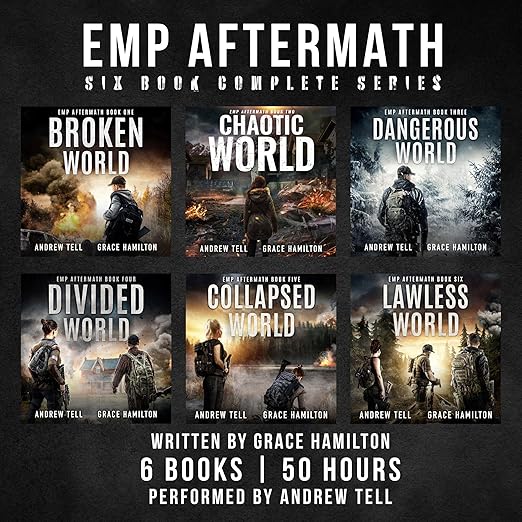
I put EMP Aftermath on during what I thought would be a short drive and ended up sitting in the parking lot for twenty more minutes because I did not want to stop. That is the most honest thing I can say about Grace Hamilton's series: it earns the kind of listening that post-apocalyptic fiction promises and rarely delivers. The scenario is familiar, an electromagnetic pulse takes down the power grid, society unravels, but Hamilton's execution separates itself from the genre's considerable pile of indistinguishable survival procedurals by keeping the family at the center and the action in service of them rather than the other way around.
The three-strand structure is the book's riskiest and most rewarding choice. Laurel, an ER doctor who refuses to abandon her patients when the hospital evacuates, is handling a crisis that is immediately intimate, she is also caring for her sick mother. Her husband Bear is hundreds of miles away in a remote mountain cabin in Minnesota, beginning a grueling overland journey back toward his family with only his dog Jessamine and an orphaned boy named Trent for company. And their daughter Mae has made choices that place her inside a violent militia with access to surviving weapons of war. Three storylines, three registers, three different kinds of pressure, and Hamilton keeps all three airborne for nearly fifty hours.
Bear Is No Rambo, and That's the Point
The reviews confirm what the structure promises. One listener described crying when one of the characters died, which is the highest possible evidence of character investment. Another, a proofreader by profession, specifically noted the relative absence of errors and the well-developed characters, a pointed observation in a genre where loose quality control is common. The concern about pacing that post-apocalyptic fiction often generates, too drawn out, too much description, is addressed by multiple reviewers who note that the story moved at an appropriate pace. That is not a neutral observation. Pacing EMP fiction requires restraint against the genre's natural tendency toward either action glut or survival tedium.
Bear as a protagonist is a studied subversion of the EMP thriller hero type. One reviewer made the specific point that he was not your typical Rambo, not a superhuman fighting machine able to leap tall buildings. That choice matters enormously for whether a book about a man crossing post-collapse Minnesota with a dog and a boy feels heroic or merely mechanical. Hamilton makes him capable without making him invulnerable, which keeps the journey tense rather than foregone.
Tell Differentiates Three Voices Without Caricature
Andrew Tell's performance across fifty hours is a genuine commitment, and he honors it. The challenge of three distinct protagonist perspectives, a female ER physician, a male outdoorsman, and a teenage girl embedded in a militia, requires vocal differentiation without caricature, and Tell navigates that requirement consistently. Listeners who found themselves frustrated by the homogeneity of narration in other boxset releases will notice the investment Tell brings to differentiating these characters.
At just under fifty hours, this is a significant listening commitment, and that fact should inform the decision to purchase. But the runtime reflects genuine narrative scope, not padding. The multiple reviewers who described bingeing the series, and one who noted that the books made her cry and laugh and that she loved the good guys and hated the bad, are describing the experience of sustained immersion rather than extended reading by obligation.
Mae's Divided Loyalties Ground an Over-the-Top Militia
The militia subplot involving Mae is the most conventionally thriller-adjacent element, and a few reviewers found the antagonists somewhat over-the-top. There is an inherent challenge in writing organized post-collapse villainy, it requires a degree of implausible coordination that can strain credulity. Hamilton keeps the threat grounded through Mae's divided loyalties, which gives the reader a human inside perspective on an organization that might otherwise feel cartoonishly evil.
The medical authenticity in Laurel's sections is notable. Hamilton's portrayal of an ER physician making triage decisions without power, supplies, or backup reflects genuine research into emergency medicine, and those sections have a procedural specificity that listeners with medical backgrounds will find credible rather than irritating.
Fifty Hours That Make You Earn Survival
Post-apocalyptic fiction readers who have grown impatient with the genre's tendency toward cardboard survival machines rather than actual people will find this series genuinely refreshing. The fifty-hour commitment filters casual listeners naturally, but those who sign on should expect to be held for the duration. Not recommended for listeners who want their disaster fiction without emotional cost, Hamilton makes you care about these people, and then makes you earn their survival alongside them.
Good to Know
Is EMP Aftermath a complete story or does it end on a cliffhanger requiring additional purchases?
The boxset collects multiple books in the series and provides a substantial narrative arc. Whether the full series resolves all threads depends on how many installments this edition contains, verify the included volumes before purchasing if complete resolution is a priority.
How graphic is the violence in EMP Aftermath?
There is violence, including character deaths, militia conflict, and survival-scenario confrontations. It is more emotionally intense than graphically detailed. One reviewer described crying at a character death, which suggests the impact comes from investment rather than shock imagery.
Does Andrew Tell's narration work for the female protagonists, particularly Laurel?
Tell handles both Laurel's medical-setting chapters and Mae's militia storyline with appropriate differentiation. He does not attempt to perform femininity through affectation but finds the distinct emotional register of each character, which serves the material better than vocal gimmickry would.
How does EMP Aftermath handle the science of the EMP itself?
The EMP is a premise rather than a technical document, Hamilton uses it to establish the collapse scenario without dwelling on the physics. Listeners with engineering backgrounds may find the cause-and-effect of what survives and what fails loosely specified, but the book is character-driven survival fiction rather than hard science speculation.