Quick Take
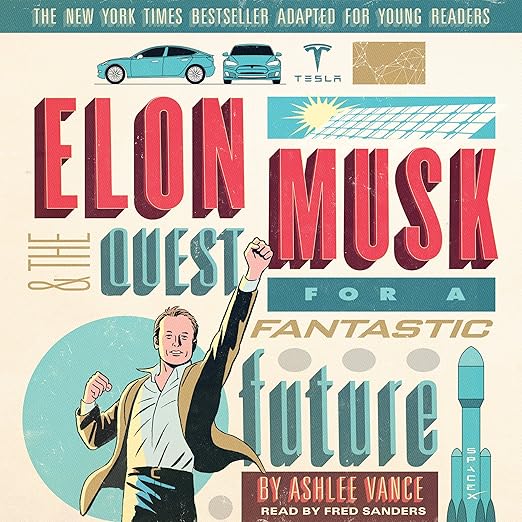
- Narration: Fred Sanders reads the young readers’ adaptation with enthusiasm calibrated to its STEM-curious audience, keeping the longer biographical stretches from losing younger listeners.
- Themes: Obsessive ambition and its costs, technology as civilization-scale problem-solving, the relationship between childhood difficulty and adult drive
- Mood: Propulsive and wide-eyed, occasionally hagiographic but grounded in reported specifics
- Verdict: An effective introduction to Musk’s story for ambitious young readers, though the adaptation captures a version of Musk the world has continued to complicate since its publication.
I want to be careful here, because writing about Elon Musk in 2026 is a different exercise than it was when Ashlee Vance published the original biography in 2015. The young readers’ edition was adapted from that text, and it carries the particular conviction of someone writing about a visionary before the full costs of that vision became part of the public record. That does not make the book dishonest. It makes it a document of a specific moment’s understanding of a specific person, which is what most biographies are.
Fred Sanders narrates the six-and-a-half hour adaptation with real energy, and the target audience, which School Library Journal pegs at high school and ambitious middle school, is well served by his pacing. Vance had exclusive access to Musk, his family, and his friends when writing the original, and that access produced a genuinely reported account rather than a hagiography. Even in the young readers’ version, the portrait is specific enough to feel like a real person rather than a motivational poster.
From South Africa to the Edge of Everything
Vance traces Musk’s childhood in Pretoria with the same detail he brings to the company histories, which is where the adaptation earns its distinction from generic entrepreneur biography. The picture of young Musk reading for hours, being bullied badly enough that it resulted in hospitalization, finding his way to Canada and then the US, and launching his first company in a rented office where he and his brother slept on the floor, is not sanitized in this version. One reviewer, buying the book for a nine-year-old with a high school reading level, notes the great lessons about perseverance alongside biographical information presented in an engaging way. That balance between lesson and detail is where Vance is strongest.
The Three Industries Argument
The synopsis frames Musk as simultaneously transforming space, automotive, and energy industries, and the young readers’ edition organizes itself around that argument with discipline. SpaceX, Tesla, and SolarCity each get their own sections, explained at a level that makes the engineering ambition legible without requiring the reader to understand rocket propulsion or battery chemistry. What Vance makes clear, and Fred Sanders delivers effectively, is that Musk approached each of these industries as a first-principles problem: not how can we improve what exists, but what would we build if we started from scratch knowing only physics. For STEM-curious young people, that framing is genuinely exciting.
What the Adaptation Cannot Quite Contain
The book was adapted from a 2015 biography of a figure whose public profile has changed substantially since then. The young readers’ edition cannot account for the years since publication, which means it presents a Musk who was controversial primarily for his ambitions rather than for his public conduct. That is not Vance’s fault, but families and teachers using this as a discussion text should be aware that the portrait is incomplete by chronology alone. One reviewer writes both about her admiration for what Musk creates and her reservations about other aspects of his choices. That tension is real, and a classroom conversation about it would be more valuable than pretending it does not exist.
Who Should Listen, Who Should Skip
Ambitious middle schoolers and high schoolers with an interest in technology, entrepreneurship, or STEM who want a detailed but fast-paced look at how large companies get built will find this well-calibrated to their needs. The Junior Library Guild selection status and School Library Journal endorsement are accurate signals of the book’s educational value. Parents who want to use the biography as a launching point for more complex conversations about ambition, accountability, and what we owe the world when we have the resources to change it will find the material supports that. Adults who have already read the original Vance biography will find little new here.
Frequently Asked Questions
Does this young readers’ edition include the same level of detail as Ashlee Vance’s adult biography?
It is an adaptation, not a condensation of the full text. The essential arc and reported details are preserved, but the length, complexity, and some of the more adult-oriented analysis from the original has been adjusted for a younger audience.
How does Fred Sanders’ narration handle the more technical sections about SpaceX and Tesla?
Sanders reads the engineering and business content with clear enthusiasm, and Vance’s explanations are accessible enough that the technical passages do not require any prior knowledge of rockets or electric vehicles.
Given how much has happened with Musk since 2015, is this biography still relevant?
The book covers his story through roughly 2015, which means it is a documented account of how SpaceX, Tesla, and SolarCity were built. It does not address subsequent years, which makes it a historical document of a specific period rather than a current portrait.
What is the recommended age range for this audiobook?
School Library Journal recommends it for high school and ambitious middle school readers. Parents of strong readers aged ten or eleven have found it accessible. It is not really suited for younger elementary children due to the business and biographical complexity.