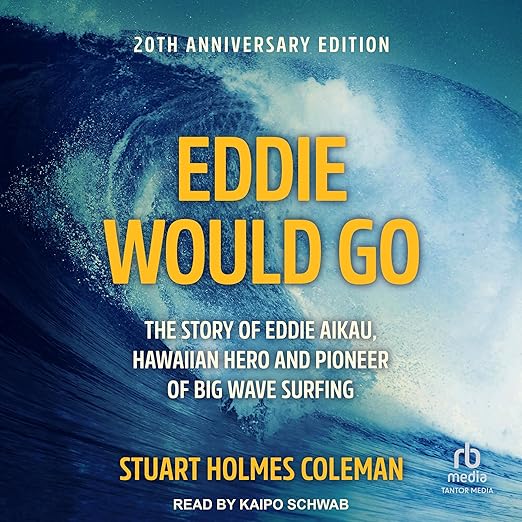
The phrase that gave this audiobook its title began appearing on bumper stickers and T-shirts across the Hawaiian islands in the 1980s. It was not a marketing slogan. It was a statement about what kind of person Eddie Aikau was: someone who paddled out when others held back, who made decisions based on what needed to be done rather than what was safe. Eddie Would Go, Stuart Holmes Coleman's biography of the legendary Hawaiian surfer and lifeguard, unpacks the life behind that phrase across nearly twelve hours of audiobook. And what it reveals is that the phrase described far more than a decision to ride a dangerous wave.
Coleman, himself a surfer and writer with deep ties to Hawaii, spent years researching Aikau's life, and the audiobook carries that research without feeling weighted down by it. The biography moves through Aikau's childhood on Maui, his emergence as a surfer willing to take on the waves at Waimea Bay that other professionals refused, his appointment as the North Shore's first and most famous lifeguard, and finally the voyage of the Hokule'a, the traditional Hawaiian voyaging canoe, and the decision Aikau made on the water that ended his life and secured his legend. At each stage, Coleman is interested not just in what happened but in what it meant, and that interpretive ambition is what separates the book from a straightforward sports chronicle.
A Closer Look at Eddie Would Go
What separates this biography from a conventional sports narrative is Coleman's consistent attention to the cultural context surrounding Aikau's life. The Hawaiian Renaissance of the 1970s, the revival of traditional navigation, language, and sovereignty movements that reshaped Hawaiian identity during that decade, is not background material in this audiobook. It is the larger story within which Aikau's individual choices make full sense. He was not just an exceptional athlete; he was a proud Hawaiian at a particular historical moment when pride in Hawaiian identity was both newly urgent and deeply contested. The Hokule'a voyage was not a sporting expedition. It was a declaration of cultural continuity, and Aikau's role in it carried everything he believed about what it meant to be Hawaiian.
Kaipo Schwab's narration serves the material exceptionally well. Several reviewers noting that the book succeeds as both Hawaiian history and surfing narrative points to the challenge Schwab is managing: holding both registers without losing either. The sequences on the water, where Coleman describes the scale and unpredictability of the waves Aikau rode, move with the propulsive energy that makes audio particularly effective for action-driven biography. The quieter passages, where the Aikau family's bonds and losses are rendered with care, receive a different kind of attention from Schwab: slower, more present, allowing the emotional weight to accumulate.
One reviewer described the book as delivering "the pure Hawaiian Aloha spirit," which is accurate but understates how much historical and cultural weight Coleman packs into that spirit. Another called it "a real page turner" for anyone who loves Hawaiian history, surfing, sailing, the sea, or "just a good story about heroism." The range of that recommendation is telling: this book works for readers who know nothing about surfing and for those who have followed big-wave competitions for decades. The narrative is organized around a life rather than around a sport, which means the waves are the arena but the person is always the subject, and that framing makes the audiobook accessible across a much wider audience than surf biography normally reaches.
The audio format specifically enhances the sequences aboard the Hokule'a and Aikau's final moments, which Coleman reconstructs with careful restraint. Hearing those passages read aloud, rather than encountering them on the page, slows the pacing in a way that gives the emotional material room to register properly. At eleven hours and forty-six minutes, the audiobook does not feel long; it feels proportionate to a life that contained enough for several books, and Schwab's narration keeps the emotional temperature calibrated across the full arc.
Things to Know Before Starting Eddie Would Go
Coleman's biography was originally published in 2001, and the audiobook reflects that era's approach: thorough, contextually generous, more interested in the full arc of a life than in delivering moments of peak intensity in rapid succession. Listeners accustomed to faster-paced narrative nonfiction may find the opening section, which covers Aikau's family background and early years on Maui at some length, slower going than they expect. The patience is rewarded, because the weight of the Hokule'a passages depends on the listener knowing exactly who Aikau was and what he valued. But the investment is real.
Listeners looking for technical instruction in big-wave surfing will not find it here; Coleman writes about surfing as a cultural and personal practice rather than as a discipline with a pedagogy. The 4.7 rating from 396 reviewers reflects a consistent and enthusiastic readership: this is a book that satisfies the specific audience it is designed for, and reviewer Scotty Mon's description of giving the book to surfing friends as birthday presents suggests it travels well beyond its immediate subject.
Who Stuart Holmes Coleman Is Writing For
This audiobook rewards listeners drawn to biography that takes its subject's cultural world seriously, to Hawaiian history and the indigenous cultural revival of the 1970s, and to stories of physical courage that are inseparable from personal conviction and community identity. Listeners who want a quick, high-intensity sports narrative may find it too expansive in its historical ambitions. For everyone else, particularly those who have encountered the phrase "Eddie would go" without knowing the full story behind it, this audiobook provides one of the most satisfying answers available and one of the most memorable biographies in the sports genre.
Common Questions
Do I need to know anything about surfing to appreciate this audiobook?
No. Coleman writes about surfing as a cultural and personal practice, and the waves serve as context for character rather than as technical subject matter. Reviewers with no background in surfing consistently describe it as compelling on the strength of the biography and the Hawaiian history alone.
How does this audiobook handle the Hawaiian cultural context alongside the surfing biography?
Coleman integrates the Hawaiian Renaissance of the 1970s, including the revival of traditional navigation, language, and sovereignty movements, throughout the narrative. The cultural history is not supplementary; it is essential to understanding who Eddie Aikau was and why his decisions carried the weight they did.
Is Kaipo Schwab's narration well suited to this particular audiobook?
Yes. Schwab handles both the exhilaration of the water sequences and the gravity of the cultural and historical material with equal care. The performance is especially effective in the final Hokule'a passages, where pacing and tone matter most to the emotional impact.