At a Glance
- Performance: Virginia Wolf brings warmth and clarity to the historical material, handling both the personal portraits and the game-day sequences with consistent energy.
- What it covers: Women's athletics and institutional resistance, Depression-era resilience, the politics of hope
- Feel: Inspiring and sometimes indignant, like finding a footnote that should have been a chapter
- Our call: A story of genuine historical significance about a team that should be far better known, told with evident personal investment from an author who has skin in the game.
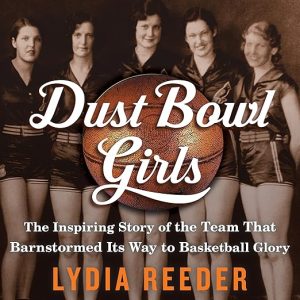
I came across Dust Bowl Girls while working through a reading list on women in American sports history, a subject where the gaps are as interesting as the texts. I was halfway through my morning walk when Virginia Wolf's narration settled into the story of Sam Babb recruiting basketball players from Oklahoma farms during the Great Depression, and I stopped moving entirely. I just stood there on the sidewalk listening. That doesn't happen to me often.
Lydia Reeder's book has an unusual origin. Her grandmother handed her a worn folder of newspaper clippings, letters, and photographs of Coach Sam Babb and the Cardinals, the women's basketball team he built at tiny Oklahoma Presbyterian College, and told her to tell their story someday. Reeder does, with the kind of thorough archival research and access to surviving team members that gives the book its texture. This is not hagiography. It is history, and it reads like it.
What Reeder captures better than most sports historians is the literal stakes of athletic performance for these particular women. Babb was recruiting from farms devastated by drought and economic collapse. The offer he made, a college education in exchange for playing basketball, was not a sports opportunity in any abstract sense. It was a lifeline. When these young women boarded his car and left their families, they were betting that this charismatic coach and his improbable dream could actually deliver what he promised.
The backdrop of the Dust Bowl and the Depression is not local color here. It is the structural condition that makes every game meaningful beyond the final score. When the Cardinals won, they won for families who needed proof that something could still go right. Understanding that transforms the basketball itself from a sport narrative into something closer to social history. One reviewer described reading it and feeling like they were traveling with the girls through every game. That proximity is earned by Reeder's research and by the surviving Cardinals' memories, which she gathered before they were lost entirely.
Why It Works in Audio
One of the sections of this audiobook that I found most illuminating was Reeder's account of how mainstream institutions, including the First Lady of the United States, actively opposed women's competitive athletics on the grounds that it was too physically and emotionally demanding for female bodies. This was not fringe opinion. It was the dominant view, backed by medical authority and reinforced by school policies across the country. The fact that the Cardinals were competing at all, let alone winning at a national level, was an act of institutional defiance whether or not they framed it in those terms.
Reeder neither overplays this angle into modern polemicism nor underplays it to keep the tone upbeat. She presents it as historical fact and lets it land with the weight it deserves. Some of the most quietly powerful moments in the audiobook come from the contrast between what these women were told they couldn't do and what they proceeded to do anyway.
What to Watch For in Dust Bowl Girls
The personal dimension of this project, Reeder's great-uncle is Coach Babb, is both its greatest asset and its only genuine vulnerability. The intimacy of the research is unmistakable. But one critic noted, with some justification, that the writing could be uneven. There are passages where the prose is slightly over-written or where transitions feel rough. These are real editorial limitations that a more seasoned collaborator might have smoothed. They did not break my engagement with the book, but listeners who are sensitive to prose quality may notice them. Virginia Wolf's narration helps considerably here, maintaining a consistent pace that carries the listener through the rougher passages.
Who Will Get the Most From It
You do not need to be a basketball fan to find Dust Bowl Girls absorbing. This free audiobook works for anyone drawn to stories of institutional outsiders, Depression-era American history, or women's history that hasn't been cleaned up for general consumption. It is a book that should have a larger readership than it does. The Cardinals of Oklahoma Presbyterian College won a national championship during one of the worst periods in American history, and almost no one outside their immediate community knew about it for decades. Reeder's book changes that, imperfectly but genuinely, and that is worth something.
Common Questions
Is the narration by Virginia Wolf well-matched to the material?
Yes. Wolf's delivery is clear and engaged without being overly dramatic, which suits the historical documentary tone of the material. She handles both the personal portraits and the game sequences with consistent energy.
Is Dust Bowl Girls available as a free audiobook and is it part of a series?
Yes, this free audiobook stands alone and is not part of a series. It is a complete, single-volume work covering the Cardinals' championship run in the 1930s.