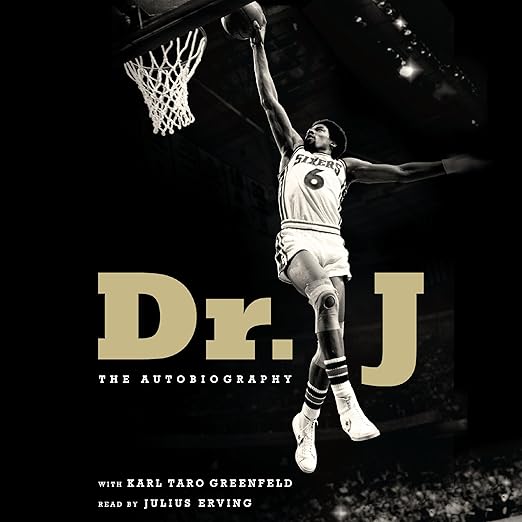
- Performance: Julius Erving reads his own memoir, and the effect is irreplaceable: the voice that describes soaring behind the backboard against the Lakers is the same one that tells you what he was carrying off the court.
- What it covers: Athletic innovation and the ABA era, the gap between public image and private struggle, grief and the limits of composure
- Feel: Candid and emotionally unguarded
- Our call: A self-narrated sports memoir that earns its candor, strongest when Erving stops being Dr. J and lets Julius speak.
Julius Erving reading his own memoir is one of those audiobook pairings where the format becomes part of the argument. Dr. J is a book about two men sharing one body: Julius, the thoughtful, privately uncertain son of a Long Island domestic worker, and The Doctor, the aerial showman who transformed what a basketball player could look like in motion. Having Erving speak those distinctions himself, in his own carefully measured voice, does something no professional narrator could replicate. The performance is not theatrical. It is something quieter and more interesting: a man in late middle age listening to himself across fifty years of accumulated decisions, proud of some of them, unflinching about others.
The audiobook covers Erving's entire arc, from his childhood in Hempstead, Long Island, through the ABA years in Virginia and New York, through the 76ers championship era, into retirement, personal crisis, and the slow reconstruction of a life after it. Sports Illustrated called this a terrific memoir by a man worthy of one, and that assessment holds. Erving has a long list of basketball achievements dense enough to fill an ordinary sports biography, but this book is not ordinary in that way. It earns the word memoir rather than autobiography because Erving is consistently more interested in examining his motivations than in recounting his statistics.
How Dr. J Holds Up
The ABA sections are historically irreplaceable. Erving is perhaps the most important figure in the history of that league, and the particular energy of those years, the barnstorming, the showmanship, the sense that basketball was being reinvented in real time by players who had no institutional reason to be conservative about it, comes through with a vividness that suggests Erving genuinely loved that period even amid its chaos. The 1976 dunk contest victory, the famous foul-line jam, is described with the precision of someone who has replayed it thousands of times, but Erving also conveys what the ABA meant as a context for experimentation: a league where players like himself could play freely in ways the more conservative NBA of that era had not yet made room for.
The account of Michael Jordan's debt to Erving is handled with characteristic understatement. Erving does not claim credit directly. He lets the historical record make the case while noting, with evident satisfaction, that what he was doing with improvised acrobatics in the early 1970s became the baseline for the next generation of players. That generosity of perspective is typical of the book's tone: Erving is not a man who needs external validation, but he is also honest about what he accomplished and why it mattered.
Why Dr. J Works as an Audiobook
Where the book becomes something more than a great sports memoir is in its unflinching account of Erving's private failures. The affair with sportswriter Samantha Stephenson, which produced his daughter Alexandra, a professional tennis player who would become publicly known in her own right, is described without the defensive hedging that characterizes most celebrity disclosures of infidelity. Erving was wrong. He knows he was wrong. He describes the consequences with the same directness he applies to describing a layup. That willingness to account for himself without the architecture of excuse-making is unusual in the genre.
The death of his son Cory in 2000 is the book's most emotionally difficult section, and Erving does not make it easy. The grief itself is described carefully, but what Erving is really examining is the different shapes grief takes and how incompatible those shapes can be within a marriage. His wife Turquoise's grief required Erving to be paralyzed by it alongside her. His own grief allowed him to function but not to match her emotional demand. The marriage could not contain both approaches. The scene he describes, emerging from the shower to find Turquoise holding a lamp and a vase, ready for physical confrontation, is told with a directness that makes you wish every celebrity memoir were this honest about the domestic dimensions of public lives.
Weak Spots in Dr. J
Erving is a thoughtful, even philosophical, narrator of his own life, and that quality is both a strength and an occasional mild limitation. Some listeners who reviewed the book noted that its thoughtfulness borders on the measured, that moments which might have produced more visceral emotional release in a different kind of memoir are treated with a certain interpretive distance. One reviewer described it as thoughtful and philosophical while also noting the sense that even more was possible. That reading is fair. Erving is not a confessional writer in the contemporary sense. He examines; he does not perform. Listeners who prefer rawer emotional texture may occasionally wish he would lean into the wound a bit harder.
The basketball content is exceptional throughout. Erving's account of the strategic and physical evolution of his game, the transition from ABA showman to more versatile NBA player, the physical management of a body subjected to the brutal demands of professional basketball across two decades, is detailed and illuminating. He writes about basketball as someone who genuinely loved the game as a craft, not just as a career vehicle, and that distinction matters when you are twelve hours into a memoir and still engaged.
The Right Listener for Dr. J
Basketball fans already familiar with Erving's career will find this audiobook essential: there is simply no better account of the ABA years, Erving's specific basketball philosophy, and the intersection of those athletic achievements with a more complicated private life than this one. Listeners who are primarily sports readers but drawn to memoir for its honesty about fallibility will find Erving's willingness to account for his own failures refreshing rather than sensational. The self-narrated format is a genuine asset; there are moments where the weight in Erving's voice while describing his son's death or the end of his marriage is something no hired reader could manufacture. Listeners with no basketball background who are drawn to sports memoir as a form of biography about extraordinary lives will also find substantial value here.
Common Questions
Does Julius Erving narrating his own memoir make a significant difference to how this audiobook lands?
Yes, substantially. Erving's own voice carries layers of meaning that a professional narrator cannot replicate, particularly in the memoir's more emotionally difficult sections around his son's death and his marriage's dissolution. Sports Illustrated called it a terrific memoir, and hearing Erving deliver it himself is part of what makes that assessment accurate.
How much of the Dr. J audiobook focuses on basketball versus personal and family life?
Both strands are woven throughout rather than separated into halves. The basketball content is detailed and historically significant, especially on the ABA years and the evolution of aerial play. But Erving consistently uses his athletic career as a frame for examining his private life, making the memoir feel genuinely integrated rather than divided between sports biography and personal disclosure.