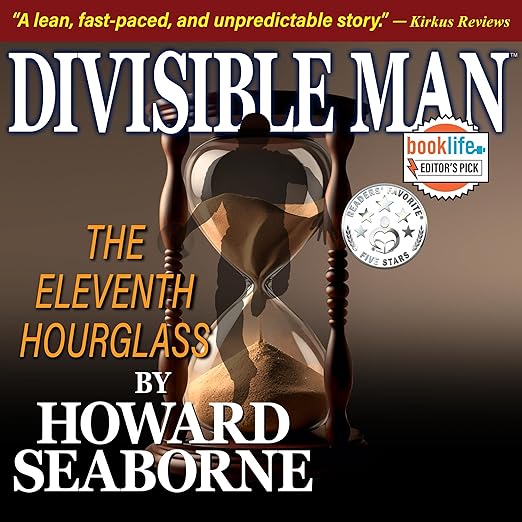
I will admit I came into this one without the ten preceding books under my belt, which put me at an immediate disadvantage and, paradoxically, told me something useful. Howard Seaborne's eleventh Divisible Man novel is written with enough series confidence that it does not stop to re-explain itself for newcomers, and that confidence is both its greatest strength and a genuine barrier for the uninitiated. Within the first fifteen minutes, I had a working sense of Will Stewart, of Pidge and Earl Jackson, and of the kind of moral stakes the series operates on. By the time the lodge setting locked into place, I was oriented enough to follow the plot, even if I was missing years of earned context.
That quality tells you something about Seaborne as a craftsman: the world is consistent and legible, and the characters carry their histories visibly. But it also confirms that The Eleventh Hourglass is not designed as a standalone.
The setup is both familiar in structure and genuinely tense in execution. Will Stewart joins Pidge and Earl Jackson on a rescue mission after learning that Earl's ex-wife Candice, who runs the remote Renell Lodge, has been threatened. What the team finds when they arrive is a scene of violence that the obvious explanation cannot account for. Seaborne builds the impossibility carefully, something has happened that should not be possible, and the way the body count climbs while that impossibility refuses to be explained gives the middle section a quality that reviewer Nicole Goodden compared to Hitchcock. That comparison is not excessive: there is real craft in the way Seaborne withholds resolution long enough for the situation to become genuinely unsettling.
Running parallel to the lodge crisis is Will's deepening entanglement with the billionaire Spiro Lewko, a recurring figure in the series whose wealth functions as both resource and trap. The synopsis notes that old secrets and criminal lies push Will toward something cold in his own heart, which is the kind of character pressure that sustains a long-running series. Seaborne is clearly building toward something larger even as this volume resolves its own crisis.
What Howard Seaborne Gets Right
The aviation detail is a consistent pleasure. Multiple reviewers single it out, one specifically asked for a character upgrade to a Cheyenne II, which is exactly the kind of engaged niche enthusiasm that indicates Seaborne's aviation sequences land with authenticity for people who know the subject. For listeners who do not, the technical material is woven in at a pace that informs without overwhelming. It gives the thriller elements a grounded texture that distinguishes Divisible Man from more generic action-adventure series.
Alex Knox's narration is steady work. He does not grandstand, but he handles the tonal shifts between quiet procedural detail and high-stakes action without the seams showing. For a ten-hour-plus listen, that consistency matters.
Where Howard Seaborne Loses Some Ground
The parallel structure, lodge horror on one track, Lewko entanglement on another, does not always feel balanced. The Lewko subplot is doing significant series-arc work, which means that for a reader coming in at book eleven, it carries weight that requires prior investment to fully feel. Without that investment, it reads as setup rather than payoff. Seaborne handles it with enough economy that it does not derail the book, but returning fans will get substantially more out of it than newcomers will.
The review count is low relative to the series' apparent following, which likely reflects the title's recent release date rather than a lack of audience. The ratings that exist are uniformly enthusiastic and specific, which suggests a loyal readership rather than casual passing traffic.
Who Should Pick Up Divisible Man - The Eleventh Hourglass
Best suited for established Divisible Man series readers who want Will's next chapter. Also works for thriller listeners who enjoy aviation detail and remote-setting tension in the Hitchcock mold. Not a sensible entry point for the uninitiated, the series architecture is too load-bearing to skip ten books. Come back after reading The Merchant of Death.
In Brief
- Narration: Alex Knox handles the series' mix of aviation procedural and supernatural tension competently, familiar enough for returning fans, accessible enough for curious newcomers.
- Themes: Hidden abilities, corporate menace, remote setting horror
- Mood: Taut and atmospheric, with a classic thriller undercurrent
- Verdict: Reliable genre entertainment for existing Divisible Man readers; entry point seekers should start at book one.