In Brief
- Voice: Alexa Borys holds the sole reading credit, which puts the whole job of separating several male leads on one voice
- Big ideas: fated mates and why-choose romance, divine politics, prophecy, coming into uncontrolled power
- Atmosphere: Fast, hot, escalating toward a third volume
- Worth it?: A competent middle book for committed why-choose readers, with prose that a recording exposes more than an ebook does.
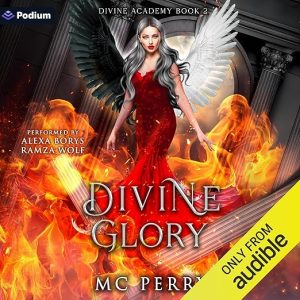
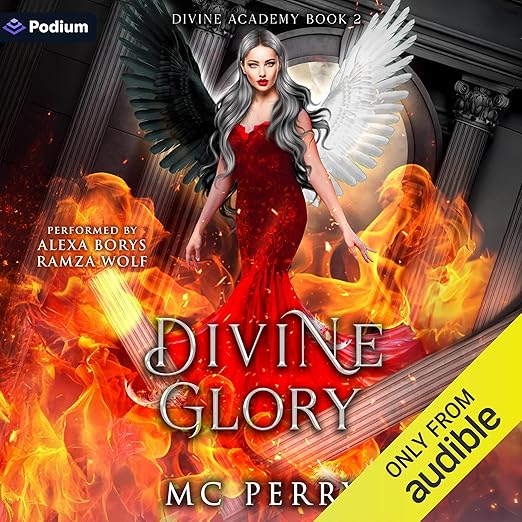
Book two of a why-choose fantasy trilogy arrives with the stakes already set, and this audiobook assumes you remember exactly where the first one left Katrina. Untapped magic runs in her, which makes her a prize the Bureau of Unaffiliated Angels wants for its collection and a problem the Council would rather remove entirely. Her fated mates come with her into the middle of that argument. Podium Audio put the recording out on February 3, 2026, and the publisher's own copy calls the book spicy, which is a useful piece of plain speaking to find on a product page.
What MC Perry Delivers
Middle books in a trilogy usually have a structural problem, and MC Perry mostly solves it by giving Katrina two enemies who want opposite things. One faction wants to own her power. The other wants it gone. That pull in two directions supplies motion even when the plot is really doing setup work for a third volume, and it keeps the prophecy material from sitting inert in the background the way prophecy material often does in academy fantasy.
Barbara Marie's January 24 entry, at five stars, describes the same escalation from the inside: intensity turned up from book one, gods watching, angels maneuvering, and the realization that Katrina is no longer simply a student at the academy but something closer to a contested asset. That account also flags trust as the central pressure, with Katrina forced to question everyone around her. On a second book that is exactly the right pressure to apply, because a reader already knows the cast well enough to feel it.
What the book does less well is give Katrina an interior life to match the size of the plot around her. She reacts, learns, and survives, and a great deal happens to her. Whether she wants anything for herself, apart from control of a power she never asked for, stays underexplored across a full volume. Listeners who came to this subgenre for a heroine with her own agenda rather than a fought-over one will notice the gap, and it widens as the political material takes over.
What MC Perry Gets Right
Alexa Borys carries the entire reading credit, and in a why-choose romance that is a specific technical demand rather than a general one. Several male leads have to remain distinguishable across a book whose emotional plot depends on knowing instantly which of them is in the room. The publisher lists no second reader and no duet format, so the whole job of separating the mates sits with one voice. Sample the recording with that in mind rather than for general warmth of tone.
Top marks in May 2025 came with the clearest picture of what this book delivers for its intended audience: a good plot, strong steam, and a heroine who may not understand much yet but is described as no pushover. That reader finished impatient for a third volume. As a summary of the appeal it is accurate, and it also tells you the balance the book strikes between world building and heat, which tilts firmly toward the second.
Just under eight hours is brisk for a fantasy romance carrying prophecy, politics, and a multi-partner relationship arc, and the brevity works in its favor. Nothing sprawls. The Council scheming and the Bureau's interest both get resolved enough to satisfy without closing the trilogy, and the pace suits listening across two or three sittings rather than being parceled out over weeks. Short books in this subgenre are rarer than they should be, and the discipline shows in how little of the runtime goes to recapping events from the first volume.
Where MC Perry Loses Some Ground
Check the dates before you trust the reception. Four of the five signed responses on this page were posted before February 3, 2026, the day the recording was released, so they were written about the ebook rather than about anything Borys read aloud. The single response written after the audio existed is the lone one-star verdict. Whatever the pool tells you, it is answering a question about a different edition, and the enthusiasm collected here predates the product on sale.
Jcat, three stars in January, supplies the sharpest criticism of the writing itself: dialogue described as rather juvenile, male leads too dominant in the explicit scenes for that reader's taste, and a heroine without much personality of her own. What makes the note credible is its ending, where the same reader admits to buying the next book anyway because something in the storyline seems promising. Ambivalence stated that plainly is worth more than either extreme on this page.
Two of the five responses arrive under the same default account name, one awarding five stars and the other a single one, so the listing cannot tell those two readers apart and neither can you. Anyone judging the book from the visible pool is working with a sample of five beneath an average built from 299 ratings, and that sample runs a good deal cooler than the headline figure does. Weigh the headline, not the handful of notes under it.
Who Should Pick Up Divine Glory
Committed why-choose readers are the audience, especially those who want the tropes delivered without irony: fated mates, an academy, a prophecy, gods with opinions, and a heroine coming into power she cannot yet steer. If the phrase spicy why-choose reads as a recommendation rather than a warning, the book does what the label promises and does it at a manageable length. Nobody here is trying to reinvent the subgenre, and that is largely the point. Familiarity is the product, and Perry delivers it without hedging or winking at the reader.
The March 2026 one-star is the shortest and bluntest thing on this page, judging the first book bad and this one worse, with an acceptable plot undone by the writing. That verdict deserves to sit beside the enthusiasm rather than under it. Prose is genuinely where the book is weakest, and a recording amplifies weak prose, because a listener cannot skim past a clumsy sentence the way an ebook reader does without noticing that they have.
Newcomers should start with book one, since nothing here pauses to catch anyone up on Katrina's parentage or how the mate bonds formed. Readers who want a slow burn, a single love interest, or explicit content kept off the page should choose something else entirely. For anyone already inside this subgenre, it is a competent second act at a sensible length, carried by a premise stronger than the sentences delivering it.
How explicit is the audiobook?
The publisher labels it a spicy why-choose romance, so multiple partners and on-page sex are the format rather than a surprise. Expect explicit scenes at regular intervals, with the group arrangement treated as settled rather than contested. How dominant the male leads read will decide most listeners' comfort with the whole thing.
Does the audiobook work if I have never read a why-choose romance before?
It can, though this is not the ideal entry point, since the mate bonds carry over from a previous volume. The conventions themselves are easy to pick up: several love interests, no elimination between them, and a plot that treats the group as a unit rather than a contest.
Why do the reviews look cooler than the overall rating?
The average draws on 299 ratings while only five written responses are visible, and those five happen to include the one-star. Small visible samples swing hard in both directions. The more useful detail is that most of them predate the recording, so they assess the text rather than the performance.