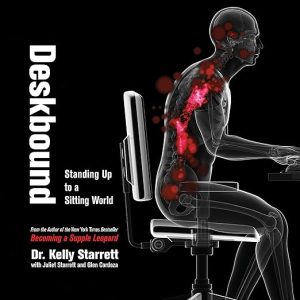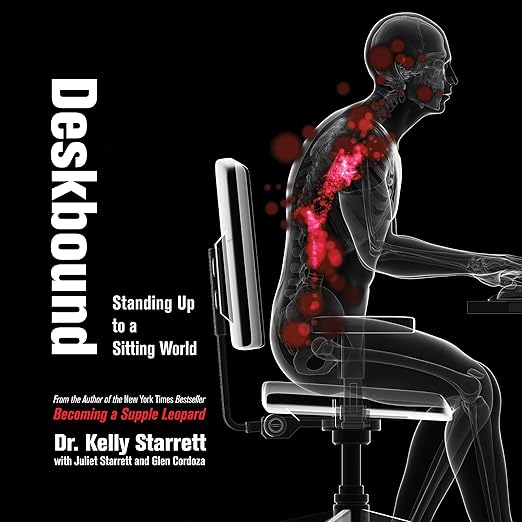
How many hours have you spent sitting down just today, and did any of them involve actual pain you have started treating as normal? Kelly Starrett spends this eight-hour audiobook building a case that your chair, not your workout routine or your diet, might be the single biggest threat to your long-term physical health, and Deskbound backs that claim with genuine physical-therapy expertise rather than vague wellness anxiety.
The credited author field names only Kelly Starrett, but one reviewer specifically notes the book was written with the help of his wife Juliet Starrett and Glen Cordoza, both real collaborators worth knowing about even though the listing itself credits Kelly alone. Starrett already had a bestseller to his name before this one, Becoming a Supple Leopard, a New York Times and Wall Street Journal bestseller according to the synopsis, and Deskbound applies that same physical-therapy framework specifically to the office worker's particular set of problems.
Highlights
The health claims Starrett opens with are genuinely alarming rather than exaggerated for effect: the synopsis cites research connecting excessive sitting to obesity, diabetes, cancer, and depression, and notes that seated office workers suffer more musculoskeletal injury than people doing daily manual labor, an inversion of the usual assumption that desk work is the safer option physically. One reviewer paraphrases Starrett's own framing directly, calling sitting 'the new smoking,' a comparison blunt enough to stick with a listener well past the audiobook's runtime.
The specific range of conditions the synopsis links to prolonged sitting is worth pausing on, since depression sits oddly alongside obesity, diabetes, and cancer in a list that otherwise reads as purely physical. Starrett's case leans on research connecting physical stagnation to mood and cognitive function, not just metabolic health, which reframes sit-less advice as mental health guidance as much as physical therapy, a broader claim than the book's fitness-adjacent genre tag would otherwise suggest.
What separates this from a generic sit-less, stand-more message is specificity: fourteen distinct mobility templates addressing particular problem areas, from carpal tunnel mitigation to spine and trunk stabilization to correct mechanics for walking, hinging, squatting, and carrying weight through daily life. A reviewer who received an advance copy calls it much more than just a message about standing up and moving more, and that assessment matches the sheer range of named techniques Starrett packs into a relatively compact eight-hour runtime.
What makes Starrett's warning land differently than typical workplace wellness messaging is timing: standing desks, walking meetings, and ergonomic consulting have all become common enough in the years since this book's release that its once-radical premise now reads as increasingly mainstream, a rare case of a health book's central argument aging into broader acceptance rather than losing relevance. Starrett was making this case before open-plan offices routinely offered standing-desk options, which gives the book's original alarm a slightly prescient weight in hindsight.
One of the book's five-star reviews comes from a reviewer whose own credentials, MPT, CSCS, CISSN, appear directly in their name, physical therapy and strength-and-conditioning certifications that signal a peer in Starrett's own field rather than a lay enthusiast. That a credentialed physical therapist calls the book essential and groundbreaking carries different weight than general reader enthusiasm alone, suggesting the underlying clinical content holds up to scrutiny from people trained to evaluate exactly these kinds of movement and injury claims professionally.
The title itself carries a double meaning worth noticing: deskbound describes both a physical state, tethered to a chair for eight-plus hours a day, and something closer to a diagnosis, a condition with specific symptoms and a specific treatment plan, which is exactly how Starrett structures the book. He is not offering vague lifestyle encouragement to move more; he is treating prolonged sitting as a genuine occupational health condition with fourteen distinct, targeted interventions, the same clinical seriousness he would presumably bring to treating an actual sports injury in his physical therapy practice, applied instead to an injury pattern that develops slowly enough most people never think to treat it as one at all.
What to Watch For in Deskbound
Kern Schmidt has no comparable physical-therapy or movement-instruction credit in this specific catalog to measure against, so his performance is worth judging on the actual craft challenge this material presents: keeping detailed physical instruction clear and followable through voice alone, when the underlying content, correct body positioning, specific mobility drills, describes something inherently visual and spatial. That is a genuinely different demand than narrating straight prose, closer to reading a recipe aloud than reading a novel, where precision and pacing directly affect whether a listener can actually execute what they are hearing.
This is the book's most honest limitation, and it applies to any movement-instruction audiobook, not just this one specifically: you cannot see correct spine alignment or proper squat depth through audio alone, and fourteen mobility templates built around precise body positioning genuinely benefit from visual reference. Starrett's broader platform, including instructional video content built around this same material, exists specifically to fill that gap, and listeners serious about actually implementing the mobility work described here should plan to pair this audiobook with some visual reference rather than expect the audio alone to fully substitute for it.
The sports-outdoors genre tag and its accompanying athletic, competitive framing undersell what this book actually is: practical occupational health advice aimed at anyone who sits at a desk for a living, not adventure or athletic-achievement content in any conventional sense. The audience Starrett is actually writing for is the office worker who has never thought of themselves as an athlete at all, which makes the genre categorization on this listing a genuine mismatch worth correcting before you commit to it expecting something more adventure-oriented.
Starrett's broader mobility-coaching platform beyond this specific book, built around instructional video content demonstrating these same fourteen templates in practice, means listeners who connect with Deskbound's philosophy have a clear, same-author next step for the visual reinforcement the audio format alone cannot fully provide, rather than being left to search for unrelated, unvetted fitness content elsewhere online.
Is This One for You?
This is squarely for anyone who spends the bulk of a workday seated, from remote workers to office employees to long-haul drivers, along with readers who already trust Starrett's expertise from Becoming a Supple Leopard and want the same rigor applied specifically to desk-bound life rather than athletic training. Starrett frames the payoff broadly, useful whether your specific goal is maximizing workplace performance, losing weight, or simply living without chronic pain, and that range matters for who should actually pick this up: you do not need to be chasing athletic performance to benefit, only to spend real hours each day sitting down.
Skip the audio-only route if you specifically need visual demonstration to execute physical mobility work correctly and safely, and consider pairing this with Starrett's video content instead of, or alongside, the audiobook if hands-on physical instruction is your main goal rather than understanding the underlying research and rationale.
Before You Listen
Is this audiobook by the same author as Becoming a Supple Leopard?
Yes, Kelly Starrett wrote both, and Deskbound applies the same physical-therapy framework specifically to office and desk-bound work rather than athletic training.
Do I need special equipment for the exercises in this audiobook?
The synopsis does not indicate specialized equipment requirements, focusing instead on body positioning, mobility drills, and workstation adjustments that most listeners can attempt with what they already have.