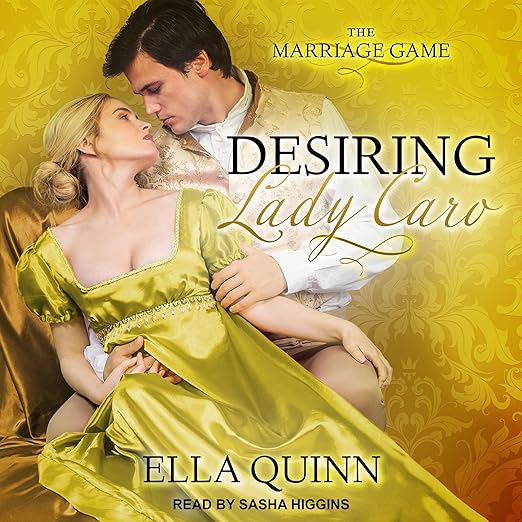
I tend to come to Regency romance with specific expectations, and Desiring Lady Caro meets most of them while doing two things I did not expect. The first is the Venice setting, which gives the novel a geographic and social freedom that Regency fiction set exclusively in London tends not to have. The second is the directness with which Ella Quinn handles the trauma that drives Lady Caro's five-year self-exile. Both of these qualities elevate what might otherwise be a pleasant but unremarkable fourth entry in a series.
The Marriage Game series follows a group of bachelors who are, one by one, being diplomatically routed toward marriage by a combination of fate and strategic women. Gervais, Earl of Huntley, arrives in Venice to visit his aunt Horatia, who is also Lady Caro's godmother. Caro has been in Venice for five years following events in England that the novel reveals carefully rather than all at once. The Marchese di Venier, a dangerously determined Italian nobleman, has been pursuing her with the kind of persistence that makes the word pursuing insufficient. When Gervais arrives and improvises a false betrothal to extract Caro from an uncomfortable situation, the standard Regency machinery begins to move.
What Ella Quinn Delivers
Regency romance typically confines itself to the small social world of London's Season, country houses, and the strict behavioral codes that govern both. Venice in the early nineteenth century was not England, and Quinn uses the difference. Caro has fled to a place where English rules do not fully apply, which gives her a degree of agency and freedom that a London-based heroine of the same period would not have. The Marchese as a villain is operating under a different set of cultural assumptions, which makes him genuinely threatening rather than merely inconvenient in the way English rakes tend to be.
The journey that Gervais and Caro eventually make together, from Venice through France toward England, extends the geography further and gives the novel an adventure dimension that distinguishes it from drawing-room romance. One reviewer described it as gripping from its opening pages with new locales on the continent, and that is accurate. The movement through physical space mirrors the movement through emotional territory in a way that Quinn handles with a light structural touch. The settings are specific enough to feel researched without overwhelming the character dynamics that are the real business of the book.
What Ella Quinn Gets Right
Desiring Lady Caro contains two simultaneous love stories. The central romance between Gervais and Caro runs alongside a second romance involving Horatia, Caro's godmother, and a captain who has loved her for years. The parallel structure is common in Regency fiction, and Quinn manages it with reasonable skill. The two stories illuminate each other thematically: both pairs are navigating the gap between what they feel and what they are willing to say, both are dealing with old wounds that prevent direct declaration, and both reach resolution in ways that feel earned within the conventions of the genre.
One reviewer noted that today's lovers blurt declarations freely while Regency heroes and heroines guard their words and doubt that the object of their affection could love them in return, and that observation captures the emotional grammar of the book well. The sustained uncertainty about whether love is reciprocated, which is the engine of most Regency romance, is handled here with patience. Sasha Higgins's narration helps considerably. She moves between the two romantic threads without losing the distinction of voice or emotional register that keeps each story legible on its own terms.
Where Ella Quinn Loses Some Ground
The most substantive element of Desiring Lady Caro, and the one that sets it apart from lighter genre entries, is Quinn's treatment of what drove Caro out of England. The novel deals with the aftermath of sexual assault, and it does so with more care and seriousness than the genre average. One reviewer acknowledged this as a genuine redeeming feature while also noting that the recovery arc, in which a woman so scarred by assault becomes voraciously passionate relatively quickly, may strain some readers' credibility.
That tension is real and worth naming. The genre conventions of Regency romance require that the heroine eventually become fully present to the hero, and the speed of that transition is shaped by plot necessity as much as psychological realism. Quinn does not trivialize the trauma, and the early scenes in which Caro's wariness and her management of situations that might compromise her safety are written with evident thought. But the arc concludes in ways that the genre demands, and readers who come to the book primarily interested in the psychological realism of trauma recovery may find the pacing of that recovery compressed. Readers who come primarily for the romance will find it handled better than they might expect.
Who Should Pick Up Desiring Lady Caro
The Marriage Game series is designed so that each book follows a different couple, with previous couples appearing as secondary figures. Desiring Lady Caro functions reasonably well as a standalone, and a first-time Quinn reader can enter here without disorientation. The world-building required to understand the social dynamics is handled efficiently in the opening chapters, and the relationship between Gervais and Caro is developed fully enough to carry a listener who has not met either character before.
Established series readers will have the additional pleasure of seeing earlier couples in their secondary appearances, and Quinn's consistent world is a significant part of the series' appeal. At eleven hours, this is a substantial listen, and Higgins's narration sustains the period tone without becoming stiff or mannered. The melodramatic Marchese di Venier is the kind of villain who would not survive contact with a more psychologically realistic novel, but in the Regency register Quinn is working in, he functions as intended: providing external pressure that forces the two protagonists into proximity and honesty. The book does what a well-made fourth series entry should do, which is to deliver on the series' promises while giving its specific couple their own individual weight.
A Few Questions About Desiring Lady Caro
Does Desiring Lady Caro work as a standalone if I have not read the previous Marriage Game books?
Yes, Quinn structures each book to follow a new couple with the previous couples as secondary figures. A first-time reader can enter here without confusion. Established series readers will get additional pleasure from seeing earlier characters, but the central romance stands fully on its own.
How does Quinn handle the trauma backstory driving Lady Caro's behavior?
More seriously than the genre average. The aftermath of sexual assault is treated with evident care in Caro's wariness and protective behaviors early in the novel. Some readers have noted that the recovery arc is compressed by genre convention, which is a fair observation, but the issue is neither ignored nor trivialized.
Is the Venice setting used meaningfully or is it merely decorative?
Quinn uses the continental setting to give Caro a degree of agency and social freedom that England's Regency conventions would not permit. The Marchese di Venier operates under different cultural assumptions that make him genuinely threatening, and the journey through Venice and France serves the character arc rather than just providing backdrop.
How does Sasha Higgins's narration handle the two parallel romance plotlines?
Higgins maintains clear distinction between the two romantic threads, Lady Caro and Gervais on one side and Horatia on the other, without losing the period warmth that holds the novel together. Her pacing suits the Regency register Quinn works in, measured enough to honor the era's emotional restraint while keeping the romance present.