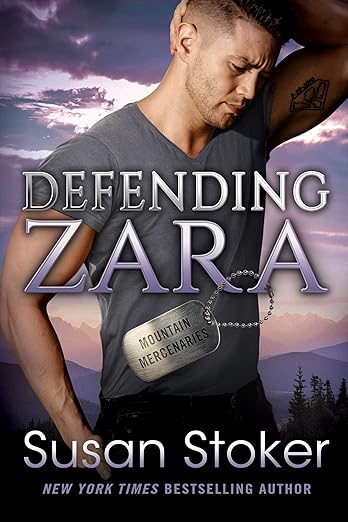
Before You Press Play
- Narration: Stella Bloom brings steady, warm energy to both the military action sequences and the tender moments between Meat and Zara, handling the dual POV romance with genuine emotional range.
- Themes: Human trafficking survivor resilience, wounded soldier vulnerability, trust rebuilt through shared danger
- Mood: Tense and protective, with bursts of heat
- Verdict: A competently crafted military romance that delivers on both the action and the emotional core, strongest for readers already invested in the Mountain Mercenary world.
I picked up Defending Zara on a Tuesday afternoon when I needed something with forward momentum, the kind of story that keeps you locked in without demanding too much of you. Susan Stoker has built a devoted readership in the military romance subgenre, and this installment, part of her Mountain Mercenaries series, arrives with all the hallmarks her fans expect: a scarred operative, a woman who has survived the unthinkable, and Lima as an unlikely backdrop for both violence and healing.
The setup wastes no time. Hunter Snow, call sign Meat, is in Peru to dismantle a human trafficking network preying on the barrios, and things go sideways fast. Left for dead and separated from his team, he wakes up in the care of a stranger who knows something about survival herself. What follows is a slow burn built on mutual necessity, with Stoker layering in the intimacy of caretaking before anything more charged develops between them. It is a structure the subgenre knows well, but Stoker executes it with enough specificity about Lima and enough interiority for both characters that it feels lived in rather than templated.
One of the things Stoker gets right here is the specific disorientation of a trained operator who has been stripped of all his advantages. Meat is not the kind of character who collapses easily, but being separated from his unit in a foreign city while badly injured forces a particular kind of stillness on him, and that stillness is where the emotional story actually lives. Stoker uses this window well. He cannot perform competence. He can only receive care, and that dependency becomes the foundation for a connection that might not have formed otherwise. It is a smart structural choice for a subgenre that often struggles to find convincing reasons for two very capable people to need each other.
Zara's backstory is harder terrain. Her knowledge of the trafficking networks is experiential rather than academic, and Stoker does not look away from what that means. The treatment is not graphic in a gratuitous sense, but it is present, and readers sensitive to trafficking-related trauma should go in knowing this is woven into the fabric of the narrative. What Stoker avoids, to her credit, is the tendency to make Zara's past function purely as backstory for Meat's heroism. She has agency throughout, and her survival skills are as relevant to the plot as his tactical training. The dynamic between them earns its heat because both characters are operating from positions of real exposure rather than from behind the armor their respective backgrounds might otherwise provide.
What Stands Out
Stella Bloom handles the narration across ten and a half hours, and she earns her keep in a story that shifts registers frequently. Military romance requires a narrator who can read action scenes with enough urgency to maintain tension while also slowing down for the quieter, more vulnerable exchanges, and Bloom manages both convincingly. Her voice for Zara has a kind of careful restraint that fits someone who has learned to measure her trust, while her performance during the action sequences has appropriate weight without tipping into melodrama. The accents in a story set partly in Lima are handled with reasonable care rather than caricature, which matters more than many listeners consciously register.
Where the narration is most effective is in the scenes where Meat is at his most physically vulnerable. Bloom does not overdramatize his condition, but you feel the cost of every conversation he has while recovering. That restraint serves the story well. There is a tendency in military romance narration to play the heroes larger than life, and Bloom resists it here, which gives the emotional arc more room to develop at human scale.
Before You Commit to Defending Zara
This is the kind of question that comes up with any mid-series military romance, and the answer with Defending Zara is a qualified yes. Stoker provides enough context about the Mountain Mercenaries unit to keep a new reader oriented, and the central love story is self-contained. You will miss some of the emotional shorthand that comes from having followed Meat through earlier entries, and a few references to events and relationships from previous books will land less fully, but the narrative does not collapse without that history. Fans of the series will get more out of it, but newcomers to Stoker's work will find it accessible as a starting point.
The broader series structure is visible throughout, which is both a strength and a mild limitation. The villain is appropriately dangerous and the trafficking storyline has genuine stakes. The romance moves at a pace that feels earned rather than rushed. But some of the resolution in the final third follows a pattern familiar to anyone who has read extensively in this subgenre: the cavalry arrives, the threat is neutralized, the emotional declaration follows. Stoker is not trying to subvert those conventions, and for her intended audience, she is not expected to. A 4.8 rating across more than eleven hundred reviews suggests the formula is working exactly as designed.
Best Suited For
If you enjoy military romance with a protective hero, a survivor heroine who is not reduced to a victim role, and a foreign setting that gives the action stakes a different texture than domestic thrillers, Defending Zara delivers what it promises. The Lima barrios setting adds geographic specificity to what could easily have been a generic backdrop, and Stoker's handling of both the physical recovery arc and the trafficking subject matter is more careful than the genre average.
Readers who are not already invested in military romance as a genre, or who find the conventions of the protector-romance template frustrating, will not find enough here to win them over. The pacing in the recovery scenes is slow by design, and those who prefer romance that moves faster toward its emotional payoff may find the middle section tests their patience. If trafficking-related content in romantic fiction is something you actively avoid, this is not the entry point to change your mind on that.
Common Questions
Does Defending Zara work as a standalone, or do I need to read the Mountain Mercenaries series first?
It functions as a standalone. The central romance between Meat and Zara is self-contained, and Stoker provides enough background on the team. However, readers who have followed the series will get more out of the character dynamics and references to earlier events.
How does Stella Bloom handle the dual-POV structure and the emotional range this story requires?
Bloom is well-suited to this material. She differentiates Zara's careful vulnerability from Meat's reluctant dependence without overselling either, and her pacing through the recovery scenes keeps the emotional intimacy intact.
Is the human trafficking storyline handled sensitively or does it feel exploitative?
Stoker weaves it into the narrative as a lived reality for Zara rather than a plot device for the hero's heroism. It is present and emotionally honest but not graphic or gratuitous. Readers who are sensitive to this subject matter should be aware it is central to the story.
Is the Lima setting used meaningfully, or is it just a backdrop?
The Lima barrios setting gives the trafficking storyline geographic specificity and adds to the sense of isolation when Meat is separated from his team. It functions more as atmosphere than as deeply researched local detail, but it does more than a generic foreign-country backdrop would.