Quick Take
- Narrator: Oliver Highpoint handles the dual emotional registers of Mera's captivity trauma and Kovak's stoic thaw with steady control; his voice for the Vinduthi carries an alien flatness that gradually opens in ways that match the character arc.
- Subjects: captivity-to-claiming romance, emotional awakening in a closed-off warrior, survival bonding under impossible odds
- Tone: Intense and visceral, with genuine warmth breaking through the darkness in the second half
- Bottom line: A third-series entry that benefits from knowing who the Vinduthi are, but delivers complete emotional satisfaction for those already in the universe.
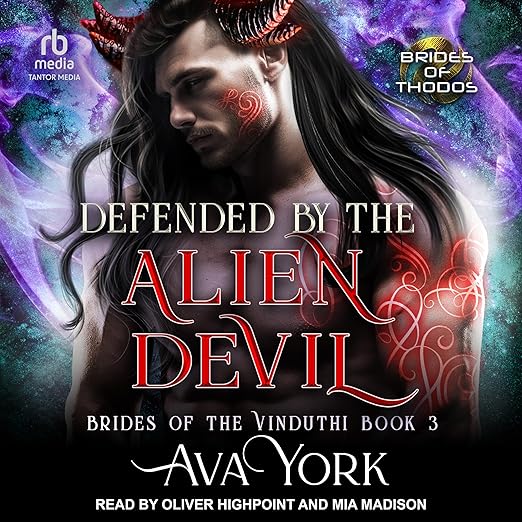
The Brides of the Vinduthi series arrives at its third installment with Defended by the Alien Devil, and the setup Ava York has built for Kovak, the Vinduthi alien described by readers as robotically stoic, pays off in ways that the earlier volumes were preparing for. This audiobook, narrated by Oliver Highpoint over four hours and thirty-four minutes, centers on Mera, a human woman who has been caged and tortured for an indeterminate time until an injured Vinduthi warrior is thrown into her cell near death. The claiming mark dynamic that drives the central plot - Mera asks Kovak to mark her as his to protect her from their captors - is the series' signature arrangement, and in this volume it carries the most emotional weight of any so far.
What Ava York Delivers
The character of Kovak is what makes this installment distinct within the series. Reviewers consistently describe him as robotic and emotionally flat before his captivity with Mera, and the novel's project is to document a specific kind of awakening in a character who has suppressed affect as a survival mechanism rather than as a personality trait. That distinction matters. A character who feels nothing is narratively inert; a character who has learned not to feel, for reasons that are visible in the text, is a much more interesting object for a romance. York handles the distinction carefully: Kovak's stoicism is earned and explained, and his thaw is gradual and physically registered rather than announced. One reviewer notes that he "finds his ability to feel, even if he doesn't want to," which is an accurate and affectionate summary of the arc.
Mera is well-drawn within the constraints of a four-and-a-half hour runtime. She has been physically and emotionally abused over an extended period, and York writes her not as rescued but as resourceful - "she kept her wits and tried to figure out a way to escape" in one reviewer's words. The dynamic between Mera and Kovak is not one of simple protection; they save each other in both directions, and the balance of that mutual dependency is what transforms the claiming bond from convenience to genuine connection. The action sequences - bloody, high-stakes, with odds that the synopsis describes as "impossible" - punctuate the emotional development rather than replacing it. York's pacing across the short runtime is controlled; she does not sacrifice character work for plot mechanics.
Oliver Highpoint's narration is well suited to the material's emotional range. He reads Kovak's early flatness with a deliberate absence of warmth that would be dull if it weren't clearly calibrated to pay off later; as the character opens, Highpoint's voice registers the change in small increments. He handles Mera's perspective with more immediate warmth, which creates a useful tonal contrast between the two internal states. The intimate, prison-cell setting of much of the novel means the audio format creates a specific kind of closeness between narrator and listener that enhances the tension. There is nowhere to look away when you are locked in a cell with two characters who are discovering each other.
The four-and-a-half hour runtime is shorter than many comparable alien romance audiobooks, but it does not feel abbreviated. York's efficiency as a writer is visible in how much character development she fits into the space: Kovak's backstory, Mera's captivity, the mechanics of the claiming mark, and the action-heavy escape sequence are all given adequate space without any feeling of being rushed. The series regulars who have followed the Vinduthi across multiple volumes will find this installment's contribution to the broader world-building satisfying; the alien mafia gang's internal dynamics have developed with consistency across the series.
Where Ava York Loses Some Ground
Series context matters. Listeners coming to Defended by the Alien Devil as their first Brides of the Vinduthi title will follow the story without significant confusion, but they will miss the layers of world-building and character history that returning readers bring. The Vinduthi culture - their claiming mark traditions, their gang structure, their physical characteristics - are introduced as needed but not explained from first principles. Reviewers who are most enthusiastic about this volume are clearly already familiar with the series, and their enthusiasm is partly for how this installment fits into and advances what came before. Starting here is possible; starting at Volume 1 is recommended.
The darkness of the setup - captivity, torture, physical injury - is significant in the early sections. York does not soften these elements; Mera's captivity is drawn with enough specificity to establish real stakes rather than genre gesture. Listeners who are sensitive to torture and captivity content should know the first act is not gentle, even if the ultimate trajectory of the novel is toward warmth and connection. The "mature themes" content note in the synopsis covers explicit romance content in addition to the captivity violence; both are present and handled purposefully rather than gratuitously.
Who Should Pick Up Defended by the Alien Devil
Readers already invested in the Brides of the Vinduthi series should not wait; Kovak's arc is a payoff the earlier volumes have been building toward. Alien romance readers who enjoy stoic-warrior heroes with earned emotional depth will find this calibrated to their preferences. Listeners drawn to captivity-to-connection dynamics and claiming mark tropes will find the execution clean and satisfying. Those new to alien romance looking for an accessible entry point should start with the first Brides of the Vinduthi volume rather than here. Listeners who prefer lighter content without violence or explicit material should look elsewhere; the darkness is integral to the emotional payoff, not incidental.
Common Questions
How explicit is this audiobook?
The content note specifies mature themes. The audiobook includes both captivity and violence in the opening sequences and explicit romantic content later in the narrative. Both are purposeful to the story.
What makes Kovak different from the heroes in the earlier Brides of the Vinduthi audiobooks?
Kovak is described across reviews as uniquely stoic and emotionally closed, even by Vinduthi standards. His arc is specifically about an awakening that the earlier heroes did not require, which makes his volume the most emotionally charged in the series so far.