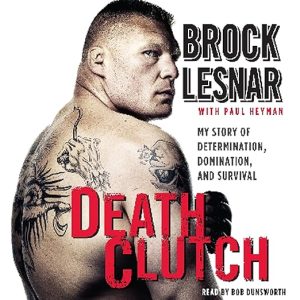
Can you know someone for years through their physical presence alone and then have that presence entirely recontextualized by hearing them speak at length? That is something close to what Death Clutch offers longtime Brock Lesnar followers. The audiobook - narrated by Bob Dunsworth rather than Lesnar himself - gives you the man's story in his own words across five and a half hours, and it is not the story the WWE's production team constructed. It is more specific, more plainspoken, and in places more private than the public persona.
What Brock Lesnar Delivers
One reviewer flagged something genuinely interesting about this audiobook: the content differs from the hardcover. The audiobook version includes a chapter about Kurt Angle that is absent from the print edition, as well as numerous minor differences throughout. For a fan who wants the fullest version of Lesnar's account of his career, the audio version has material that print readers never received. That is a meaningful distinction when deciding which format to choose.
Lesnar describes himself in the synopsis as a man who shares his true personal story of determination, domination, and survival. That self-description is accurate in the sense that the memoir is built around sporting achievement - amateur wrestling, professional wrestling, UFC heavyweight competition - rather than personal revelation in the conventional memoir sense. One reviewer put it plainly: Lesnar is not an outgoing personality and will not go into great details about his personal life, as that is his life. What he does discuss is his professional arc, and that arc is genuinely unusual. Few athletes have competed at the elite level of two different sports, particularly sports as physically demanding and structurally different as NCAA Division I wrestling and UFC heavyweight competition.
What Brock Lesnar Gets Right
The audiobook rewards listeners who arrive with some knowledge of the terrain. Lesnar's accounts of the wrestling world against the MMA world, as one reviewer described it, are most meaningful when you know enough of the landscape to read the gaps as well as the statements. His point of view on the WWE during the period when he was its most dominant performer, and then on the UFC when he arrived as a thirty-year-old rookie despite never having competed professionally in MMA, carries its full weight for listeners who can place those accounts within the wider story of both industries.
At five and a half hours, Death Clutch is a brisk listen. Bob Dunsworth's narration matches the material's energy - direct, unornamented, moving at the pace Lesnar himself seems to prefer in communication. The comparison one reviewer made to a great POV that is absolutely mesmerizing is somewhat generous, but the momentum is real. You are rarely waiting for the next thing to happen, which is the fundamental requirement of sports memoir narration.
The survivorship element of the memoir - the "Death Clutch" concept itself, drawn from the wrestling grip that refuses to release regardless of pain - functions as both the title's organizing metaphor and as a genuine description of Lesnar's competitive psychology. He is constitutionally unwilling to release a grip, whether on the wrestling mat, in the Octagon, or on a career that his diverticulitis nearly ended in 2009. That stubbornness is the thread running through the entire five hours, and it gives the memoir a coherence that purely chronological sports biographies often lack - there is a single quality being tested and demonstrated across every chapter.
Where Brock Lesnar Loses Some Ground
Listeners expecting confessional depth will find this memoir reserved. Lesnar discusses what he is willing to discuss - his sporting achievements, his competitive mindset, his early farm life in South Dakota - and the things he keeps private, he keeps private. For some listeners that restraint reads as authenticity; for others it reads as a gap in the narrative. The memoir does not attempt to explain Lesnar's polarizing public reception or to defend his reputation. It reports events from his perspective and moves on.
The tag categorizing this under "Cycling" in its genre data is clearly a metadata error - this is an MMA and professional wrestling memoir with no connection to cycling whatsoever. The WWE and UFC content is the entire subject. That mislabeling is worth noting for listeners who arrive through genre browsing rather than direct searching.
Who Should Pick Up Death Clutch
This audiobook is best suited for WWE and UFC fans who want firsthand perspective from one of the most unusual athletes to compete in both environments. The Kurt Angle chapter exclusive to the audiobook version is a specific draw for wrestling history enthusiasts. Listeners who followed Lesnar's career across both industries will find the audio format adds a layer of direct engagement - Dunsworth's narration gives Lesnar's words more presence than reading them silently.
Casual listeners with no familiarity with professional wrestling or MMA will find the memoir harder to place - the significance of many of the events and rivalries Lesnar describes requires some existing context to land fully. And listeners who prefer memoir that operates on the emotional or psychological register, exploring motivation and inner life rather than career chronology, should know this is a sporting memoir in the most focused sense: achievement-oriented, concrete, and unreflective in the literary sense of the word, which can be read as a strength or a constraint depending on what you want from the format.