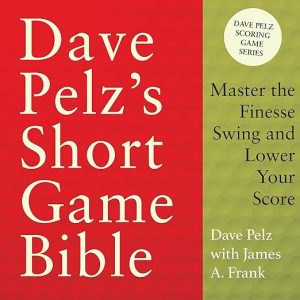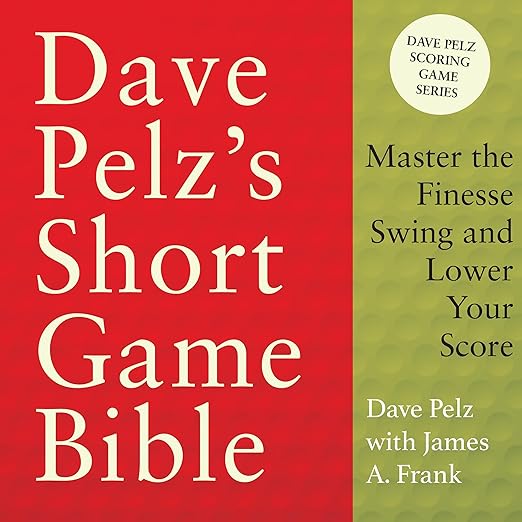
Dave Pelz's core argument has not changed in decades of golf instruction: the majority of strokes lost by amateur golfers are lost within 100 yards of the hole, and fixing your driver while ignoring your wedges and putter is the most common and most expensive mistake in the game. Dave Pelz's Short Game Bible, narrated by Joel Richards and running 13 hours and 54 minutes, is the audiobook version of the national bestseller that made this argument with enough scientific rigor to change how serious amateur golfers think about practice. Part of the Dave Pelz Scoring Game series, it works in close conversation with the companion Putting Bible and represents the foundational text of Pelz's pedagogical system.
How Dave Pelz's Short Game Bible Holds Up
Pelz spent years as a physicist at NASA before turning to golf instruction full-time, and that background is not incidental to the book's authority. His research methodology, studying thousands of golfers across skill levels, identifying common error patterns, quantifying the impact of short game improvement on scoring outcomes, produces specific claims rather than conventional wisdom. The famous Golden Rule of Golf he quotes: "He who rules the short game collects the gold", is not a motivational aphorism but a statistical observation: Pelz has the data showing that short game accounts for the majority of scoring variance at every level below professional tour play, and he references that data throughout rather than simply asserting the conclusion.
The audiobook covers the full range of short game situations: pitching at varying distances, chipping from different lies, sand play from both standard bunkers and from hardpan or fried-egg lies, uphill and downhill approaches, and the terrain-specific adjustments that most amateur instruction glosses over entirely. Reviewer Lamont H. Johnson described it as "most comprehensive book on the short game I've found" with content that "meticulously explains" all varieties of shots and backing statistics. Reviewer G.W. Sims, an engineer himself, vouched for the science and praised specifically that Pelz "isn't written for scientists, just golfers", meaning the rigor is present in the research but the communication is accessible to any golfer willing to think carefully about what they are doing and why.
Why Dave Pelz's Short Game Bible Works as an Audiobook
Joel Richards's narration is competent and appropriately clear for a technically demanding instructional text. The audiobook's production notes credit Richards explicitly, with engineering by Matt Kulewicz and publication by Echo Point Books and Media in Brattleboro, Vermont. The companion PDF bundled with this audiobook is not optional for full value, it contains the charts, photos, and visual instruction that the audio references throughout the text. Pelz is by training and temperament a visual teacher, and the PDF is where that dimension of the system lives. Download it before beginning the audio so the reference material is available when Richards cites a specific figure or technique diagram.
The audio itself remains instructionally coherent without the PDF, but listening without it is like following a cooking demonstration without being able to see the technique being demonstrated, the verbal description is complete, but the visual reinforcement that locks in understanding is absent. The 4.6 rating across nearly 1,000 reviews includes one notable qualification from reviewer Jack Spratt, who noted that having previously attended the three-day Pelz short game school provided essential context for getting maximum value from both this audiobook and its Putting Bible companion. The school-to-book pipeline is not a prerequisite, but some listeners may benefit from pairing the audiobook with instructional video material for the spatial and visual dimensions of the swing mechanics being described.
Weak Spots in Dave Pelz's Short Game Bible
Pelz's method requires the listener to do something that most golf instruction books do not ask: conduct a personal weakness analysis before prescribing practice. His system begins with assessing where your actual strokes are being lost, not where conventional wisdom says most golfers at your handicap lose them. This means the audiobook's prescriptive sections, the instruction on specific shot types, are most valuable after the diagnostic framework has been internalized. Listeners who skip the early chapters on self-assessment and jump directly to the technique sections will get useful instruction, but they will miss the targeting logic that makes Pelz's system different from generic short game advice.
The foreword by Lee Janzen, two-time US Open champion, establishes the credibility context that Pelz's list of high-profile students, Tom Kite, Colin Montgomerie, Vijay Singh, Payne Stewart, Annika Sorenstam, and others, reinforces. Pelz did not become the leading short game authority by persuading recreational golfers alone; he changed how touring professionals think about the scoring zone, which is the strongest possible endorsement of a system's rigor. Richards reads these sections with appropriate authority, neither overselling the celebrity context nor underselling the specific claims being made about what the short game can do for a golfer at any level.
The Right Listener for Dave Pelz's Short Game Bible
This audiobook is built for the serious amateur golfer who has hit a handicap plateau and is willing to invest nearly 14 hours in a systematic understanding of why. Players who already know they are losing strokes inside 100 yards and want a science-based framework for addressing specific weaknesses will get the most from it. Tour or near-tour level players are already working with coaches at this level of detail. Beginners who have not yet established basic ball-striking consistency will find the short game analysis premature, build the full swing first, then return to Pelz. For the mid-handicap golfer who has been grinding the same range for years, this audiobook is the most systematic diagnostic and instructional tool available in audio form, paired with a PDF that extends its practical reach considerably beyond what the audio alone can deliver.
Quick Take
- Voice: Joel Richards reads clearly and without affectation, pacing technical instruction at a slightly slower cadence than narrative passages, appropriate for a book that requires the listener to absorb specific mechanics rather than follow a story.
- Big ideas: Short game as the primary driver of scoring improvement, scientific rigor applied to golf instruction, personal weakness diagnosis before technique prescription
- Atmosphere: Methodical and authoritative, like sitting in a lecture by someone who has done the research and is patient about explaining it
- Worth it?: Pelz has the data to back his central claim, that the short game is where most amateur golfers lose their strokes, and this audiobook is the most systematic audio treatment of that argument available.
Common Questions
Does Dave Pelz's Short Game Bible audiobook work as a standalone, or should I also listen to the Putting Bible?
It works as a standalone. The two books in the Dave Pelz Scoring Game series are complementary, the Putting Bible covers one specific dimension of the short game, while this audiobook covers pitching, chipping, sand play, and situational shots. Either can be read independently.
How does Joel Richards handle the technical instruction passages in the Dave Pelz's Short Game Bible audiobook?
Richards is clear and appropriately deliberate with technical material, swing mechanics, specific shot descriptions, and situational adjustments are read at a pace that allows for absorption. The production also credits engineering by Matt Kulewicz, suggesting care was taken with audio quality for this technically demanding text.