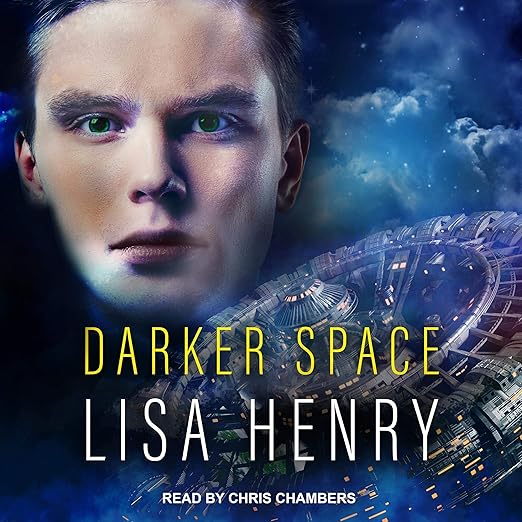
- Performance: Chris Chambers handles Brady's rough, first-person voice with authority, the chip-on-shoulder delivery suits the material, though some listeners wanted more POV access to Cam.
- What it covers: Survival guilt and domesticity, alien incomprehension, the difficulty of ordinary life after extraordinary trauma
- Feel: Tense at the edges, surprisingly tender at the center, with a slow-burn dread from out in the black
- Our call: A confident, character-driven sequel that deepens the stakes without abandoning what made the first book work, best experienced after reading Dark Space.
I started listening to Darker Space on a commute home and ended up sitting in the car for twenty minutes after I'd parked because I wasn't ready to stop. Lisa Henry builds something unusual in this second Dark Space entry: a sequel that is largely about trying to have a normal life while knowing that the thing that destroyed your capacity for normalcy is still out there, watching. The alien Faceless, specifically Kai-Ren, does not disappear just because Brady Garrett and Cam Rushton got home safely. That's the psychological engine of this book, and Henry runs it with considerable skill.
Brady is back on Earth, living with Cam and Cam's younger sister Lucy. By the metrics of his life before, a feral refugee from Kopa, the kind of person the system wrote off early, this is more than he should have expected. Henry is honest about that. Brady knows it, which is part of what makes him so difficult to be around in his own head: the gratitude is real, and so is the fear that he'll ruin the one good thing he managed to land. That interior texture is what elevates the first half of the book above what could have been a marking-time setup for the alien threat's return.
How Darker Space Holds Up
Henry is working in a tradition of science fiction that uses the alien as mirror: what the Faceless represent, what Kai-Ren's ongoing surveillance means, and what the military's endless cycle of interviews and tests does to two people trying to build something ordinary, it all feeds into a portrait of a relationship under a specific, strange kind of pressure. One reviewer described wanting more of Cam's perspective, and I understand that instinct; the single first-person POV means everything is filtered through Brady's particular brand of self-doubt and defensive humor. But Henry's choice to stay in Brady's head is also what makes the intimacy work. You feel his anxiety about Cam from the inside, which is more disquieting than an omniscient account would be.
The first half is slower, as several reviewers noted, but that slowness is doing real work. It's establishing what Brady and Cam have and why it matters. When Kai-Ren's presence re-enters the narrative, from out in the black, as the synopsis puts it, the threat to that ordinary life lands harder because Henry made you care about the ordinariness first.
The Best Parts of Darker Space
Chris Chambers is well-suited to Brady's voice. The character is rough-edged, self-deprecating in a way that masks real fear, and not always sympathetic in the traditional sense, he's aware of his own emotional limitations, which makes him more interesting than if he were simply likable. Chambers leans into that without making Brady exhausting to spend time with. The tender scenes between Brady and Cam have a different quality than the action or the nightmare sequences, and Chambers modulates between them convincingly.
At just over 8 hours, Darker Space is tight for science fiction romance. Tantor Media produced it cleanly. The listen never feels padded, which is notable given how much of the story is interior rather than event-driven in the first half.
Weak Spots in Darker Space
The dual-POV limitation is real and worth mentioning upfront. Multiple reviewers specifically noted that Cam is under-explored, we understand Brady's love for him and his fear of losing him, but Cam himself remains slightly opaque, his perspective on captivity with Kai-Ren and on building domestic life with Brady only ever glimpsed through Brady's eyes. For a romance, that asymmetry creates intimacy in one direction and a slight flatness in the other.
Listeners who found the first book's pacing frustrating will find the sequel's opening similarly slow. Henry is more interested in emotional architecture than in event density, and the first half of Darker Space is very much a domestic novel with an alien threat on the horizon. Whether that's a feature or a limitation depends entirely on what you're coming for.
Should You Listen to Darker Space?
This is a book for readers who finished Dark Space and needed to know what happened next. It's also for listeners who value character interiority and emotional texture in their science fiction romance and are willing to spend time in a complicated, self-aware narrator's head. The mature themes noted in the listing are real, this is not light reading, but they're handled with more psychological care than shock value.
New listeners should start with the first book. Brady's situation in Darker Space only makes sense if you understand where he came from, and the Kai-Ren dynamic carries weight it wouldn't have without the context of Dark Space. The series is short enough that starting from the beginning is a reasonable commitment.
Is the single Brady POV a significant limitation in Darker Space, given that Cam is a major character?
It's a genuine trade-off. Staying in Brady's perspective creates intense intimacy with his anxiety and self-doubt, but Cam remains somewhat opaque. Readers who wanted dual POV access to Cam's inner life, especially his experience of captivity with Kai-Ren, will feel the gap. Henry made a deliberate choice and it serves the emotional tone, but the limitation is real.
How much does the alien threat actually appear in Darker Space, compared to the domestic life setup?
Kai-Ren's presence operates as a background dread for much of the book. The first half is explicitly domestic, Brady, Cam, and Lucy building a life while navigating military debriefs. The alien threat re-enters meaningfully in the second half. Think of it as a slow escalation rather than continuous action.
Does Chris Chambers' narration work for a first-person narrator who is rough-edged and not always sympathetic?
Yes. Chambers leans into Brady's chip-on-shoulder quality without making him unpleasant to spend time with. The tender scenes have a different register than the defensive or anxious ones, and Chambers handles both convincingly. Brady is difficult by design, and the narration respects that without amplifying it.
Are the 'mature themes' listed in the synopsis primarily about violence, or sexual content, or both?
Both are present. The alien captivity backstory contains disturbing psychological content, and the romance between Brady and Cam includes explicit scenes. Henry balances them as part of a coherent character portrait rather than as separate genre elements, but listeners who are sensitive to either should be aware.