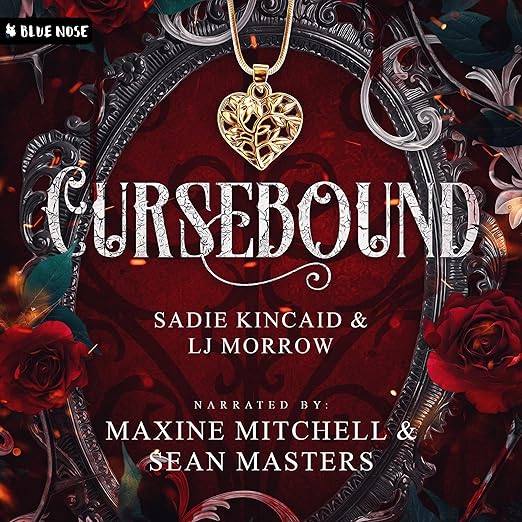
Cursebound, the first book in Sadie Kincaid and LJ Morrow's A Curse of Blood series, opens with exactly the premise its synopsis promises: a vampire hunter named Rosa Capelli who loves her job, a 400-year-old enforcer named Luca da Firenze who should be her sworn enemy, and a collision between those two worlds that neither of them is remotely prepared for. Narrated by Maxine Mitchell, this audiobook runs just over ten hours and functions as exactly the genre entertainment it presents itself as - fast, spicy, and structurally committed to building the mythology it introduces rather than treating world-building as optional decoration around a romance plot.
Rosa is a seer who hunts and ends out-of-control vampires, as a reviewer clarifies, not simply a generic slayer. Luca is a capo in the da Firenze Family, one of the main Cosca families of ancient vampires, sent to kill or capture Rosa when her identity as something more than a hunter becomes apparent. The dual first-person narration lets Kincaid and Morrow show both perspectives without filtering one through the other's bias, and Maxine Mitchell executes this with enough tonal separation that listeners are never confused about whose chapter they are in. Rosa sounds like someone who uses humor as armor. Luca sounds like someone who has never had to explain himself to anyone and is doing so now, uncomfortably, for the first time in centuries. That contrast is where Cursebound earns its energy.
The world-building is layered in through action rather than exposition, which keeps the pacing from stalling in the early chapters. The Cosca families, the ancient vampire political structure, and Rosa's own evolving understanding of what she is emerge through conflict rather than backstory dumps - a discipline that rewards patient listeners and makes the later revelations land with proper weight. A reviewer who entered the book with established enthusiasm for the vampire mafia premise described being obsessed from the prologue, and the opening chapters do move at exactly that pace. Kincaid and Morrow do not waste setup time. One reviewer who had been in a reading slump specifically credited this book with breaking it, noting the combination of dark themes and the I Vow, You Vow, We Vow vow structure as the thing that snapped her back into active engagement. That is the book's particular skill: it creates a ritualized framework for its romance that gives the relationship stakes beyond simply attraction or chemistry.
What Works
The audiobook format suits this particular book well. Mitchell's range covers both the comedy of Rosa's sarcasm and the gravity of Luca's four-century perspective, and the pacing she brings to the hotter scenes manages to be both faithful to the material and dramatically effective without becoming performative. Readers who have followed Kincaid's Broken Bloodlines series will recognize the author's comfort with possessive, high-stakes romance and her willingness to put her protagonists through genuine danger rather than using threat as pure atmosphere. One reviewer specifically noted that the collaboration with LJ Morrow has pushed Kincaid's work in a direction that feels fresh even for established fans, particularly in the paranormal mythology layered beneath the romance.
The vampire mafia framework is not original as a subgenre - it owes debts to J.R. Ward, to Kresley Cole, to a dozen others - but Cursebound builds its own internal logic convincingly enough that the familiar bones feel inhabited rather than borrowed. The Cosca family hierarchy, the specific rules governing seers and hunters in this mythology, and the particular history between Luca's family and Rosa's profession are specific enough to read as invented rather than assembled from genre parts. That specificity carries the series through its first installment and leaves enough open to make the continuation feel necessary rather than optional. The romance itself resists quick resolution in ways that reflect the structural power imbalance the setup creates - Kincaid and Morrow understand that their central conflict is not simply attraction but identity, and they treat Rosa's evolution through the story with more care than the spicy-premise framing might suggest.
Things to Know Before Starting Cursebound
The book is explicitly the first in a series and ends with enough resolution to be satisfying while keeping enough threads open to make the next installment feel urgent. Listeners who dislike series that withhold central relationship resolutions should know that Cursebound resolves its central tension but leaves the broader threat and mythology deliberately unfinished. The spice level is consistent and explicit throughout - this is adult paranormal romance with open-door scenes across the runtime - and the author's note flags specific trigger warnings accessible at the author's website, which is worth checking before beginning if you have content sensitivities. The novel's length, described as 150,000 words by the author, means the audio runtime of just over ten hours reflects a fully built story with room for both plot and character development, not a novella padded out with internal monologue. Listeners accustomed to Kincaid's previous series will notice some tonal differences in how the mythology is constructed here - the paranormal elements carry more weight than in her contemporary mafia work, and the series requires more buy-in to the supernatural framework than readers who come primarily for the romance heat may initially expect.
Who It's For
This audiobook is built for readers who already enjoy paranormal romance and want their vampire mythology served alongside possessive heroes, substantial world-building, and genuine romantic tension rather than instant resolution. Fans of Kincaid's previous Broken Bloodlines series will adapt quickly to the new setting and recognize her characteristic approach to the possessive hero dynamic. Those new to the genre but curious about dark romance with supernatural elements will find Cursebound an accessible and well-constructed entry point. Listeners who prefer slower romantic builds, lower heat levels, or fantasy that prioritizes world-building over romance will find the pacing and content differently calibrated than their preference, but for the target audience the combination here is precisely what it promises to be.
Common Questions
How does Maxine Mitchell handle the dual narration between Rosa and Luca in this audiobook?
Mitchell differentiates the two POVs primarily through pace and tone rather than obvious vocal shifts. Rosa's chapters carry a sharper, more comedic rhythm; Luca's read slower and carry centuries of accumulated weight. The distinction is consistent enough that listeners quickly learn to feel the shift without needing chapter headers to orient them.
What is the spice level and content of this audiobook?
The romance is explicit throughout - this is adult paranormal fiction with open-door scenes. The author flags dark themes and trigger warnings via her website at shanteltessier.com. The audiobook is not suitable for younger listeners or those who prefer closed-door romance. The forbidden romance premise and possessive hero dynamic are structural throughout, not limited to specific scenes.