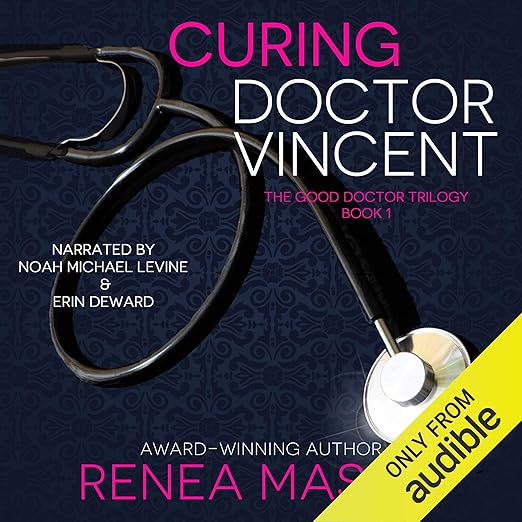
Gratitude and desire tangle immediately in Renea Mason's Curing Doctor Vincent, and the resulting audiobook never lets Elaine Watkins forget she owes the man propositioning her a real debt. Is she saying yes to Xavier Vincent's proposal because of the cure that saved her sister's life, or because she wants exactly what he's offering? The Good Doctor Trilogy opens with Elaine, a public relations advisor at the pharmaceutical company Vincent's breakthrough made famous, summoned to what she assumes is a business meeting in Paris. Instead, the physician lays out his actual request: not marketing strategy, but Elaine herself, on his terms, indulging appetites he's kept carefully hidden behind a company-icon reputation. The six-hour runtime keeps that central tension, professional gratitude bumping against real desire, at a rolling boil.
The Verdict, Briefly
Vincent describes himself in his own words as a king, not a saint, telling Elaine plainly that 'kings command and conquer' and that she came to Paris 'expecting a saint.' That line does a lot of work for the book's whole premise: Mason isn't interested in softening Vincent into a misunderstood nice guy underneath the dominance, she wants the reader sitting with the actual discomfort of wanting someone who tells you exactly how uncompromising he intends to be. Elaine's arc runs counter to the expected surrender narrative. Rather than simply yielding to Vincent's demands, she spends the book weighing whether it's easier to feed his desires or walk away, and eventually devises a plan of her own, which keeps her from reading as a passive object even inside a story explicitly about submission and control.
Noah Michael Levine narrates, and his newscaster-adjacent cadence, the same authoritative delivery that's served him well on historical reportage elsewhere, translates surprisingly well into Vincent's commanding register here; a man who talks about ruling rather than asking benefits from a voice that already carries natural weight. One reviewer's posted product details credit a two-voice performance alongside Erin Deward, which would track with the his-and-hers structure erotica in this vein often uses to keep both Elaine's internal conflict and Vincent's controlled intensity distinct.
Vincent's public identity as the talented physician and company icon who developed a life-saving cure adds a layer the book returns to again and again: everyone around Elaine, her sister included, sees only the celebrated doctor, while she alone gets access to the man issuing ultimatums about his sexual appetites behind closed doors. That gap between public reputation and private demand is where most of the book's tension actually lives, more than the explicit scenes themselves, and it gives Curing Doctor Vincent a sharper psychological hook than a simpler billionaire-seduction premise would offer.
Why Curing Doctor Vincent Works as an Audiobook
This is an Audie Award winner in the Erotica category from 2016, and the recognition tracks with what's on the page: a genuinely commanding antagonist-turned-love-interest, a heroine given real interiority instead of just reactive desire, and a Paris setting used for more than postcard atmosphere. A 4.3 average across 775 ratings is a strong signal for a genre where reader expectations run specific and unforgiving; erotica audiences know within the first hour whether a book delivers on its premise, and this one clearly does for a large, sustained readership.
One reviewer who read straight through all three books in the trilogy says the story 'flows pretty easily into the next,' especially between the second and third installments, which is worth knowing going in: this is book one of a continuous arc, not a standalone romance that happens to have sequels. Listeners who commit to Curing Doctor Vincent should plan on continuing, since Mason builds toward payoffs that this first six-hour entry deliberately leaves open.
Mason also paces the reveal of exactly what Vincent wants with real control, withholding the full scope of his unique sexual appetites long enough that Elaine's eventual understanding lands as a genuine turning point rather than an opening-chapter info dump. That structural patience is a craft choice worth noting specifically for listeners who have sampled enough erotica to know how often this kind of premise front-loads everything into chapter one instead.
Points to Consider
The heat level here runs high and explicit, with dominance and submission dynamics that go well beyond a typical steamy romance's innuendo. Listeners should also register the specific imbalance the plot is built on: Vincent isn't just wealthy and confident, he's the man whose medical breakthrough saved Elaine's sister, which means her gratitude and her desire are never fully separable, and the book knows it. That's clearly intentional, Mason uses the discomfort as the engine of the story rather than glossing over it, but it's worth knowing upfront rather than discovering mid-listen.
At just over six hours, this is a brisk entry point that resolves almost nothing by design; it's the setup volume of a trilogy, and listeners expecting a complete romantic arc in one sitting will find themselves at a cliffhanger instead. The pacing favors tension-building scenes in Paris over plot mechanics, so anyone hoping for a fast-moving thriller-adjacent erotica should recalibrate toward a slower, atmosphere-first read.
Who Should Listen to Curing Doctor Vincent
Readers who enjoy a commanding, morally gray love interest paired with a heroine who ultimately claims her own agency will find a lot to like here, especially anyone already partial to doctor-billionaire romance archetypes and willing to commit to a full trilogy rather than a single satisfying book. Levine's narration adds real authority to Vincent's dialogue, which matters in a book that leans so heavily on his voice doing the seducing.
Skip this one if explicit content and pronounced power imbalances aren't your genre preference, or if you'd rather a romance resolve within a single audiobook instead of building toward a trilogy-length payoff. Readers sensitive to gratitude-as-motivation dynamics, where a heroine's attraction is entangled with a literal life debt, should also go in aware that the book leans into that discomfort rather than resolving it quickly.
How explicit is the content in the Curing Doctor Vincent audiobook?
This is Audie Award-winning erotica with high, sustained heat and dominance-and-submission content that goes well beyond typical steamy romance innuendo, so listeners should expect explicit scenes throughout.
What is the power dynamic between Elaine and Dr. Vincent in this audiobook's story?
Elaine owes Vincent a genuine debt since his medical breakthrough saved her sister's life, and the book deliberately keeps that gratitude tangled up with her growing attraction rather than separating the two.