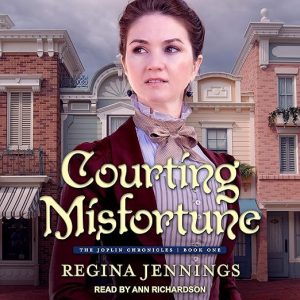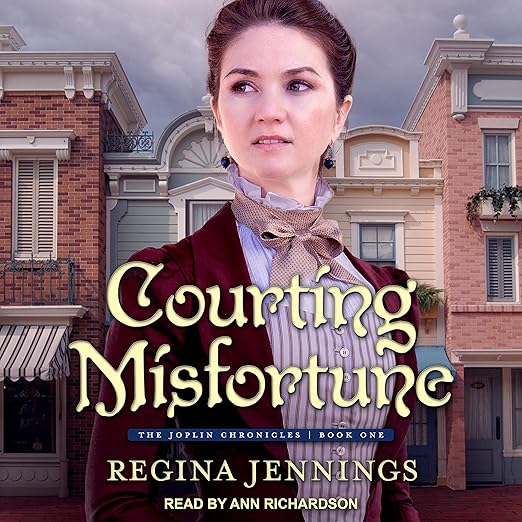
Calista York needs exactly one more successful case to secure her job as a Pinkerton operative, and the case she's handed sends her straight into the rowdy mining town of Joplin, Missouri, hunting for a kidnapped mob boss's daughter. The trouble is, Calista has extended family in Joplin who have no idea she's working undercover, and neither does the missionary pastor determined to shut down the very baby raffle she needs as cover. Can she keep her disguise intact while Matthew Cook keeps getting in her way for reasons of his own? This audiobook, the first in Regina Jennings's Joplin Chronicles, narrated by Ann Richardson, turns on exactly that tension.
Our Take on Courting Misfortune
The double-disguise structure is what elevates this past a standard inspirational romance premise. Calista is hiding her real mission from her own family while Matthew fights corruption and the baby raffle without any idea what she's actually doing in town, which means nearly every scene between them carries a second layer of risk underneath the obvious romantic one.
One reviewer's response captures the appeal well: “I enjoyed this wonderful story and the history behind Joplin, Missouri.” That same review specifically praises how the era's mining history gets woven into the plot rather than sitting in the background as pure set dressing.
Pinkerton operatives were a real and often overlooked part of American law enforcement history, and building a heroine around that specific, historically grounded profession gives Calista's competence a texture beyond a generic feisty-heroine archetype. Her cover story, tangled up with actual extended family who don't know what she's really doing in town, raises the personal stakes well past a simple undercover-agent plot.
The stakes are personal on both sides of the disguise, too. Calista risks her career and her family relationships if her cover slips, while Matthew risks the very fundraising effort meant to help a children's home if his campaign against the baby raffle succeeds too visibly. Both leads are working against each other's stated goals well before either understands what the other is actually trying to accomplish.
Why Listen to Courting Misfortune
A second, fully complete review is worth quoting at length, since it wasn't cut short the way some others were: “I was intrigued by the story!” the listener wrote, adding they “was drawn into Calista and Matthew's story” and would “definitely be reading the rest of the series.” That's a strong, unqualified endorsement from someone new to Regina Jennings's work.
Ann Richardson is a newer name in this particular genre, and the role asks a lot of her: a Pinkerton operative's toughness, period-appropriate propriety, and a genuine faith element, all within one coherent voice. Whether all three registers land equally well is a fair open question rather than a settled strength, and it's worth judging for yourself early in the listen.
As the opener to The Joplin Chronicles, this also establishes Regina Jennings within the specific space of inspirational historical romance set against real regional American history rather than a more generic historical backdrop. Joplin's mining-town identity isn't just scenery, reviewers specifically credit the historical detail as one of the book's stronger elements.
Matthew's own motivations deserve a mention too: he became a missionary expecting a calling that would take him far from home, only to end up a short train ride away fighting local corruption instead. That mismatch between expectation and reality gives him a specific kind of restlessness that pairs naturally against Calista's own secret-keeping.
Real moral complexity sits underneath the raffle conflict too. Matthew isn't opposing a cruel scheme purely for cruelty's sake, the raffle is meant to raise funds for a children's home, which means he's fighting the method while presumably supporting the cause, a nuance that keeps him from reading as a simple obstacle standing between Calista and her mission.
What to Watch For in Courting Misfortune
The Christian tag on this one means real content boundaries apply: expect a faith-forward story with closed-door intimacy conventions typical of the subgenre, rather than a steamier historical romance. Worth flagging plainly for anyone unfamiliar with Christian romance norms so expectations are calibrated before the first chapter.
One more reviewer's reaction, “I felt for Calista dealing with her family”, hints that the extended-family subplot carries real emotional weight rather than functioning as comic meddling alone. Go in expecting some heavier family-dynamics material layered underneath the disguise caper, not just lighthearted misunderstandings.
The mechanics of the central mystery add real tension beyond the romance: the missing girl at the center of Calista's case, a baby raffle Matthew is trying to shut down, and a disguise Calista can't afford to have slip in front of either her family or her love interest. Each of those threads creates its own opportunity for the plot to unravel, which keeps the stakes feeling genuinely earned rather than manufactured.
The pressure Calista faces from two directions at once, her career on the line professionally, her family's trust on the line personally, is exactly the kind of double bind that genre readers who favor competent, high-stakes heroines tend to respond to most strongly, more than a threat coming from a single, simpler source.
Calista's cover story is a genuine high-wire act for her improvisational skill specifically, since a Pinkerton investigation depends on staying unnoticed while an entire extended family who knows her personally keeps trying to fold her back into their lives. That tension, wanting genuine connection with family she loves while needing to keep them at arm's length professionally, gives the disguise plot real emotional cost beyond a simple ticking-clock mechanic.
Who Should Listen to Courting Misfortune
Fans of inspirational historical romance, readers who like a competent professional-woman heroine paired with a principled love interest, and anyone who enjoys a small-town mystery running alongside the central romance will find a lot to like in Courting Misfortune.
This is book one of The Joplin Chronicles, and based on how quickly at least one new reader committed to continuing the series, this one functions as much as a series audition as a standalone read. Worth knowing before you commit, especially if you'd rather wait and judge the whole series at once instead of one book at a time.
This should land especially well with readers who specifically want a heroine defined by her professional competence first, a Pinkerton operative with a real job on the line, rather than a heroine whose primary identity is defined by the romance itself.
Western-set historical fiction in general, not just the romance angle specifically, is well served here: Joplin's mining-boom identity shapes the plot's texture throughout, giving the setting real specificity rather than treating the 1800s Missouri backdrop as interchangeable scenery.
- Voice: Ann Richardson is a newer name to this genre, and the role asks a lot of her: a Pinkerton operative's toughness, a period-appropriate propriety, and a faith element all in one register.
- Big ideas: Undercover investigation, faith-forward romance, small-town family secrets
- Atmosphere: Warm, earnest, with real mystery-plot momentum
- Worth it?: A solid inspirational historical romance that earns its series-starter momentum, especially for readers who like a heroine with a real job to do.