Before You Press Play
- Performance: Virtual Voice (AI-generated), serviceable for a dense manual, but 18 hours of AI narration will test patience; the print edition may suit this reference-heavy content better.
- What it covers: Post-collapse security, small unit tactics, community defense
- Feel: Methodical and serious, written from genuine military experience
- Our call: A substantial and credible tactical manual for readers serious about post-collapse preparedness, more military operations primer than general survival guide.
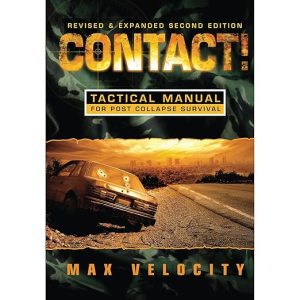
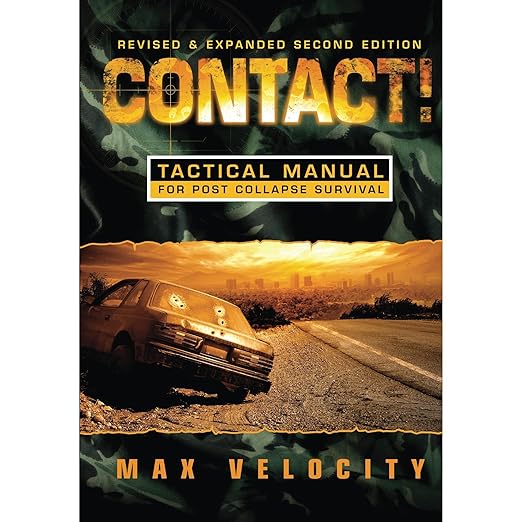
Contact: A Tactical Manual for Post Collapse Survival arrived on my radar through a conversation I was not expecting to have. A friend who had spent years working in emergency management mentioned it without irony as one of the most practically grounded resources in a genre she found otherwise frustrating. Her complaint about most preparedness content was that it oscillated between romanticized homesteading fantasy and paranoid doom-watching without ever getting to the hard questions about organized human behavior when institutional infrastructure fails. She said this one was different. She was right.
Max Velocity is a pseudonym for an author with verifiable special operations and private security contracting experience, service in SOF and subsequent employment as a contractor in Iraq and Afghanistan. That background is not decoration. It shapes every section of this book, from the opening discussion of individual self-defense to the later, more demanding content on forming and training tactical defense teams. This is military knowledge filtered through a prepper lens, not prepper fantasy filtered through military vocabulary.
The structure follows a logical escalation. It begins with the individual, self-defense posture, situational awareness, basic security thinking, before moving to the family and small group, and then to what Velocity calls tactical teams: organized defense forces that a community might need to form in a serious post-collapse scenario. That progression is careful and intentional. The book is not arguing that you need a squad. It is arguing that you need to understand how squads work before you need one.
One reviewer with nearly 25 years of active-duty light infantry experience called it excellent and specifically praised the treatment of battle drills, optics, combat first aid, and physical fitness requirements for light infantry operations at the fire team and squad level. That endorsement from a qualified military reader carries significant weight. Another reviewer noted that the book "might save your life and the lives of those you love" while explicitly warning that it will not produce heroes or super-survivors, a calibration that is more valuable than most preparedness content offers.
The Best Parts of Contact!: A Tactical Manual for Post Collapse Survival
As noted in the product information, this audiobook uses Virtual Voice narration. That is worth naming directly: 18 hours and 7 minutes of AI-generated audio applied to dense tactical manual content is a substantial commitment, and the listening experience is less engaging than a human narrator would provide. The material itself is serious and reference-heavy, which compounds the challenge. Many listeners who own this title use the print edition as their primary resource and the audio as supplementary. That is a practical approach for content of this type.
For listeners committed to the audio format, the Virtual Voice narration handles the technical terminology clearly if mechanically. The material does not require emotional performance, it requires clarity and consistent pacing, and on those metrics the AI narration is at least functional. Chapters on tactics, command structure, and decision-making benefit from the straightforward delivery; sections requiring more interpretive nuance feel flatter than they should.
Before You Commit to Contact!: A Tactical Manual for Post Collapse Survival
Several reviewers raised a useful clarification: the majority of this book, roughly 80 percent by one estimate, addresses training tactical groups for organized operations rather than general family survival. Readers expecting a broader preparedness guide covering food storage, water procurement, and individual evasion will find those topics present but not the book's primary focus. Velocity addresses this directly in the author's note, distinguishing Contact from its companion volume Rapid Fire based on audience and purpose. This book is the military operations primer; those looking for general family preparedness should calibrate expectations accordingly.
The book is written for a US audience with specific attention to the legal right to bear arms. UK and international readers will find some sections less applicable to their legal and material reality, as one British reviewer noted. The core tactical concepts transfer across borders; the equipment and legal framework discussions are more US-specific.
Should You Listen to Contact!: A Tactical Manual for Post Collapse Survival?
Serious preparedness readers with some existing foundation in security thinking who want credible military knowledge applied to post-collapse scenarios will find Contact genuinely useful. Military veterans looking for civilian preparedness content that respects their background will find the tactical rigor appropriate. General preppers expecting a broad survival guide covering the full spectrum of post-collapse life should read the description carefully before purchasing, this is a specialized manual, not a comprehensive homestead guide. Those sensitive to AI narration over long runtimes should strongly consider the print edition for a reference work of this length and density.
A Few Questions About Contact!: A Tactical Manual for Post Collapse Survival
Is this book suitable for someone with no military or tactical background?
Velocity explicitly writes for both tactical newcomers and military veterans. The earlier sections on individual and family security are accessible without military background. The later sections on small unit tactics become more demanding, but the book provides enough foundational context that motivated civilians can follow the material.
What is the difference between Contact and Velocity's other book Rapid Fire?
Velocity describes them as aimed at different audiences rather than as sequels. They share some core tactical content but differ in emphasis and depth. He recommends buying one or the other based on your specific needs, not both.
The narrator is Virtual Voice. How does AI narration affect an 18-hour tactical manual?
Virtual Voice handles the terminology clearly but lacks the pacing variation and interpretive quality of human narration. For dense reference material, many readers prefer the print edition, which allows bookmarking and margin notes that suit a manual's use pattern better than continuous audio.
How firearms-centric is this book, and does that limit its usefulness for international readers?
The book is substantially firearms-focused in its equipment discussions, which reflects the US legal context and the author's experience. Tactical concepts around movement, command structure, and decision-making transfer across jurisdictions, but the equipment-specific content is written for readers who have or can legally acquire firearms.