Key Details
- Performance: Hillary Huber delivers with gravity and tonal range, moving fluently between lyrical portrait-writing and cold procedural documentation.
- What it covers: CTE and football, institutional suppression of science, the immigrant American Dream
- Feel: Increasingly outraged beneath a controlled journalistic surface
- Our call: A rigorously reported, genuinely moving account that is more complex and more damning than the film adaptation managed to convey.
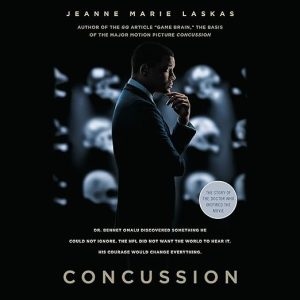
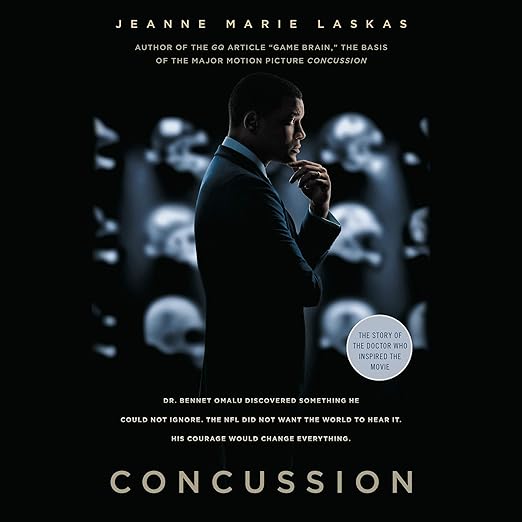
I listened to Concussion during a long drive through western Pennsylvania, which felt appropriate given that the story is rooted in Pittsburgh and in what the game of football means to that city. Jeanne Marie Laskas is a gifted narrative journalist, and this audiobook, narrated by Hillary Huber, is the fully realized version of the GQ story that first introduced the world to Dr. Bennet Omalu. By the time I reached the Pennsylvania state line I had already been listening for several hours, and I found it genuinely difficult to stop at the gas station. The book has that quality of tightening its grip the longer you stay with it.
The premise sounds narrow: a forensic pathologist examines the brain of a deceased former football player and makes a discovery that the NFL would spend years trying to suppress. But the scope of what Laskas has written is considerably larger than that. This is simultaneously a portrait of an immigrant's encounter with American ambition and disillusionment, an account of institutional corruption operating in plain sight, and a medical mystery whose stakes turn out to be enormous. Huber's narration handles all three registers with skill, modulating between the personal warmth of Omalu's story and the cold procedural anger of the NFL chapters.
How Concussion Holds Up
The character of Bennet Omalu is the book's greatest achievement. Laskas first met him in 2009 while reporting the GQ story, and the relationship between reporter and subject has clearly produced a level of access that allows for real psychological depth. Omalu came to America chasing the dream from Nigeria, carrying wounds from civil war, and motivated by a deeply spiritual conviction that the dead deserved to have their stories told. When he received the body of Mike Webster, the former Pittsburgh Steelers center who had spent his final years tasering himself to manage pain and fixing his rotting teeth with Super Glue, Omalu refused to treat the case as routine.
What he found in Webster's brain, the protein deposits now known as chronic traumatic encephalopathy, was the one truth the NFL was most motivated to ignore. Laskas is careful and rigorous about the science without losing sight of Omalu's emotional and moral experience. Reviewer majorfan described the book as simultaneously an immigrant story, a big business story, and a story about American heroes destroyed by the institution that celebrated them. That triangulation captures something essential about why this book works: each thread is substantial enough to carry the narrative on its own, and together they create something harder to dismiss than any single framing would be.
Why Concussion Works as an Audiobook
The chapters dealing with the NFL's response to Omalu's findings are where the book becomes most uncomfortable for anyone who has not followed this story closely. Laskas draws a deliberate comparison to the tobacco industry's documented suppression of health research, and the parallel holds up under examination. The league's strategy involved publishing rebuttals in scientific journals, applying pressure through official channels, and publicly questioning Omalu's credentials and methods, all documented in enough detail to be genuinely damning in its cumulative effect.
Reviewer Rose Richards noted that even readers without strong interest in football will find this portion compelling, because what it describes is the predictable behavior of a wealthy institution protecting its product at the expense of the people who generate its revenue. That observation points to the book's secondary moral argument: not just that CTE is real, but that the players were failed by everyone who profited from watching them absorb blows, and that accountability has arrived slowly and incompletely. Laskas's restraint in pressing that argument too forcefully actually makes it land harder than if the book were more explicitly polemical.
Weak Spots in Concussion
Hillary Huber has one of the more distinctive voices in audiobook narration, with a clarity and gravity that serves serious nonfiction well. She does not attempt to render Omalu's Nigerian accent, which is a wise choice: the goal is comprehension and emotional truth rather than performance. What she does capture consistently is the tonal range the material demands, moving between the lyricism of Laskas's descriptive passages and the tighter, more precise language of the medical and legal sections. The ten-hour runtime passes without the narration becoming monotonous, which is a meaningful achievement for procedurally dense material.
The book's pace slows somewhat in the middle sections as Laskas accumulates evidence of the NFL's institutional resistance. Some listeners have found this portion less propulsive than the opening chapters. Those sections are, however, doing important structural work: the accumulated weight of documented obstruction is what makes the moral argument stick rather than evaporate after the listening session ends. A shorter version of this story would be less outrageous and therefore less honest about what actually happened over decades of deliberate suppression.
Who Should Listen to Concussion
Listeners who saw the Will Smith film adaptation should understand that the book provides considerably more depth, both on Omalu's inner life and on the documented institutional behavior of the NFL. The film's compression necessarily simplified the story, and Laskas's original account is more complex and more unsettling in its implications. Anyone interested in sports, public health, institutional power, or immigration will find the book rewarding on its own terms. At 4.4 stars across nearly a thousand ratings, the book has reached readers across the full spectrum of initial sympathy toward football, and it has persuaded many of them of something they did not expect to believe when they started listening.