- Read by: Jack Calihan handles the dark romantic material with appropriate intensity, giving Marcus a menacing authority that does not tip into parody.
- At its heart: Dark romance, power imbalance, captivity and coercion, redemption arc
- Vibe: Intense and immersive, demanding rather than comfortable
- Short version: A complete dark romance trilogy that delivers exactly what its premise promises, for readers who know the genre's conventions and come to it with open eyes.
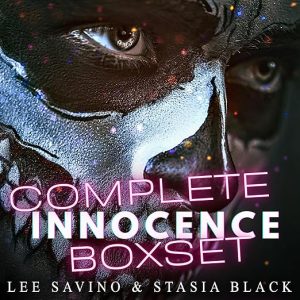
There is a conversation that anyone reviewing dark romance has to have at some point, and I might as well have it at the beginning. The Complete Innocence Boxset is not trying to depict a healthy relationship. Cora is held captive. Marcus is a criminal underworld figure who kidnaps her and calls it a love story. The boxset includes a note warning readers about dark and intense sensual scenes, which is accurate but understates the nature of what Stasia Black is doing with the power dynamics at the center of this trilogy. I am going in with those facts on the table, because readers who pick this up knowing what it is will have a fundamentally different experience from those who do not.
With that said: within the context of what dark romance as a genre is attempting, Black does it well. The plotting across three books is tighter than most boxsets of this length, the emotional arc between Marcus and Cora is genuinely developed rather than simply asserted, and the secondary cast, particularly a character named Sharo who multiple reviewers singled out as a standout, adds dimension to a world that could easily feel like a two-character sketch extended over twenty-seven hours.
First, the Big Picture
The trilogy's central challenge is making Marcus's evolution from predator to protector feel earned rather than convenient. Black's mechanism for this is Cora's specific history. Cora has grown up in total isolation on a farm, raised by an abusive mother who kept her from all contact with the outside world. She arrives in the city without a birth certificate, without a social security number, and without any established relationships that could be threatened or used. This is not coincidental: Black is establishing why Cora's captivity has a different texture than a simple abduction story would have.
The connection to Marcus's own history, the revenge for his sister that drives his initial obsession with Cora, is revealed gradually across the three books, and the revelation that Cora resembles the woman who tormented his sister creates a dynamic that Black navigates more carefully than the setup might suggest. It is not comfortable material, but it is purposeful rather than arbitrary, and that distinction matters to whether the arc earns its eventual resolution. One reviewer described herself as totally falling in love with the characters, particularly Sharo, in ways she did not expect given the darkness of the premise.
The Best Parts of Complete Innocence Boxset
The most common criticism in the reviews is the length of the separation between Marcus and Cora in the middle sections of the trilogy. One reviewer noted that extended sequences where Cora works through the Iris mystery largely alone, without Marcus, created passages that felt thin and that invited skimming. This is a fair observation about the trilogy's structural weakness: Black is a skilled writer of intimate tension between her two leads, and the moments when that tension is suspended for extended plot work reveal how much of the book's energy comes from their dynamic specifically.
At twenty-seven hours, the boxset is a substantial commitment, and it rewards listeners who can sustain investment across the full arc rather than those who expect consistent intensity throughout. The payoff in the final sections of the third book is, according to multiple reviewers, worth the slower middle passages. But knowing going in that the second book in particular can feel extended will help manage expectations for what is, at its best, a genuinely absorbing trilogy.
A Few Reservations
Dark romance is a narrator's test. The male lead in a captivity narrative has to be voiced with enough menace to make the power dynamic legible while maintaining enough interiority that the character's eventual vulnerability is believable. Calihan gets this balance right more consistently than many narrators assigned to this material. His Marcus is genuinely threatening in the early sections without becoming cartoonishly villainous, and when the character's own damage begins to surface, the transition feels continuous rather than arbitrary.
The female perspective, which is how Cora's sections are written, is handled with more care than you might expect. Calihan does not attempt to feminize his voice, which would be a mistake, but he modulates his delivery for Cora's sections in ways that communicate interiority and emotional texture rather than just external action. This is the kind of subtle calibration that makes a twenty-seven hour commitment feel sustained rather than exhausting.
Who Should Listen to Complete Innocence Boxset
This trilogy is designed for readers who are already fluent in dark romance conventions: non-consent elements, morally compromised heroes, and possession as love language are all present throughout, and they are presented with genre earnestness rather than critical distance. New readers who are not already comfortable with these elements should know what they are entering before they start.
For readers who like this genre and are looking for something that delivers the emotional peaks while building out a genuinely complex secondary world, the Complete Innocence Boxset earns its length. The criminal underworld that Black constructs around Marcus has internal logic and specific texture, and the cast surrounding the central couple is more substantial than the boxset format typically produces. The ending satisfies, which in a three-book commitment is not always guaranteed. What keeps the trilogy from feeling merely transgressive is Black's commitment to giving both characters genuine interiority rather than reducing either to a function of the other's arc.
Does the Complete Innocence Boxset contain non-consensual content, and how explicit is it?
Yes. This is a dark romance trilogy with captivity as its central dynamic, and non-consensual elements are present throughout. The sensual content is described as dark and intense in the publisher's own note, and the power imbalance between Marcus and Cora is the book's foundational premise rather than a temporary obstacle. Readers who prefer romance without these elements should choose a different title.
Is it necessary to have read other Stasia Black books before starting this trilogy?
No. The Complete Innocence Boxset is a self-contained trilogy, and no prior familiarity with Black's other work is needed. The boxset collects all three books in the story, from Innocence through Awakening to Queen of the Underworld, so everything required to follow the arc is included.
How does the pacing hold up across 27 hours? Are there significant slow sections?
The middle of the trilogy, particularly extended sections of the second book where Cora works through a subplot largely separated from Marcus, is the most commonly cited pacing issue. Multiple reviewers mentioned that these passages invited skimming or a reduction in pace. The first and third books are more consistently intense. Knowing this in advance helps set expectations for a long-form commitment.
Is the ending of the trilogy satisfying, or does it leave threads unresolved?
The trilogy has a complete ending that resolves the central Marcus and Cora arc. Several reviewers mentioned that the story is emotionally satisfying even at its conclusion, though the world Black creates leaves room for further stories involving secondary characters. At least one reviewer noted that there may be additional material set in Marcus's underworld world.