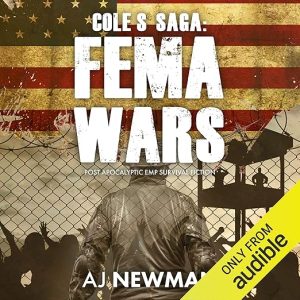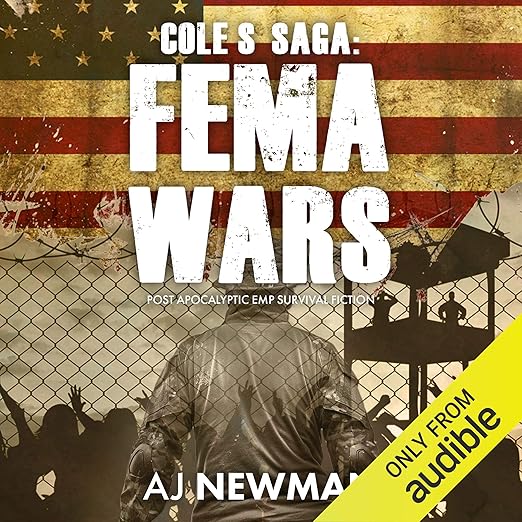
Cole's Saga: FEMA Wars is the second book in AJ Newman's Cole's Saga series, and it has the properties that make second entries in post-apocalyptic survival fiction either satisfying or frustrating depending on your expectations. The first book established the world, the characters, and the primary antagonism, a FEMA apparatus that has become something close to a slave state in the power vacuum after an electromagnetic pulse event. This installment picks up directly from that setup and delivers what the series promises: movement, conflict, loss, and Cole trying to hold his group together on an increasingly perilous journey toward Oregon.
Newman's premise is not unusual for the EMP subgenre. The grid is down, civil authority has collapsed into something worse than absence, and a small group of survivors with various skills and competing personalities have to navigate a landscape full of criminals, ideologues, and a FEMA organization that plans to rebuild civilization under its own control using forced labor. What Newman adds is the soap-opera texture of the personal relationships, Cole's marriage to Gemma after the events of book one, the ongoing friction with Jack who second-guesses every decision, and the accumulating losses that the synopsis describes as a personal tragedy this time around.
What We Made of It
Newman writes with the priorities of someone whose audience reads for plot and character rather than for prose. The sentences do their job and move on. A reader who identified themselves as a recreational reader rather than a critic noted they could see where they would want to offer gentle corrections, but that they enjoyed the interplay between characters and kept reading anyway, which is an honest description of what Newman delivers. The dialogue is workmanlike but functional. The action sequences are paced well. The survival details, the practical logistics of moving a wounded group across hostile territory, have enough specificity to feel grounded without becoming a gear-catalog exercise. One reviewer with background in the genre specifically praised Newman's unique point of view within the SHTF subgenre, which is a fair observation. He is not trying to be Cormac McCarthy. He is trying to keep you turning pages.
What Makes Cole's Saga: FEMA Wars Worth Hearing
Kevin Pierce narrates with a dependable plainness that suits the material. Cole is not a florid character, and Pierce does not treat him like one. The narration keeps pace with Newman's plotting without adding unnecessary emotional interpretation. For listeners who have followed the series from book one, which is where you should start if you are coming to this fresh, the audiobook format suits the binge-friendly, episodic quality of the saga. The FEMA-as-antagonist premise is efficient in audio because Pierce can deliver the institutional menace without lingering on it; the horror of what FEMA is doing lands quickly and the story moves on, which is the right balance for this kind of fiction.
What Might Not Land
A reviewer specifically noted frustration with an amnesia plot device that appears mid-series, and with twins being used as interchangeable romantic partners, both of which are narrative shortcuts that readers who prize internal consistency will find grating. Newman is not meticulous about consistency across installments, which is a genuine limitation. The series also wears its politics overtly; the FEMA-as-authoritarian-threat premise will land very differently depending on your relationship to government and emergency management institutions. This is not subtle political fiction, it operates in the tradition of survivalist genre that treats federal authority as inherently suspect, and that premise is built into the DNA of every plot choice.
The Right Listener for Cole's Saga: FEMA Wars
Start with the first book. Newman's saga is designed to be consumed in sequence, and arriving at FEMA Wars without the prior character investment undercuts the personal tragedy that this installment hinges on. For fans of the EMP survival subgenre, James Wesley Rawles, A.G. Riddle's survival-adjacent work, or similar, Newman offers a more romance-inflected version of the formula, which one female reviewer specifically noted made the series more accessible than the genre average. Skip it if you need your post-apocalyptic fiction to be ideologically complex; Newman is working with a clear moral framework that is not interested in complicating itself. Embrace it if you want a fast-moving, character-driven survival story where losing people actually costs something.