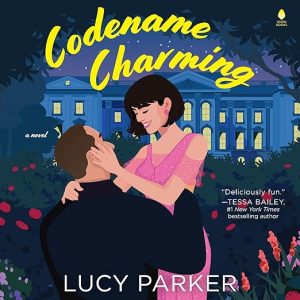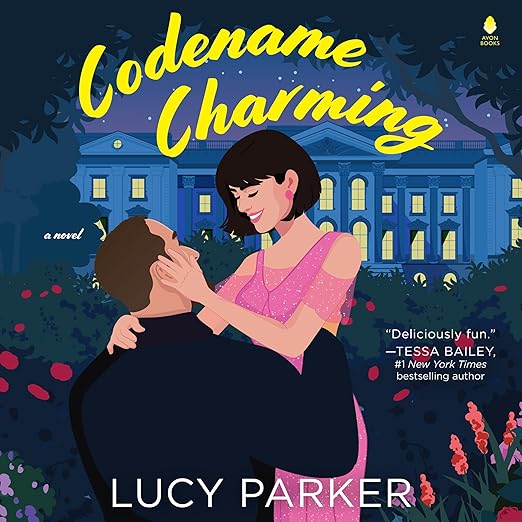
I came to Lucy Parker through Act Like It years ago and have followed her career with consistent enjoyment, which means I came to Codename Charming with specific expectations and real stakes for whether it would meet them. It did. Parker is one of the few romance writers working today who can sustain genuine wit across twelve-plus hours of audio without the humor curdling into something merely clever or, worse, cynical. Codename Charming follows Petunia De Vere, known as Pet, and the very large, very stoic royal bodyguard Matthias Vaughn through a fake relationship that begins for press management reasons and develops into something considerably more complicated.
The setup positions Pet and Matthias at the intersection of a royal household, a tabloid press eager for scandal, and a genuine practical problem: a blurry photograph of Pet with her employer, the lovable bumbling royal Johnny Marchmont, has generated rumors she is his secret mistress. The solution proposed by the royal PR team, that Pet and Matthias stage a fake relationship to redirect the narrative, is the kind of high-concept romantic comedy premise that can either feel contrived or feel inevitable depending on the execution. Parker makes it feel inevitable. The dynamic between Pet's spontaneous warmth and Matthias's rigid containment is established quickly and credibly, and the slow erosion of that containment is the pleasure center of the novel.
Our Take on Codename Charming
What Parker does exceptionally well in this book, better than in many fake-relationship romances, is give Matthias reasons for his emotional walls that are specific and convincing rather than generically tragic. He is not closed-off because he was hurt once; he is closed-off because his entire professional identity is organized around controlled vigilance, and Pet threatens that structure not by being dramatic but by being genuinely, persistently kind. That is a more sophisticated character dynamic than the genre often manages.
The side characters are a genuine strength. Johnny Marchmont is a delight, a royal who causes chaos through pure benign incompetence rather than cruelty, and the extended scene involving a Scottish swearing parrot that one reviewer described with barely-contained joy is, genuinely, one of the funniest set pieces Parker has written. It runs long, as the reviewer noted, and the length is entirely earned. Parker knows how to build comic timing in prose, and this scene demonstrates that at full extension.
Why Listen to Codename Charming
Anne-Marie Piazza is well-cast for this material. Pet is a character who could easily tip into cloying if handled poorly, she is optimistic, enthusiastic, and consistently kind, which in the wrong hands reads as saccharine rather than genuine. Piazza finds the texture of the character's warmth without softening it into sweetness. She also handles the tonal range required here: romantic comedy requires quick movement between funny and tender, and Piazza navigates those shifts without jarring transitions.
At nearly thirteen hours, Codename Charming is a substantial romantic comedy listen. One reader noted the pacing feels occasionally uneven, with some scenes over-developed while others move too quickly. That is a fair observation. Parker is a generous writer, her books tend toward fullness rather than compression, and not every scene pulls equal weight in service of the central romance. Listeners who prefer their romantic comedies tightly edited may feel this in the middle section. The final act, however, earns its emotional resolution without shortcuts.
What to Watch For in Codename Charming
This is the second book in a duology following Battle Royal, and while it works as a standalone, readers who have met the royal newlyweds from that first book will have additional context and affection for their appearances here. Parker writes connected worlds rather than strict series, so knowledge of Battle Royal enriches rather than gates access to Codename Charming.
The minor criticism that the book is too long, one reader described it as ambling, is worth taking seriously if you are someone with limited patience for the extended slow-burn middle section of romantic comedies. Parker gives the relationship time to develop naturally, which rewards patient listeners with a resolution that feels earned rather than rushed. But it does require sitting with some extended scenes of Pet and Matthias awkwardly negotiating their fake relationship before the real feelings clarify.
Who Should Listen to Codename Charming
Lucy Parker readers who have already encountered her voice will need no persuasion here. Readers new to her work who enjoy romantic comedy with genuine wit, who have loved Helen Hoang, Talia Hibbert, or early Sophie Kinsella, will find this a satisfying introduction to her sensibility. The royal setting adds a slightly heightened, self-aware quality to the material that suits Parker's brand of humor well.
If you dislike the fake-relationship trope on principle, Codename Charming is unlikely to convert you, the trope is the engine here, and Parker does not subvert it so much as execute it very well. But if fake-dating done right is the kind of romantic comedy you love, this is close to the best version of it currently available in audio.
Before You Listen
How does Anne-Marie Piazza handle Pet's optimistic, enthusiastic personality without making her feel saccharine?
Piazza finds the genuine warmth in Pet without over-sweetening it, she gives the character energy and specificity that makes the enthusiasm feel like a personality rather than a performance. Listeners who sometimes find relentlessly positive romantic heroines grating will find Piazza's version of Pet more grounded than expected.
The reviews mention a Scottish swearing parrot scene that runs long, is it worth it?
Unanimously, yes. It is the standout comic set piece in the book, and Parker builds it with careful timing. The length is part of the joke, and the payoff is real. Multiple reviewers specifically called it out as the scene they would recommend the book for, which tells you something.
How does Codename Charming compare to Parker's other books, is it one of her stronger entries?
Most readers who know Parker's catalog well place it close to her best work. It has stronger central characters than some of her earlier books and a more developed emotional arc for the hero. Readers who loved Act Like It or The Austen Playbook tend to respond well to Codename Charming.