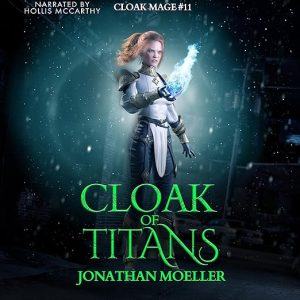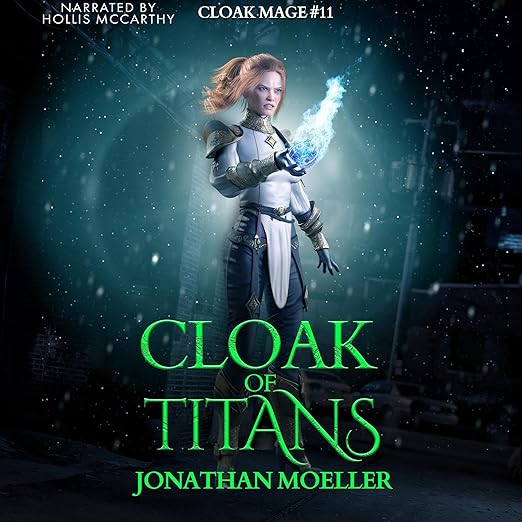
I came to Cloak of Titans without the prior ten volumes of the Cloak Mage series behind me, which is not the recommended approach and is the reason this review is less granular about character history than it might otherwise be. What I can speak to from the outside is the quality of the listening experience on its own terms, and what I found was a novel that communicates its stakes clearly even to the uninitiated, which is actually a harder achievement than it sounds in a series this deep into its run.
Jonathan Moeller writes under a label that some promotional materials describe as pulp fiction, and one of the most perceptive reviews in the available data pushes back on that characterization in a specific and interesting way. The reviewer who wrote that Moeller has left pulp fiction behind with this story is pointing at something real. Cloak of Titans operates with a complexity of political setup and moral consequence that transcends the pulp model, while retaining the propulsive readability that made the series popular. That combination is not common and it is not easy.
The premise, as Nadia narrates it directly to the reader, is layered. A rebel Elven noble pushes past a threshold, civil war threatens between the High Queen and the nobility, and the entire crisis turns out to be engineered. The wizards of Singularity, who have apparently been working toward this moment across a very long timeline, have built the civil war as a trap and their weapons are now ready. This is the kind of climactic architecture that only works if the prior books have been doing structural preparation for it, and the reviews suggest they have been. The payoff of a well-executed long setup is a specific and satisfying thing to listen to, and the reactions from series readers here suggest this is what Cloak of Titans delivers.
Hollis McCarthy's narration of Nadia's first-person voice is a significant part of what makes the book work in audio. Fantasy novels with ensemble casts and political complexity can collapse in narration if the voice does not carry authority. McCarthy's Nadia is clear, purposeful, and emotionally calibrated: the voice of someone who understands the stakes and is not pretending otherwise. The reviewer who found the climactic battles reaching a new level of skill is pointing at what happens when good writing meets good narration in a sequence that demands both.
The Best Parts of Cloak of Titans
For listeners already in the Cloak Mage series, the answer is self-evident: this is reportedly where the long buildup pays off at scale. Multiple reviewers describe it as the strongest entry in the series, and the specific mention of Nadia's torment in what one reviewer calls the Eternity Crucible as among the most difficult if not brilliant writing they have encountered carries real weight. That kind of claim about a specific scene, from a reader who had invested in ten prior volumes, is the kind of testimony that tells you whether an author has earned their climax.
For the broader Moeller readership, this book also represents an interesting data point about what happens to a prolific genre writer who keeps pushing the ceiling of their own work. Moeller is known for output and reliability; this series apparently shows him also pushing for depth. The combination of those qualities in an eleven-volume series is worth paying attention to.
Weak Spots in Cloak of Titans
This is emphatically not an entry point. All five reviews in the available data assume full familiarity with the world, the political landscape, and the character relationships. Nadia's role as a human Marshal in Elven politics, her history with specific characters, and the nature of the Singularity threat are referenced without explanation. Coming in at book eleven would be disorienting regardless of the novel's individual quality.
The first-person narration is also worth noting as a structural choice. Nadia tells her own story, which means everything in the novel is filtered through her perspective and the gaps in her knowledge. Listeners who prefer omniscient narration or wider political perspective will be working within those constraints throughout.
The Right Listener for Cloak of Titans
Readers who have followed the Cloak Mage series through its first ten volumes will find this the installment that multiple reviewers describe as the series' high point. Those unfamiliar with the series should start at book one. Genre readers interested in political fantasy that takes its own worldbuilding seriously, and who are willing to commit to a long series to reach this point, will find the series described by its most enthusiastic readers as worth that investment. Anyone looking for a standalone fantasy experience at this level of complexity and political depth should look elsewhere; the payoff here is explicitly a function of the accumulated context.
The Short Version
- Narrator: Hollis McCarthy narrates Nadia's first-person voice with authority and urgency, making the political complexity accessible without flattening it.
- Subjects: Power and responsibility, civil war as engineered trap, loyalty tested by revelation
- Tone: Tense and escalating, with the propulsive quality of a series approaching its reckoning
- Bottom line: A standout entry in the Cloak Mage series that delivers on the promise of its long buildup and raises the stakes for everything that follows.
Is Cloak of Titans accessible to readers who have not read the prior ten Cloak Mage books?
No. The novel assumes complete familiarity with the world, the political landscape, the character histories, and the nature of the Singularity threat. All five available reviews are written by readers deep into the series, and nothing in the novel re-establishes context for newcomers.
What makes this installment stand out compared to the earlier Cloak Mage books?
Multiple reviewers identify it as the strongest entry in the series, with the long-running setup against Singularity reaching a climactic payoff. One reviewer specifically singles out a sequence called the Eternity Crucible as among the most difficult and brilliant writing they have encountered in the series.
How does Hollis McCarthy's narration handle the political complexity and first-person voice of the novel?
Very effectively, based on reviewers' responses to the overall experience. McCarthy renders Nadia's first-person narration with authority and emotional clarity, which is essential for a novel that filters all political and military complexity through a single perspective.
Does Cloak of Titans resolve the series' main conflict with Singularity, or does it continue building toward a future installment?
Based on the synopsis and reviewer responses, this novel brings the Singularity conflict to a major confrontation rather than a complete resolution. Reviewers express eagerness for the next entry, suggesting significant threads remain open even after this installment's climax.