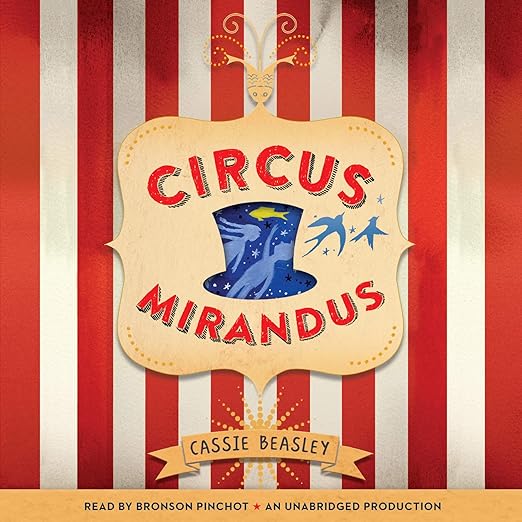
Some children's books contain a particular kind of grief that adults recognize more completely than children do the first time through. The dying grandfather, the magical promise made decades ago, the child who believes with a ferocity that the world around him does not support: these are not merely plot elements in Circus Mirandus by Cassie Beasley. They are the load-bearing structure of a novel that is, among other things, about what it costs to hope when hope seems unreasonable to everyone watching from the outside. This audiobook, narrated by Bronson Pinchot, brings that structure forward with a performance that is among the most distinctive in children's audio currently available.
Micah Tuttle is the kind of boy whose belief in his dying grandfather's stories is presented not as childish credulity but as a form of loyalty and love that the narrative takes entirely seriously. Grandpa Ephraim has told him for years about the Circus Mirandus - the invisible tiger at the gates, the birdwoman, the Lightbender - and Micah's faith in those stories is the moral center of the book. When the Circus turns out to be real, the discovery does not resolve his problem; it opens it fully and makes the stakes higher. The Lightbender owes Ephraim a miracle, and the Lightbender does not want to pay. What Micah does with that refusal is the heart of the story, and it is where the book becomes genuinely moving.
Beasley's Magic Is Bound to Real Cost
Cassie Beasley positions her debut within a recognizable tradition - Roald Dahl's combination of wonder and darkness, the atmospheric magic of Erin Morgenstern's circus world, the emotional sincerity of classic fantasy - and earns her place in that company without merely imitating it. The world of Circus Mirandus is specific and strange in ways that feel invented rather than borrowed from prior sources. The Lightbender's power and its relationship to perception and reality; the invisible tiger's role at the threshold; the way magic in this world is bound to cost rather than to wish-fulfillment: these choices give the story genuine philosophical weight that lingers after the final chapter.
Bronson Pinchot's performance in this audiobook is the kind that becomes inseparable from a book in the memory. The range of character voices he manages - from Micah's earnest urgency to the Lightbender's weary grandeur to the awful practicality of Aunt Gertrudis - is wide without being caricatured. The emotional precision of his reading in the scenes between Micah and his grandfather is remarkable: he holds the tenderness without allowing it to tip into sentimentality, which is exactly the control the material requires. Reviewer ChristusG, who read this aloud to children ranging from six to thirteen, notes that it opened great conversations throughout the story. Pinchot's audio performance creates the same conditions.
Pinchot's Two Voices Enact the Book's Central Tension
The case for the audiobook format specifically is strong here. Pinchot's vocal performance adds a layer of meaning that the print edition, however beautifully illustrated, cannot fully replicate. The distinction between Micah's voice and the Lightbender's is not just a narrator's trick; it enacts the book's central tension between youth and age, belief and resistance, the urgent and the ancient. Listening to that distinction performed makes it felt rather than merely understood, and the difference between those two experiences is considerable.
For family listening in particular, this audiobook occupies a rare position. Reviewer Lisa Tobleman describes it as classic escapism fantasy, and that is accurate, but it is escapism with genuine substance - the kind that generates the conversations ChristusG mentions. The emotional questions Beasley raises about promises, about the relationship between belief and action, about what courage looks like when the outcome is uncertain: these are worth discussing, and Pinchot's performance creates the conditions in which that discussion feels natural and necessary.
Grandpa Ephraim's Death Gives the Story Real Weight
The book has genuine sadness in it. Grandpa Ephraim is dying, and the miracle Micah seeks does not arrive in the form he expects or hopes for. Younger listeners should be prepared - or rather, should be accompanied by adults who can sit with them in the difficult moments, which are not gratuitous but are real and earned by the story's emotional work. Reviewer Christi Cassel, comparing this to The Night Circus, is identifying something accurate: both books deal with a magic that is not whimsical but consequential, that has weight and cost and does not resolve without sacrifice.
At six hours and nineteen minutes, the pacing is measured rather than rushed. Beasley takes time with the atmospheric building - the description of the Circus, the gradual revelation of its particular rules - that pays off substantially in the emotional resonance of the later chapters. Listeners accustomed to faster-moving adventure stories may initially find the tempo contemplative. It is worth the patience required to let the world accumulate around you.
Readers of Diana Wynne Jones Will Feel at Home
Children from approximately eight to twelve will find this audiobook at exactly the right level of challenge and emotional engagement. Adults who love children's literature as a form - who read Diana Wynne Jones or Lloyd Alexander or Patricia McKillip with the same seriousness they bring to adult fiction - will find this a peer without reservation. Family listening situations where parents and children can discuss the themes are the ideal context, though solo listeners of any age will find the story complete and genuinely moving on its own terms.
Young listeners who want primarily action and adventure may find the reflective pacing and emotional themes slower than their preference and less immediately satisfying. But Beasley is not writing that book. She is writing a story about grief, hope, and the specific courage of someone who refuses to stop believing when the world offers them every reasonable excuse to stop. That is a different and rarer thing, and Pinchot's performance honors it completely and with obvious investment.
Is this audiobook appropriate for children who are sensitive to themes of death and loss?
The book deals honestly with a grandfather's illness and death. The themes are treated with tenderness rather than shock, but families with children who find those subjects difficult may want to listen together rather than having younger listeners engage with the audiobook alone.
How does Bronson Pinchot's narration compare to the experience of reading the print edition?
Pinchot adds a layer of meaning that the print edition cannot fully replicate. His character voice range and emotional precision - particularly in scenes between Micah and his grandfather - make this one of the stronger cases for preferring the audiobook version over reading.
Is Circus Mirandus a standalone audiobook, or does it require other books in a series?
It is a complete, standalone story with its own resolution. It is not the first volume of an ongoing series; the narrative is fully contained within this single audiobook.
What age range is this audiobook best suited for in terms of emotional readiness and comprehension?
Ages eight through twelve represent the core audience, though reviewer ChristusG found it successfully engaged children from six to thirteen in a family listening context. The emotional themes are genuinely present rather than sanitized, which is what makes it meaningful rather than forgettable.