At a Glance
- Read by: Stephen Perring holds the credit line, while the description names three further readers on the same production
- At its heart: Accidental heroism, military comedy, propaganda against memoir, an aide who steals every scene
- Vibe: Wry and episodic, gallows humor inside a genuinely hostile galaxy
- Short version: The funniest corner of Warhammer 40,000, sold on a listing that undercounts its own cast.
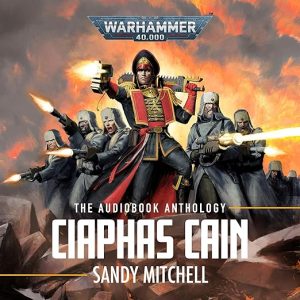
Warhammer 40,000 fiction usually arrives at maximum volume, and Ciaphas Cain is the franchise's standing joke about that. A commissar celebrated across the Imperium as a hero, whose own archived account makes plain that he was mostly trying to stay alive, honored in propaganda pieces that everybody except him believes. This audiobook gathers thirteen short stories and one novella of exactly that, presented as usual by Inquisitor Amberley Vail, back in the Cain archive and picking out the strangest entries in it.
The Review
Comedy in this setting works by contrast, and Sandy Mitchell has been running the same reliable machine for years. Brave, stalwart, uncompromising, cool under fire: the official description of the man, followed immediately by the question of whether any of it is true. Cain flees, improvises, takes credit he did not earn, and keeps arriving at unlikely victories in the galaxy's worst warzones. The gap between the legend and the memoir is the entire comic engine, and it never stops producing. What keeps the joke from wearing out across a whole anthology is that the cowardice is genuinely competent: Cain survives because he is good at reading a room, which is a skill the Imperium does not otherwise value.
michael m. identified the collection's actual center of gravity in a ten-word five-star verdict: fun, funny, love Cain, but Jurgen is the real MVP. Anyone who has spent time with these stories will nod along at that assessment. The aide is the running gag that has outgrown its own premise, and several pieces here work because of what the aide does rather than what the commissar claims to have done.
Cain's account is written in the first person and presented by somebody else, which is a structure that suits a spoken format unusually well. A man telling you what really happened, wrapped inside a document another character has assembled and annotated, sits closer to a found-recording format than to a conventional novel. The layering gives the reading two distinct registers to work with before a single character speaks.
Why Listen to Ciaphas Cain: The Anthology
Rebekkah Watkins arrived expecting the usual, found something else, and left five stars, admitting to surprise that a Warhammer book contained so many happy stories and interesting characters. That reaction is the best argument for this collection. Warmth is genuinely scarce in this setting, and Mitchell supplies it without abandoning the grimness that makes the setting recognizable in the first place. Camaraderie between soldiers who expect to die badly turns out to be a rich vein, and the short form suits it, since a friendship can be established and paid off inside a single story.
Thirteen stories and one novella cover a remarkable amount of ground. Old Soldiers Never Die anchors the collection, and around it sit pieces including Fight or Flight, The Beguiling, Echoes of the Tomb, Sector Thirteen, A Mug of Recaff, The Only Good Ork, and Rotten to the Core. The situations range from a warp-tainted infection threatening to overwhelm the world of Lentonia with a starving horde of undead, to Cain's early years with the Valhallan 12th fending off a tyranid invasion on a barren mining world.
Horror sits underneath most of the humor, and that is why the humor lands. A commissar murdered by an unknown hand, with the killer's attention turning toward Cain next, is not a comic setup on paper. Mitchell plays these as genuine threats and lets the comedy come from one man's transparent self-interest inside them, which is a far harder trick than parody and considerably more rewarding. Parody would require the threats to be fake, and here they never are.
The Caveats
RC TK, at four stars, raised the collector's objection: most of these stories have been printed elsewhere, and only a few are available exclusively here. The listing does not say which is which, so anyone who already owns earlier Cain collections is buying partly blind. For newcomers the point is irrelevant, and for completists it may be the deciding factor, which makes the omission an unhelpful one. A contents list appears on the page, so the information needed to check for overlap is partly available, but only to somebody who already knows what they own.
Cast credits are the second problem, and this one is squarely on the listing. The narration credit shows Stephen Perring alone, while the description printed directly beneath it states that the recording features Perring together with Penelope Rawlins, Emma Gregory, and Phillipe Bosher. Four readers, one credited. A production that puts distinct voices behind Cain, his aide, and the inquisitor framing the whole thing has made a real casting decision, and the entry conceals three quarters of it.
Runtime is where the page contradicts itself outright. The description closes by stating a running time of approximately six hours and twenty-eight minutes, while the listing itself shows ten hours and twenty-seven minutes. That gap is far too wide to be a rounding error, and nothing explains which figure describes the product on sale. The shelving is odd too: general fiction and short stories rather than science fiction, on a series line carrying no volume number.
Should You Listen to Ciaphas Cain: The Anthology?
Leo Deriada's five-star verdict calls it a great entry point into the setting, and that holds up. Short pieces demand less commitment than a novel, the jokes work off military bureaucracy rather than deep lore, and a listener who could not tell an ork from an eldar will still follow a story about a man trying to avoid being sent somewhere dangerous. Curiosity about the universe is enough.
Purists who want their far future unrelieved should skip this without hesitation, because Mitchell is laughing at the whole apparatus. Anyone tracking chronology will also find the anthology frustrating, since the stories jump across Cain's career with no regard for order. And the jargon does arrive fast, commissar, Imperium, tyranid, warp, with no glossary offered to anyone who wants one. Context does most of the work, but a listener allergic to invented vocabulary should sample before committing.
Underneath the jokes is a book about how institutions manufacture heroes, which is a sturdier subject than the packaging suggests. Cain survives, the legend grows, and the archive keeps the truth for later. Buy it for the stories, which remain the most purely enjoyable thing this franchise produces, and treat the credit line as a puzzle somebody else can solve.