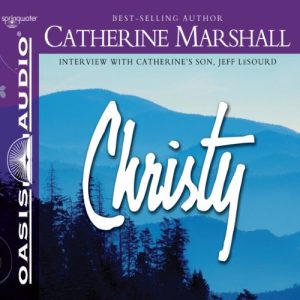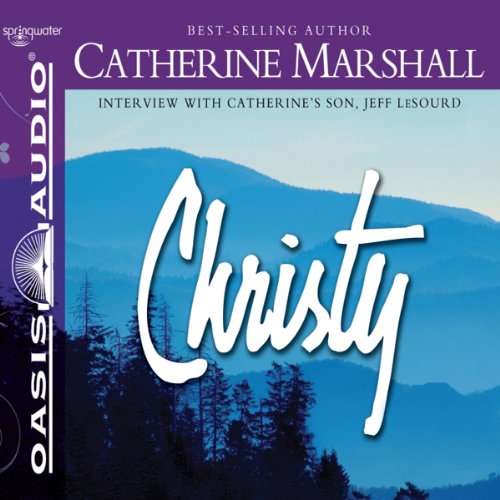
I came to Christy later than most. I had heard Catherine Marshall's name for years in the context of beloved faith-based fiction, but I only finally sat down with Kellie Martin's narration on a long drive through rural Tennessee - which, in retrospect, was almost too fitting. Something about watching the Smoky Mountains roll past the window while Christy Huddleston rode into Cutter Gap for the first time made the whole listening experience feel staged by the universe. By the time I pulled over for coffee, I had already decided I wasn't stopping until it was done.
Christy was published in 1967, based loosely on the experiences of Marshall's own mother, Leonora Whitaker, who left her comfortable home in 1909 to teach in the Appalachian highlands. The fictionalized version gives us Christy at nineteen - impulsive, earnest, and thoroughly unprepared for the poverty and complexity she finds in the mountain communities. What could easily become condescending social fiction instead becomes something richer: a portrait of a young woman whose assumptions are dismantled one by one, and who grows into genuine empathy rather than pity.
The Review
Marshall's great achievement here is that Cutter Gap is never romanticized. The mountain families carry fierce pride alongside real hardship, and their suspicion of outsiders has been earned by generations of exploitation. Christy's early impulse to fix things runs headlong into a world that doesn't need fixing so much as it needs someone willing to stay. That distinction, quietly made across the novel's middle sections, is what elevates Christy above the missionary-memoir mode. The characters she encounters - the shrewd and compassionate Dr. MacNeill, the idealistic minister John Wood, the fearsome Aunt Beecher - are genuinely three-dimensional. Reviewer "mourning dove" called them "true to life," which lands exactly right.
The faith element is central but not coercive. Christy's spiritual development is tested, not preached. She arrives with the certainty of youth and leaves each chapter a little less sure of easy answers. That intellectual honesty about doubt is part of why this novel has outlasted so many contemporaries in its genre.
What Makes Christy Worth Hearing
Kellie Martin, best known to many listeners as an actress, turns out to be a quietly excellent audiobook narrator. Her voice suits the 1912 setting without affectation, and she handles the Appalachian dialect with care - not caricature. The real test in narrating Christy is the internal monologue, which Marshall writes extensively and with psychological depth. Martin moves between introspection and dialogue cleanly, and her performance of the emotionally difficult passages - particularly the scenes involving violence and illness - is restrained in exactly the right way.
At nineteen hours and two minutes, this is a substantial listen, but the pacing of Marshall's prose actually rewards the audio format. The long descriptive passages that might slow a reader's eye translate naturally to the ear, giving the Smoky Mountains time to accumulate as a presence in the story.
The Caveats
One review flagged that readers who come to this book expecting nonfiction may feel misled, and that is a legitimate caution worth repeating. Marshall wrote Christy as a novel, fictionalizing her mother's true story, and the emotional resolution is shaped accordingly. The book ends without the full romantic closure some readers expect - deliberately, it seems, since Marshall did not live to write the planned sequel that would have resolved the question of which man Christy ultimately chooses. That ambiguity bothers some listeners and resonates deeply with others. Know before you start that this is not the kind of story that wraps everything in a bow.
There is also a tonal shift in the final third as the spiritual themes intensify. Listeners less interested in the faith arc may find the later chapters more demanding than the vivid social realism of the opening. Marshall earns most of it, but the shift is real.
Who Should Pick Up Christy
This audiobook is well suited for listeners who appreciate character-driven historical fiction with a genuine spiritual dimension, particularly those drawn to the American South or to coming-of-age stories that take their protagonist's interior life seriously. It works well for fans of novels like Olive Kitteridge or Peace Like a River - books where faith and doubt coexist without resolution. Listeners looking for a fast-paced thriller or a light romance will find the nineteen-hour runtime a harder commitment. Those who already love this novel and are discovering it in audio form for the first time will find Kellie Martin's narration a worthy companion to Marshall's text.
- Read by: Kellie Martin brings a youthful warmth to Christy Huddleston that fits the character's nineteen-year-old idealism without tipping into naivety - her voice holds just enough gravity for the harder passages.
- At its heart: Faith under pressure, social justice and poverty, coming-of-age in an unfamiliar world
- Vibe: Warm and earnest, with stretches of real emotional weight
- Short version: A deeply felt classic of Christian fiction that earns its reputation through character depth and a richly rendered Appalachian setting.
Does Kellie Martin handle the Appalachian dialect well in her narration?
Generally yes. Martin approaches the regional dialect with care rather than broad caricature, which suits the novel's respectful treatment of mountain culture. Some listeners may notice occasional inconsistencies across the nineteen hours, but the overall performance is warm and tonally appropriate.
How prominent is the Christian faith element in Christy?
It is central to the story but not heavy-handed. Christy's faith is tested rather than celebrated, and Marshall engages honestly with doubt and disillusionment. Listeners who are not religious but enjoy stories about moral growth and spiritual questioning will find the faith element integrated into the character development rather than imposed on top of it.