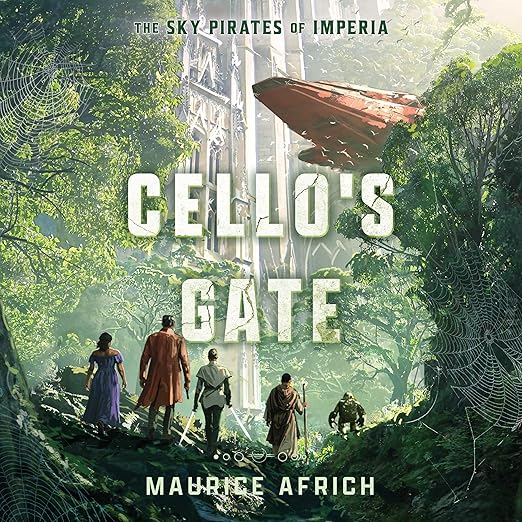
Cello's Gate
Audiobook & Ebook

Cello's Gate by Maurice Africh | Free Audiobook

Part of The Sky Pirates of Imperia #1

By Maurice Africh

🎧 20 hours 📘 Simon Maverick 📅 November 3, 2026 🌐 English
🎧 Listen Free on Audible 📖 Read on Kindle

Free 30-day trial · Cancel anytime

About This Audiobook

With a wit to rival Matt Dinniman’s Dungeon Crawler Carl, action on par with Pierce Brown’s Red Rising, and the scope of Tamsyn Muir’s Gideon the Ninth, Cello’s Gate is a rollicking, edge-of-your-seat sci-fi fantasy epic about a ragtag crew of rogues on the hunt for mythic treasure. They did not, however, sign up to save the world.

One crew of sky pirates. Seven mythological stones. A race to find them all.

Captain Grey and his crew of sky pirates have a reputation for doing the impossible. From breaking into high-security military research facilities to conning the iCity elite—there isn’t a lock they can’t pick, a safe they can’t break, or a hidden treasure they can’t find. Until now.

Returning from a harrowing heist involving a neon battery and a trash chute, Grey and his crew are approached by Dalia, the immortal daughter of the infamous ArchGovernor—and she has an offer.

The job? Locate and steal the Stones of Indigo—seven fabled rocks invested with godlike power. The search for the first stone is a bona fide treasure hunt, guided by an ancient map to a deadly, uncharted island that’s protected by a mysterious guardian. The score? One million credits per crew member, per stone. The catch? Well, that’s where things get a little complicated.

The stones don’t exist. They’re a myth. A bedtime story told to little pirates to make them believe that power and wealth are attainable if you just work hard enough.

And to make matters infinitely worse, Grey’s never trusted immortals, and Dalia’s definitely hiding something. Something bad. And if they don’t figure out what it is, it might cost them their lives.

🎧 Listen Free on Audible

Free 30-day trial · Cancel anytime

Quick Take

  • Narration: No narrator listed in the metadata; the audiobook’s 20-hour runtime suggests a significant production, and the quality of the listening experience would hinge on whoever carries this ensemble cast.
  • Themes: Heist fantasy and found family, mythology versus technology, trust and immortality
  • Mood: Fast, funny, and consistently surprising
  • Verdict: A debut that earns its comparison to Dungeon Crawler Carl in energy if not in format, best for readers who want character-driven action fantasy with genuine wit.

I started Cello’s Gate on a Friday evening and found myself still listening at midnight, which is the clearest thing I can say about what this book does well. Maurice Africh is a debut author, and debut fantasy novels of this length, nearly twenty hours in audio form, carry a particular kind of risk: the world isn’t established enough to carry structural weaknesses, and first books often buckle under the weight of their own ambition. Cello’s Gate doesn’t buckle, though it does wobble briefly in places.

The premise is genuinely fun: a crew of sky pirates, led by Captain Grey, a man whose fundamental optimism is one of the book’s great assets, takes a job from Dalia, the immortal daughter of the ArchGovernor, to locate seven mythological Stones of Indigo. The catch is that the stones are generally understood to be fictional. The job is either the score of a lifetime or an elaborate trap, and Grey and his crew spend most of the book discovering which.

Our Take on Cello’s Gate

The comparisons to Dungeon Crawler Carl and Red Rising that appear in the book’s marketing are doing specific work. They’re signals about register and energy rather than claims of structural similarity. Cello’s Gate shares Dungeon Crawler Carl’s irreverent humor and ensemble sensibility, and it shares Red Rising’s willingness to escalate stakes without warning. The Gideon the Ninth comparison is less convincing at the level of prose, but in terms of a complex world delivered with deadpan confidence, there’s something to it.

What Africh does particularly well is make his characters feel like they have histories with each other. Grey’s crew operates with the kind of shorthand that suggests a long working relationship, and the book reveals those histories in the way good ensemble storytelling does: through argument, through assumed knowledge, through the moments when someone makes a decision that surprises everyone else and turns out to make perfect sense. Reviewers who loved this book consistently cited the characters first, which is usually the right priority signal in fantasy.

Why Listen to Cello’s Gate

At twenty hours, Cello’s Gate is a substantial investment. The book justifies that length by actually using it; this isn’t a 600-page fantasy that could have been 400 pages with some editing, though one reviewer made that argument. The world-building is embedded in the action rather than delivered in expository chapters, which is the right approach for an adventure-focused narrative. The iCity elite, the magical research facilities, the uncharted island with its mysterious guardian, all of these are introduced through the crew’s engagement with them rather than through description for its own sake.

Grey as a protagonist is the book’s most considered achievement. The optimistic captain who isn’t blindly so, as one reviewer put it precisely, is a specific character type that’s harder to write convincingly than the brooding alternative. Africh gives Grey genuine strategic intelligence and a capacity for uncertainty that keeps him from becoming a power fantasy.

What to Watch For in Cello’s Gate

One reviewer noted that the opening drops readers directly into action, then goes through a brief period where Africh seems to be finding his narrative voice. That’s accurate. The first fifty or so pages in the equivalent audiobook timeline feel slightly unfocused before the story snaps into coherence. This is a common debut issue, and it resolves itself fairly quickly, but listeners who need to be hooked immediately should know the sustained quality kicks in a bit after the opening.

The multiple point-of-view structure is mostly a strength, giving the ensemble genuine depth, but it does require listeners to track several characters simultaneously from early in the book. This is manageable but worth noting for anyone who prefers single-perspective narration.

Who Should Listen to Cello’s Gate

Fantasy and science fiction readers who want their adventure delivered with real wit rather than po-faced seriousness should find this rewarding. It’s particularly suited to fans of ensemble casts, heist structures, and worlds where magic and technology coexist without either dominating. Listeners who found Dungeon Crawler Carl’s humor clicked with them specifically because it came attached to genuine heart will likely respond similarly here. Skip it if you need your world-building delivered through comprehensive exposition before the action starts, or if 20-hour debuts feel like too much to commit to without an established author behind them.

Frequently Asked Questions

Is Cello’s Gate a complete story, or does it end on a cliffhanger requiring the next book?

The main plot of the stone hunt reaches a significant resolution, but the book is clearly the opening of a series and leaves larger questions about Dalia and the ArchGovernor unresolved. It functions as a satisfying first installment rather than an unfinished fragment.

How does the humor in Cello’s Gate work within an action-heavy fantasy narrative, does it undercut the tension?

The wit is built into the characters and their relationships rather than deployed as comedic asides. Grey’s voice in particular handles humor and urgency simultaneously, which is the sign of a writer who understands how people actually talk under pressure.

The synopsis compares Cello’s Gate to three acclaimed authors. Is that a fair characterization or publisher marketing?

The comparisons are aspirational but not dishonest. The Dungeon Crawler Carl energy comparison is the most apt. Readers expecting line-by-line prose equivalence to Pierce Brown or Tamsyn Muir will be disappointed; readers using those names as genre signals for tone and ambition will find the comparison reasonable.

Does the multiple point-of-view structure make the audiobook harder to follow than a single-narrator story?

It requires attention in the early chapters to establish who each character is, but Africh differentiates his POV characters distinctly enough in voice and concern that the transitions become easy fairly quickly.

Ready to listen?

🎧 Listen to Cello’s Gate for free

Free 30-day trial · Cancel anytime

What Listeners Are Saying

★★★★★

The most fun I have had reading in a long time!!

WOW. Cello’s Gate by Maurice Africh completely blew me away. I loved this book so much and genuinely did not want it to end. The easiest 5 stars I've ever given.From the very beginning, I was fully immersed in the world, the story, and especially the characters, all of whom…

– Becky S.
★★★★★

Refreshing, Action-Packed Sci-Fi Fantasy!

It was truly a treasure to read Cello’s Gate Book 1. The world-building, character depth, allusion, the plot-twists & turns, & the mysteries solved, it left me staying up late just to see what happened in the next chapters. It’s a sci-fi fantasy with multiple POV’s that are all main…

– Haddi
★★★★☆

A solid first book in a new fast-paced sci-fantasy adventure

A ragtag crew of sky pirates take on a job too good to be true landing them in a battle between immortals.This was a solid debut, self-published or otherwise. It starts strong, dropping you into the action, but follows with a brief period of the author struggling a little to…

– K
★★★★★

great debut!!

This book was a remarkable debut! I was lucky to get an advanced reader copy and I really enjoyed this one. Sci fi but not too dense, very fun and lovable characters, and some really cool whimsical mechanics. I’m itching for the next one to see where this story goes!!

– Lauren Tonn
★★★★★

Loved this book

It reads like home, but the wildest, most dangerous home you've ever visited. The worldbuilding sings so loud in my mind I can hear the wind in the forest, smell the sweat, feel the hum of their torches. People feel real, with flaws and strengths, not caricatures. The pace is…

– Tim
Alexandra Reed

Written by Alexandra Reed

Founder & Literary Critic