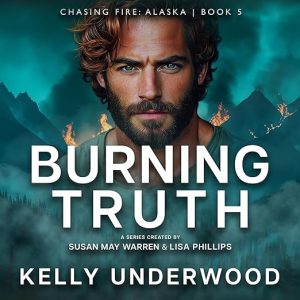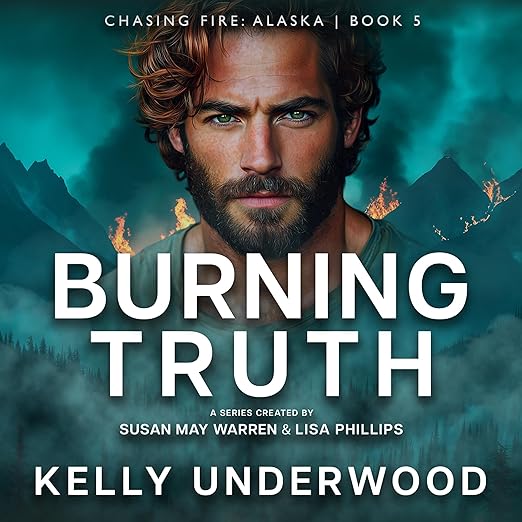
I tend to approach series entries cautiously. Reading book five without the prior four usually means arriving at a party where everyone else already knows each other. With Burning Truth, the fifth entry in Kelly Underwood's Chasing Fire: Alaska series, I made an exception, and I am glad I did. Underwood structures the novel so that Dani Barlowe and Grizz function as a new central pairing, introduced fresh, without requiring intimate knowledge of the series' prior relationships. It is, in the best sense, a book that earns its readers at book one.
The setup is built on strong genre bones. Dani, a journalist whose career was damaged by a previous professional mistake, is given a final-chance assignment: investigate a reported militia compound in the Alaskan wilderness and bring back the story that restores her reputation. She is not prepared for what she finds, or for the violence that follows. Grizz, a hotshot firefighter whose identity is entirely bound up in protecting the Alaskan land he lives on, encounters her, reluctantly, after she stumbles into territory he knows and she does not. The two have nothing obvious in common. They are both carrying histories of trust broken in ways that have made them careful with other people. The book's central dramatic question, whether they can extend trust to each other while being hunted by people who want them both silenced, drives the narrative with real efficiency.
Is Burning Truth Worth Your Time?
What Underwood does well is refuse to let the romance operate in isolation from the thriller elements. Dani and Grizz do not have quiet moments to understand each other slowly; they are given high-pressure situations that force them to demonstrate, through action, whether they are the people they need each other to be. This is structurally sound romantic suspense: the external danger is not mere backdrop but the actual mechanism through which the emotional relationship develops. When Grizz acts to protect Dani at cost to himself, it means something because Underwood has established clearly what that cost is.
The faith element, which Underwood handles through Grizz's specific character rather than as explicit theme-setting, is present but not intrusive. One reviewer described it as learning to trust one another but ultimately God, which captures the way the book's spiritual dimension operates: it is part of Grizz's identity rather than the book's overt subject matter. Readers who prefer Christian romance without heavy-handed moralizing will find this approach congenial; those who prefer faith elements kept entirely separate from the narrative will notice them but should not find them disruptive.
Why Burning Truth Works as an Audiobook
Jason Kirkover's narration handles the dual-protagonist structure with the kind of discipline that romantic suspense requires. The book alternates perspective between Dani and Grizz, and Kirkover communicates these shifts clearly through subtle differences in rhythm and register rather than through exaggerated character voices. Dani's sections have a slightly more interior, self-doubting quality; Grizz's are more action-oriented and externally focused. Kirkover captures these different orientations without overplaying either.
At just over four hours, the audiobook is notably shorter than most entries in the romantic suspense genre. This brevity is both its virtue and its constraint. The pacing is excellent, never dawdling, and the story feels complete within its runtime. Some reviewers, including one who found Dani's drive to prove herself somewhat repetitive in the middle sections, may find that the shorter format actually helps: there is less room for a single character motivation to overstay its welcome.
Weak Spots in Burning Truth
The brevity means the relationship development is compressed. Dani and Grizz move from hostility to trust to something more within a timeline that some listeners will find entirely believable given the intensity of shared survival and others will find rushed. This is a common trade-off in the romantic suspense genre, where external pacing and emotional development are perpetually negotiating priority. Underwood comes down firmly on the side of pace, which suits the audiobook format but may leave readers who want more psychological interiority feeling underserved.
The militia plot involves some elements that are described in reviews as genuinely dangerous rather than conventionally thriller-dangerous: a reader mentions a colleague's murder, being shot at, the specific threat of a compound with real capabilities. Underwood does not sanitize the external threat, which gives the romance its stakes. This is not a book where danger is primarily a pretext for throwing the protagonists together; the danger is real within the fiction.
The Right Listener for Burning Truth
Readers who enjoy clean romantic suspense with faith elements, set against an outdoor wilderness backdrop, will find this squarely in their interest. Fans of the Chasing Fire series who are current with the earlier Alaska books will find the payoff in seeing Grizz's story finally told. New listeners to the series can start here without confusion. The listener who should look elsewhere is one seeking a long, slow-burning romance with extensive internal monologue; Underwood's mode is kinetic and external, and the book's pleasures are those of momentum rather than depth.
A Few Questions About Burning Truth
How prominent is the Christian faith element in Burning Truth?
It is present primarily through Grizz's character and values rather than as explicit thematic content or sermon-like passages. One reviewer described the faith dimension as trusting in God alongside trusting each other. Readers familiar with inspirational romance will recognize the register; those who prefer it kept subtle should not find it intrusive.
At just over 4 hours, is Burning Truth too short for a satisfying romance and thriller plot?
For listeners comfortable with the romantic suspense genre's convention of compressed timelines and fast-moving romance, the runtime works well. The pacing is tight, the story completes itself satisfyingly, and the brevity suits the audiobook format. Readers expecting a slow-build romance with extensive character development may find it rushed.