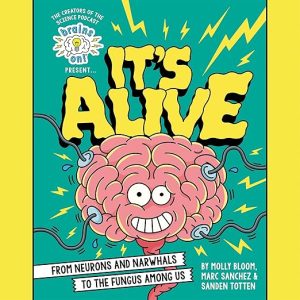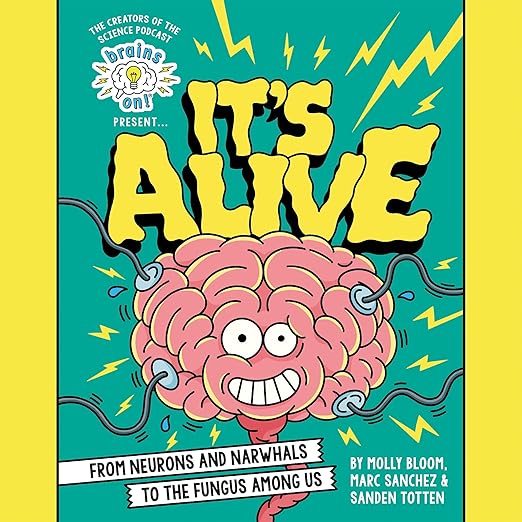
Molly Bloom and the Brains On! team have built something unusual here: science writing for young listeners that respects their capacity for real information while making the whole enterprise feel like discovering something strange and wonderful rather than sitting through a lesson. Brains On! Presents...It's Alive is the audiobook version of the podcast's approach to biology, covering territory that ranges from deep sea creatures and carnivorous plants to stinky bacteria and the mechanics of why you cannot tickle yourself. The subject matter sounds like a list of greatest hits from curious eight-year-old brains, and that is exactly the point. The Brains On! podcast won awards by treating children's questions as worthy of serious science, and this audiobook follows through on that same commitment.
Bloom narrates her own work, which suits the material exactly. Her voice carries the podcast's signature blend of genuine enthusiasm and dry wit. She does not perform enthusiasm at the listener. She simply sounds like someone who actually thinks it is remarkable that trees communicate with each other underground, which is the only way to make a young listener feel the same thing. That authenticity is surprisingly rare in children's educational audio, and it is the quality that reviewers keep returning to when they describe why children remember specific facts days after listening.
Strangeness Beats Taxonomy as the Organizing Principle
The craft decision that matters most in this audiobook is structural. Bloom and the Brains On! creative team do not organize the biology content by conventional taxonomy, moving from mammals to birds to plants in the expected sequence. Instead the book follows the logic of strangeness, grouping material by what is most likely to produce a genuinely surprised response. Animals with superpowers sit alongside plants that eat meat and brains that deceive their owners. The organizing principle is wonder rather than classification, which is the right call for an audience that has not yet been trained to expect science to feel systematic.
The jokes embedded throughout are not decoration. They function as cognitive breaks that allow young listeners to consolidate one piece of information before the next arrives. Comedy as information processing aid is underused in children's education, and the Brains On! team has clearly thought carefully about how to integrate it without letting it overwhelm the actual content. The result is an audiobook that one reviewer describes as having the effect of something you would find on the coffee table, meaning it is the kind of thing you return to rather than complete and put away.
Bloom's Delivery Never Condescends to Any Age
The material is more substantive than the playful framing might suggest. Jellyfish stinging, tree communication via mycorrhizal networks, the proprioceptive reasons for the impossibility of self-tickling: these are real phenomena explained with real accuracy. The Brains On! podcast has always valued scientific rigor alongside entertainment, and that standard carries over into the audiobook. Children who listen to this are encountering actual biology, not simplified approximations of it, packaged in a way that makes the complexity enjoyable rather than intimidating.
At four hours and twenty-seven minutes, the audiobook is long enough for a serious young science listener but also very well suited to episodic listening in shorter sessions. The chapter structure allows natural stopping points, making it practical for car trips, homework breaks, or the half hour before bed when the goal is engagement rather than high stimulation. Adult co-listeners, including a reviewer who read this to their seven-year-old nephew, consistently report enjoying it as much as the children do. The information is not only for young audiences, and Bloom's delivery never condescends to any age.
Print Illustrations Are Absent from the Audio
This is a science audiobook rooted in the podcast medium, which means its production style is conversational and dynamic. Listeners accustomed to more formal academic audio may notice that the book prioritizes liveliness over exhaustive coverage of any single topic. The depth on individual subjects is appropriate for the intended age range and the format's goals, but older or more advanced young listeners who already know the basics of the topics covered may want companion reading that goes deeper into the mechanisms being described.
The original print book contained colorful illustrations that are referenced throughout the text. In the audiobook format those illustrations are absent, and a few passages that describe visual elements work better when listeners have the print version alongside to reference. This is not a dealbreaker but it is worth knowing, particularly for parents who want to use this as a read-along across formats.
The educational philosophy embedded in this audiobook is worth naming directly. Bloom and the Brains On! team operate from the premise that curiosity is not a distraction from learning but its primary engine. The questions that open each section, why do jellyfish sting, do trees talk to each other, why can you not tickle yourself, are not rhetorical warm-ups before the real content. They are invitations to genuine inquiry, and the answers delivered through the rest of each section carry weight precisely because the question was real. That commitment to treating curiosity as intellectually serious, rather than as something to be managed or redirected into rote information delivery, is the quality that separates this from ordinary children's science audio.
Existing Brains On Fans Get a Natural Extension
This audiobook is an excellent choice for children between roughly six and twelve who are naturally curious about how living things work, and for families who want science content that adults can genuinely enjoy alongside their kids. Existing fans of the Brains On! podcast will find this a natural extension of something they already love. Parents who are looking for STEM-aligned audio content that does not feel like homework will find this one of the most enjoyable options currently available. It is also a strong choice for teachers and educators looking for audio supplements to classroom science units on biology, ecosystems, and the human body.
At a Glance
- Read by: Molly Bloom brings the same high-energy curiosity to the audiobook format that made the Brains On! podcast a success, pacing the science at a speed that holds young listeners without leaving adult co-listeners behind.
- At its heart: Biology as surprise and wonder, the living world as fundamentally weird, science as a practice of asking better questions
- Vibe: Enthusiastic and slightly ridiculous in the best way
- Short version: A science audiobook for kids that earns repeat listens because the facts are genuinely astonishing and the delivery never talks down to its audience.
Is this audiobook connected to the Brains On! podcast, and do listeners need to know the podcast to enjoy it?
The audiobook is created by the Brains On! team and shares the podcast's tone and approach, but it is entirely self-contained. No prior knowledge of the podcast is needed.
What age range is this audiobook best suited for?
The content and delivery work well for children roughly between six and twelve, with the sweet spot around seven to ten. Adult co-listeners consistently report enjoying it as much as the children, so it functions well as shared family listening.
Is the science in this audiobook accurate, or is it simplified to the point of being misleading?
The Brains On! team prioritizes scientific accuracy alongside entertainment. The biology described, including phenomena like mycorrhizal tree communication and platypus electroreception, reflects real science rather than approximations of it. The simplification serves accessibility without sacrificing factual correctness.