- Performance: Lori Prince reads T.B. Markinson's sapphic romance with a performance that tracks the comedy without sacrificing the emotional undercurrent - she is particularly good with Alice's sardonic deflections.
- What it covers: Literary soulmates and found connection, slow-burn friends-to-lovers, Jane Austen as cultural inheritance and argument
- Feel: Cozy and intellectually warm, with genuine emotional stakes
- Our call: A well-constructed sapphic romance that earns its literary pretensions - the Jane Austen scaffolding is plot-functional rather than decorative, and the central relationship develops with proper patience.
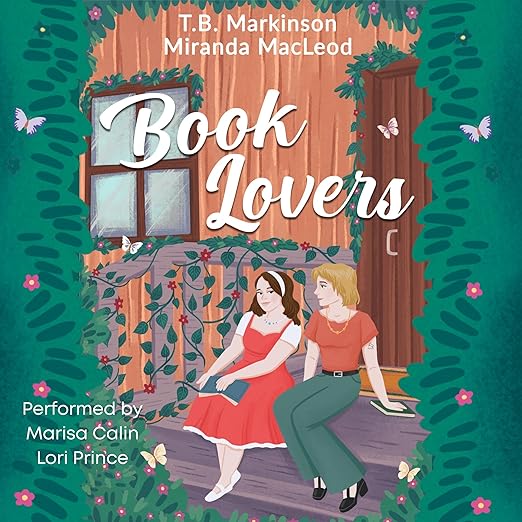
Bennet Webb arrives in Bath alone. Her dream trip to honor Jane Austen's 250th birthday was supposed to include a proposal; instead, she is standing in the city of Northanger Abbey and Persuasion with the particular flatness of a plan that went sideways before it started. That opening situation is the premise of the Book Lovers audiobook, written by T.B. Markinson and narrated by Lori Prince across eleven hours and 17 minutes. The fact that Bennet's unexpected companion in Bath is a waitress and aspiring novelist named Alice Higgins, who actively dislikes Austen, is the kind of setup that literary romance readers will recognize immediately as promising.
Markinson writes sapphic romance co-authored with Miranda MacLeod, and Book Lovers sits in the friends-to-lovers, slow-burn category with a literacy about its own genre that keeps it from feeling formulaic. The transatlantic book swap at the center of the relationship - Alice reads Bennet's beloved classics, Bennet tries Alice's contemporary picks - is a romance mechanic that actually builds character rather than serving as a pretext for scenes. Each book they exchange is a piece of self-disclosure. By the time the relationship becomes explicit about what it is, the reader has watched these two people reveal themselves through their reading histories, which is a structurally smarter foundation than most contemporary romance manages.
The Austen connection is not incidental to this novel's design. Bennet is named for the protagonist of Pride and Prejudice, and the Bath setting is chosen because of its centrality in Austen's biography and fiction. Reviewer B, A Reader noted that the novel functions as the story of Jane Austen enthusiast Bennet Webb and contemporary lit fan Alice Higgins, which is accurate: the two women's different relationships to Austen represent different ways of understanding what literature is for. Bennet reads for connection to a shared cultural heritage; Alice reads for contemporary relevance and emotional immediacy. Their book swap is, among other things, an argument about what fiction owes its readers, and that argument gives the romance its intellectual texture.
The comedy is reliable without being the book's primary register. Reviewer koalakat21 described it as filled with laughter and tears and emotional journeys, which captures the tonal range correctly: Markinson and MacLeod's co-writing produces a novel that can be funny in one paragraph and quietly devastating in the next, often within the same scene. Alice's sardonic relationship with Austen's work produces some of the best comedy; her growing engagement with it despite herself produces some of the best emotional development. At eleven hours and 17 minutes, the book takes its time, and the slow-burn designation is accurate: Markinson does not force the romantic resolution before the emotional foundation is ready for it.
The supporting cast contributes to the sense of a story with a real world around it rather than two characters in a romantic vacuum. The residents of Bath and the ongoing transatlantic correspondence that sustains the relationship after Bennet returns to Boston both receive enough attention to feel credible rather than decorative.
Bennet's Name Signals the Austen Connection
Lori Prince's narration is one of the better sapphic romance performances in recent audiobook production. She handles Alice's voice with a sardonic quality that makes Alice's deflections funny rather than frustrating, and she tracks Bennet's particular combination of literary earnestness and social fumbling with sympathetic precision. The dual-register challenge of a romance where one character is skeptical and one is enthusiastic is harder than it sounds: narrators often over-correct by playing the skeptic as cold or the enthusiast as naive. Prince maintains the humanity of both positions throughout eleven hours without the characterizations flattening.
The book-discussion scenes are well-rendered in audio specifically because hearing titles and passages discussed aloud adds a layer that print cannot provide. When Bennet and Alice debate the merits of Austen versus contemporary literary fiction, the conversation has a spoken quality that Markinson seems to have anticipated in the writing. These are not scenes where characters explain their views for the reader's benefit; they are arguments between two people who genuinely disagree and are equally invested in the outcome.
Prince Balances Two Very Different Readers
The pacing is deliberately patient. The payoff in slow-burn romance depends on the reader trusting the author's control of the timeline, and Markinson earns that trust over the first several hours but requires it for the middle section. Listeners who prefer romance with a faster emotional escalation should be aware that the friends-to-lovers development here is genuinely slow, a choice rather than a failure, but one that affects the listening experience. If you have had good experiences with sapphic slow-burn before, this is well-made. If slow-burn tends to test your patience, the eleven-hour runtime will likely become a factor before the ending arrives.
The Austen references are extensive and assume some familiarity with at least Pride and Prejudice and Persuasion. Readers with no Austen background will follow the plot but miss the resonances that Markinson builds the novel's emotional logic around. A basic familiarity with Austen's work - even just knowing who Elizabeth Bennet is and what Bath means in Austen's fiction - will significantly improve the listening experience.
Sapphic Romance Fans Meet Austen Devotees
Sapphic romance readers who appreciate literary fiction as an emotional framework rather than set decoration will get the most from this audiobook. Austen fans who have been looking for a contemporary sapphic romance that engages seriously with the Austen world will find this well-constructed. Listeners who enjoy Emily Henry's character work or Casey McQuiston's wit in a slower, more introspective register will find Markinson's approach compatible. Anyone who identifies with the particular experience of building intimacy through shared reading will find the book swap mechanic genuinely satisfying.