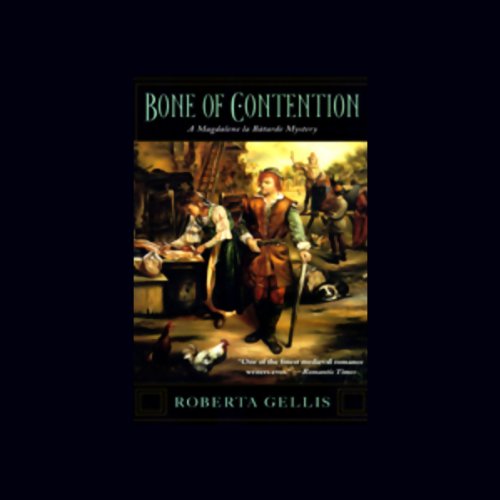
I came to Roberta Gellis's Magdalene la Batarde series the way I suspect many readers do: sideways, through a recommendation that mentioned the unusual protagonist rather than the genre. A former prostitute turned brothel keeper who solves murders in twelfth-century England, operating in the shadow of King Stephen's civil war, is not exactly a familiar archetype. That premise alone got me to start Bone of Contention, and Nadia May's narration kept me there for the full eleven and a half hours.
This is the third book in the series, set during the period of political instability surrounding Stephen's great council at Oxford. Magdalene's patron, William of Ypres, draws her into a situation that begins as political maneuvering and becomes something darker. The murder itself is embedded in the kind of scandal that medieval politics specialized in, forged documents and competing claims for power, and Magdalene's network of informants, specifically her former colleagues among Oxford's whores and barmaids, provides the investigative infrastructure that no official channel could replicate. That detail is one of the series' genuine strengths: Gellis grounds her mystery in the social logic of medieval England rather than layering modern investigative procedure onto a historical backdrop.
Gellis Gives Servants and Whores Real Depth
Gellis is a careful historical novelist, and Bone of Contention shows the depth of research that distinguishes her from writers who use the medieval period primarily as atmosphere. The political machinery around Stephen's reign is rendered with enough specificity to matter to the plot without becoming a lecture. Reviewers who have followed Gellis from her earlier noble family sagas note that this series shows a new attention to people outside the aristocracy: servants, tradespeople, women in precarious situations, all drawn with the kind of comprehension that comes from genuine interest rather than condescension. One long-term reader described the characters as vivid, three-dimensional figures who clearly inhabit their time period without becoming museum pieces. That is a difficult balance to strike in historical fiction, and Gellis manages it.
May Trusts Listeners With Forged Betrothal Papers
Nadia May is the right narrator for this material. She reads with a precision that suits Gellis's layered plotting: the scene-setting passages get the same care as the dialogue, and May's pacing respects the density of the historical context without letting the audiobook become ponderous. The mystery itself is genuinely well-constructed. Reviewers note that each book in the series delivers complex, satisfying plotting with resolutions that feel earned rather than convenient. The political scandal at the heart of this installment, forged betrothal papers and accusations of treason, works both as a historical document and as a plot engine. Gellis does not simplify the period to make the mystery more accessible. She trusts her readers to keep up, and May's narration signals that trust by not over-explaining.
Only Four Books, and Readers Want More
Listeners new to the series should know that Gellis does not provide extensive recaps of earlier books. Magdalene's relationships with William of Ypres and with Sir Itchen of Bellamy carry emotional weight that previous installments have earned. The audiobook is fully comprehensible as a standalone, but the investment in Magdalene as a character is considerably richer if you have spent time with her before. The series has four entries total, and more than one reviewer expressed sadness that there are not more, which is a specific kind of high praise for a mystery series. If you come to this one first and find yourself wanting more context, the earlier books reward the backtrack.
Shardlake and Cadfael Fans Meet Their Match
Listeners who enjoy historical mysteries set outside the familiar Tudor or Victorian periods will find this medieval Oxford setting genuinely distinctive. Fans of C.J. Sansom's Shardlake series or Ellis Peters's Cadfael novels may recognize the combination of rigorous period detail and satisfying procedural plotting. Those who want a female protagonist with real agency operating within a fully realized social system, rather than a modern sensibility dressed in period costume, will find Magdalene la Batarde one of the more interesting investigators in the genre. New listeners to the series can start here, but starting from book one is the better approach.
Before You Press Play
- Voice: Nadia May is authoritative and precise, giving the medieval Oxford setting genuine texture without slowing the narrative pace.
- Big ideas: Justice at the margins of power, political intrigue in a fractured England, community among women outside respectable society
- Atmosphere: Richly detailed and unhurried, with a confident period sensibility
- Worth it?: The third Magdalene la Batarde mystery rewards readers already invested in Gellis's medieval world and holds up confidently as a standalone procedural.
Questions Listeners Ask
Can Bone of Contention be listened to without reading the first two Magdalene la Batarde books?
Yes, the mystery is self-contained and the historical setting is established without requiring prior knowledge. That said, the relationships between Magdalene and recurring characters like William of Ypres carry more weight if you have read the earlier entries. Starting from book one is the more satisfying approach if you have time.
How complex is the historical and political context around King Stephen's reign?
Gellis integrates the civil war politics into the plot rather than explaining them separately. Listeners with some general knowledge of medieval English history will find the context clicks into place easily. Those coming in cold may occasionally need to pause and orient, but the story does not require specialist knowledge to follow.
How does Nadia May handle the large cast of characters across different social classes?
May provides clear vocal differentiation between characters and manages the shift between noble political figures and Magdalene's network of lower-class informants with appropriate tonal range. The social contrast between these two worlds is one of the book's strengths and May maintains it throughout.
Is the romantic element prominent in Bone of Contention?
The romance strand exists but is secondary to the mystery. Gellis is more interested in the political and investigative dimensions of this particular installment. Readers looking primarily for historical romance may find the balance tips more toward procedural here than in some other entries in the genre.