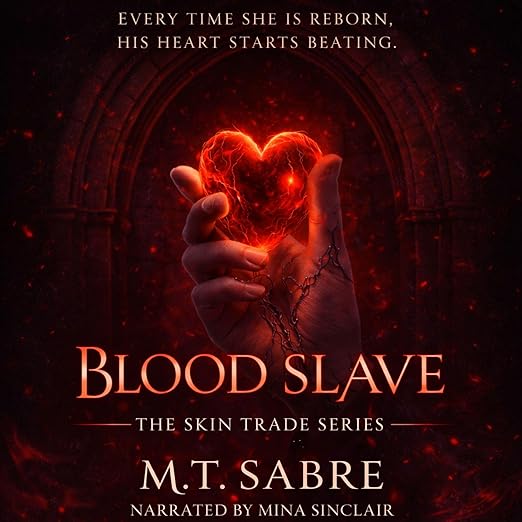
I came to Blood Slave on a Sunday afternoon when the weather had made outdoor plans impossible and I was in the mood for something that asked nothing of my better nature. Dark paranormal romance is a specific appetite, and I have learned to approach it on its own terms rather than literary fiction's. M.T. Sabre's Skin Trade series opener had been on my list for a while, partly because of the unusual volume of five-star reviews for a debut in a crowded subgenre, and partly because slow-burn vampire fiction with a dystopian frame is a combination that either succeeds completely or fails the same way.
The world Sabre has constructed is genuinely considered. A virus transforms humans into predatory vampires. The surviving human population is, over time, reduced to a permanent servile underclass, cattle is the word the synopsis uses, and the book does not shy from the implications. Payton was taken from her family at thirteen by a gang leader named Crevan, raised in conditions designed to strip her of personhood, silence enforced, obedience mandatory, punishment physical. By the time she is placed at the Blood Auction where Seth Hayden, the Vampire King of the North, claims her, she has been conditioned for submission for years. The setup is dark, deliberately so, and the warning in the synopsis about mature content and violence is meant seriously.
A Closer Look at Blood Slave: A Slow Burn Dystopian Vampire Romance
The slow-burn designation is accurate and should be understood as a promise rather than a hedge. One reviewer who read all three books back-to-back described the first installment as primarily plot-building and world-building, laying environmental groundwork for what follows. Another reviewer specifically noted that the spice level is not there in the first book, which is worth knowing going in. The tension is psychological rather than physical, built on Payton's guarded interiority and Seth's cryptic behavior that hints at a history connecting them that neither fully understands.
What makes the relationship dynamic more interesting than the typical vampire-claims-human setup is Sabre's investment in Payton's active perspective. She is not passive, even when she appears to be. Her defiance is internal before it surfaces externally, and Mina Sinclair's narration gives that internal defiance texture without telegraphing it prematurely. The reviewer who described Payton as hardened by this cruel world and refusing to be broken captures what makes the character worth following through a first book that requires patience.
What Makes Blood Slave: A Slow Burn Dystopian Vampire Romance Worth Hearing
Mina Sinclair's narration is one of the book's genuine assets. The challenge of voicing a protagonist who has been conditioned into silence and is now learning, tentatively, carefully, to feel again is considerable. Sinclair finds the register between traumatized and resilient without flattening either quality. The result is a first-person narration that does not feel performed, which matters especially in a book where so much of the action is internal. At nine hours and twenty minutes, the pacing that some reviewers described as too thought-heavy actually benefits from audio format, where the accumulation of interiority is less visually apparent than in print.
One reviewer's concern about too many pages of internal thought is the most common criticism of this book, and it is a legitimate structural note. Sabre thinks through Payton's perspective thoroughly, perhaps more thoroughly than the early plot warrants. For listeners who want momentum, those sections can feel like stalling. For listeners invested in character psychology, they feel like building. Your preference between those two modes will largely determine your experience of this book.
Things to Know Before Starting Blood Slave: A Slow Burn Dystopian Vampire Romance
Seth Hayden is the more conventionally constructed of the two protagonists, the powerful, cold, enigmatic figure with a hidden history that connects to the heroine in ways not yet revealed. What Sabre does differently is that Seth's treatment of Payton is immediately anomalous. He treats her like she is precious rather than a blood slave, as one reviewer put it, which creates the central mystery: why, and what does he know that she does not. The cryptic words about a shared past are the mechanism that keeps the reader oriented toward revelation even when the present-tense action is deliberately slow.
The dystopian frame is more developed than many paranormal romances in which the world-building serves merely as backdrop. The virus origin story, the social hierarchy of Crevan's establishment, the militia elements in later installments, these are given enough internal logic that the world holds up to attention. Readers who engage with the setting as well as the romance will find more to hold onto than readers who treat the dystopia as wallpaper.
Who M.T. Sabre Is Writing For
Listeners who enjoy dark paranormal romance and understand what the slow-burn label actually entails will find this series worth committing to. This is not a book for readers who want the romantic resolution in the first installment. It is a first act, and a deliberately paced one. The payoff, based on reviewer responses who binged all three books, is present, but it requires the investment of getting there. Readers who object to power-imbalance dynamics even in clearly fantastical contexts should approach carefully, given the structural conditions of Payton's situation.
In Brief
- Narration: Mina Sinclair brings Payton's interiority to life with a voice that balances defiance and vulnerability, well-matched to a protagonist defined by suppressed will.
- Themes: Power, captivity, and found identity; the slow erosion of dehumanization; dark fantasy romance dynamics
- Mood: Tense and atmospheric, with the deliberate pace that slow-burn promises, not propulsive, but consistently charged
- Verdict: A strong entry point into dark paranormal romance that earns its slow-burn label, readers who want immediate heat will struggle, but those who invest in the world and its protagonist will find the payoff worth building toward.