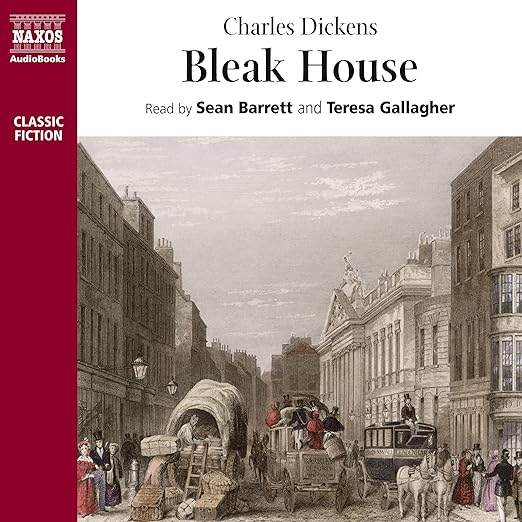
There are novels that feel different in audio than they do on the page, and Bleak House is one of them. I came to it having read the book twice in print over a span of years, and I was not expecting the audio format to change anything fundamental about my relationship to it. It did. Sean Barrett's narration for Naxos AudioBooks, released in 2006, does something that patient reading of Dickens can approximate but rarely achieves fully: it makes the voices feel like voices rather than literary effects. Dickens was a performer, a celebrated reader of his own work during his lifetime, and Bleak House in particular was written with an ear for rhythm and character that rewards being heard.
The novel requires some orientation for listeners approaching it fresh. Published in installments between 1852 and 1853, Bleak House centers on the Jarndyce and Jarndyce case, a Chancery lawsuit so ancient and labyrinthine that no one involved can fully explain its origins or predict its resolution. Around this central institutional absurdity, Dickens builds one of the most intricately connected casts in Victorian fiction. The story is narrated in two alternating registers: a third-person narrator who addresses the reader with bitter, ironic authority, and the first-person account of Esther Summerson, the novel's moral center, whose voice is warmer and more domestic but no less perceptive. Barrett manages both registers with distinction, which is the core technical achievement of this recording.
London's Fog Is the Novel's Real Villain
Literary critics have long argued about whether Bleak House or Little Dorrit represents Dickens' most fully realized critique of English institutions, but there is a reasonable case that Bleak House is the more complete work. The novel's anatomy of the Chancery system, a court of equity that consumes the lives and resources of everyone who passes through it without ever resolving anything, functions as both a specific historical target and a template for every bureaucratic institution designed to perpetuate itself at the expense of those it purports to serve. The fog that opens the novel, thick and settling over everything, extending into every corner of London life, is not decorative. It is the operative metaphor for everything that follows.
Into this fog Dickens places an extraordinary range of characters. Inspector Bucket, one of the first detectives in English literature, appears late enough in the novel to feel like a structural surprise. Lady Dedlock, whose secret forms one of the novel's primary mysteries, is given more psychological complexity than Dickens is usually credited with. Mrs. Jellyby, absorbed in philanthropic work for Africa while her household and children collapse around her, is one of the great satirical portraits of misplaced moral energy in English fiction. And Esther Summerson herself, who Dickens asks to function as both protagonist and reliable ethical guide in a story full of unreliable institutions, is a more interesting creation than her initial modesty suggests.
Sean Barrett Splits Cleanly Into Two Voices
The alternating narrative structure of Bleak House is one of the elements that makes it challenging in print and rewarding in audio. Barrett differentiates the two voices clearly enough that listeners can orient themselves at each chapter transition without re-reading the opening lines. The third-person narrator's satirical impatience comes through in Barrett's pace and tone, clipped and ironic, against Esther's warmer, more measured first-person delivery. This is technically demanding work over an eleven-hour recording, and Barrett maintains it throughout.
The Naxos AudioBooks production is clean and professional, which matters for a novel this long. This is also a free audiobook available through Audible membership, which makes the Barrett recording accessible as a first encounter with the text for listeners who have never read Dickens in any form. Given that Bleak House is frequently cited by critics as the place to start with Dickens for readers who have already worked through the more familiar novels, having a recording of this quality at no additional cost is worth noting.
Following a Huge Cast Without Flipping Back
One question worth addressing directly for listeners considering Bleak House as their entry point to Dickens: is the audio format a good way to encounter this particular novel for the first time? The answer is yes, with a caveat. The novel's plot involves a large cast of characters whose connections to each other are revealed gradually and sometimes unexpectedly, and in print you can flip back to an earlier chapter to verify a name or relationship. In audio, this is harder to do. Listeners who are comfortable following a complex narrative without the ability to reference earlier passages will manage well. Those who know they need to double back regularly to confirm connections may want to have a print edition available alongside the recording.
New to Dickens? Start Somewhere Smaller First
Listen if you have any relationship with Victorian literature and have not yet attempted Bleak House. The Sean Barrett Naxos recording is one of the strongest available, and the audio format genuinely serves the novel's theatrical qualities. Also listen if you are interested in the history of detective fiction, the critique of institutions as a literary mode, or the Victorian social novel more broadly.
Approach carefully if you are new to Dickens entirely. Bleak House is a late, mature novel with a large cast and a complex plot, and first encounters with Dickens often benefit from starting with something more narratively contained. David Copperfield, Great Expectations, or A Tale of Two Cities might offer a better initial orientation. Once you know what Dickens sounds like, Bleak House is the richest territory he offers.
Common Questions
Is Sean Barrett's Naxos recording the best available audiobook version of Bleak House?
Barrett's Naxos recording is widely considered among the finest available. His management of the dual narrator structure, the third-person satirical voice and Esther Summerson's first-person account, is technically exceptional and has been praised by Dickens scholars and general listeners alike.
How does the audio format handle Bleak House's alternating narrators?
Barrett differentiates the two voices clearly throughout. The third-person narrator carries a tone of ironic, clipped impatience, while Esther's chapters are rendered with a warmer, more measured delivery. The transitions are legible without requiring the listener to refer back to chapter headings.