Can a marriage arranged for money hold eleven hours of audiobook together when neither party will say out loud what they actually want? That is the bet Caroline Linden makes in the second book of The Truth About the Duke, and the answer depends almost entirely on how much patience you have for two intelligent people talking around the one subject that matters. I think the bet pays off, though not without a stretch in the middle where the wanting does most of the work.
Is Blame It on Bath Worth Your Time?
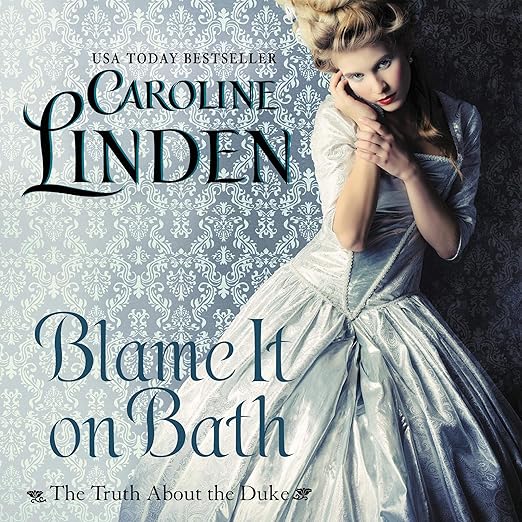
Caroline Linden built this trilogy on a single legal threat. As one reader lays out the arc, the old Duke of Durham has died and someone is threatening the family with proof of an earlier marriage that was never terminated, which would make the second marriage bigamous and the three sons illegitimate. The estate goes with the legitimacy. That premise gives every book in the series the same clock and lets each brother solve it differently, and the publisher sets this installment up as the story of "a blackmailed nobleman facing the loss of his birthright and bent on revenge, and the willing heiress he intends to marry for her money". The sting in that sentence arrives at the end: she is also, in the same copy, "a lady who has loved him from afar for years."
So the transaction is only a transaction on one side, and Linden knows exactly how much that is worth. A reader who calls the book "An ugly duckling" describes the heroine as Katherine Howe, the widow of a viscount, "a very plain woman but is also an heiress thanks to her commoner father", dressed in "dark, unfashionable" clothes and possessing "no strength to fight against other people's wishes." Put her opposite a man who has decided to marry for money out of pure strategic calculation and the asymmetry does the plotting for you. Another reader summarizes the pairing efficiently: "The hero is smart and a really decent guy who is a realist; the heroine is smart and has a sense of humor".
What makes the second book work is the gap between what these two people know. He is marrying for money and makes no secret of it. She has, in the publisher's phrase, "loved him from afar for years", and nothing in the setup suggests he has any idea. Every exchange after that runs on two levels at once, and you are the only party holding both of them. It is the oldest engine in the genre and among the most reliable, because the pressure comes from inside the marriage rather than from anything the plot has to arrange. The title points at where that pressure eases. Bath, and the publisher's own line about what happens there staying there, promises a stretch away from the London crisis in which the two of them are something other than parties to a contract.
The heat level is genuine. The publisher promises "a wonderfully sensual yarn", one reader files the book under "Fun, sexy, well written", and nothing in the responses suggests the intimacy is fade-to-black. Julia Quinn's line on Linden, quoted on the listing, is that she "touches every emotion", and the publisher positions the prose as reminiscent of "Julia Quinn and Liz Carlyle," which is a fair signal of register: warm, witty, more interested in feeling than in period detail for its own sake. Reader enthusiasm runs high. One finished it "in a day and a half" and wished it had "another 500 pages", and another reader, whose "experience with this author has not been consistent", was "delighted" to enjoy this one. That second endorsement is the more informative of the two.
Before You Commit to Blame It on Bath
Eleven hours and ten minutes is a long book by the standards of the genre, and the pacing is the honest risk. The central obstacle is concealment rather than incident. She has years of feeling to keep quiet about and he has a revenge he is not discussing, and a conflict of that shape can only be sustained by postponing the conversation, which gets expensive over that runtime. If withheld communication frustrates you rather than tantalizes you, this is a lot of it. The blackmail plot runs underneath as connective tissue between the three books rather than as a thriller in its own right, so do not come expecting the mystery to carry you.
Two smaller flags. A reader who liked the book still notes that the heroine "is a bit weak when it comes to important things", and that comment stops mid-sentence with the thought unfinished, so read it as an unresolved reservation rather than a verdict. Separately, the series numbering is not consistent across the record: the publisher calls this the second installment and the listing agrees, while one reader refers to it as book three. Book one is named elsewhere in the comments as One Night in London, so if order matters to you, start there and expect the count to depend on whether shorter entries between the novels are included in the tally.
The Right Listener for Blame It on Bath
Pick this up if the marriage-of-convenience setup is your particular weakness, and especially if you like it complicated by one partner who is already in love and hiding it. Readers who came for the deLacey brothers after the first book get exactly the continuation they want, since the inheritance threat carries across all three. It also suits anyone who prefers their period romance warm and character-driven over meticulously researched, given how firmly the copy points at Julia Quinn's territory.
Give it a pass if slow-burn tension built on non-communication makes you want to shout at people, because the runtime here will test you. Skip it too if you need the historical setting to do more than provide costume and a title, since the estate crisis functions as machinery rather than as social history. One practical note for anyone deciding on the audio specifically: not a single comment engages with the audio edition, and all of them discuss the novel as text, so Gildart Jackson's reading has no listener verdict attached to it. Given that the story leans on two people concealing things from each other, a reader who can carry irony without announcing it matters more than usual, but that is a demand of the material rather than an assessment of the performance.
In Brief
- Narrator: Gildart Jackson is the credited reader; every comment on file discusses the text rather than the recording, so the performance is unreviewed here.
- Subjects: marriage of convenience, unrequited love made mutual, blackmail and disputed inheritance, plain-heroine transformation
- Tone: Warm, sensual and slow to let its characters off the hook
- Bottom line: A strong middle entry for marriage-of-convenience fans, provided eleven hours of withheld confession sounds like pleasure rather than punishment.