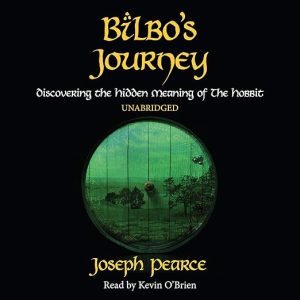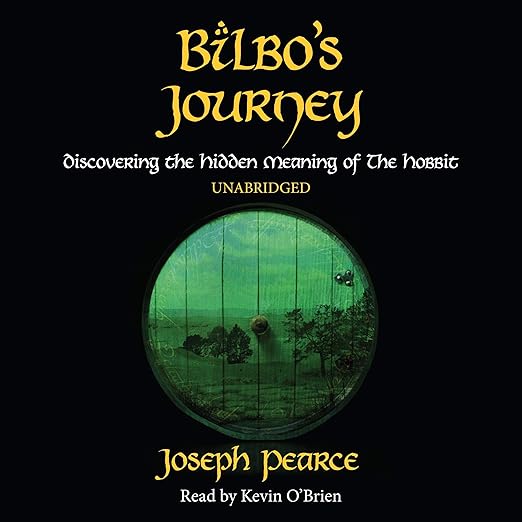
- Performance: Kevin O'Brien reads Pearce's close literary criticism with warmth and intellectual commitment, and at under four hours the performance stays focused and leaves no dead air.
- What it covers: Christian allegory in Tolkien, self-sacrifice versus comfort-hoarding, providence and grace as narrative architecture
- Feel: Scholarly but devotionally warm, accessible without being dumbed down
- Our call: Joseph Pearce's Tolkien study rewards both fans of The Hobbit and readers drawn to the Catholic literary imagination, especially as a companion to a recent re-read.
Joseph Pearce's Bilbo's Journey is an audiobook with a specific and unusually well-executed mission: to read The Hobbit as Tolkien intended it, as a work saturated in Catholic sensibility rather than as a secular adventure story that happens to feature moral lessons. Pearce is a serious Tolkien scholar with a track record of careful close reading, and this short work, under four hours, distills that expertise into an accessible companion guide that has found an audience well beyond academic circles. The 4.7 rating across 165 reviews is unusually high for literary criticism, which tells you something about how well Pearce has calibrated his approach for a readership that loves Tolkien more than it loves theoretical frameworks.
Pearce's central argument is that Bilbo Baggins's quest to confront the dragon Smaug is not merely an exciting adventure but a Christian journey of self-sacrifice, abandonment to providence, and the grace that comes from loving others more than your own comfort. He draws a sustained parallel between Bilbo's attachment to his cozy hole and Smaug's hoarding of gold, showing how Tolkien structured both as versions of the same spiritual trap: the refusal to risk anything for anyone. One reviewer specifically highlighted this comparison as the book's most illuminating moment, and Pearce handles it with the precision of someone who has read Tolkien's letters and Catholic theology alongside the primary text.
The book also traces the eucatastrophe, Tolkien's own term for the sudden joyous turn that grace permits at the climax of a story, and shows how deliberately the author embedded that concept in the narrative architecture of The Hobbit. For readers who have always sensed something underneath the adventure surface of the book without having the vocabulary to articulate it, Pearce provides both the vocabulary and the close reading that proves the intuition correct. The 165 reviewers who have given this book an average of 4.7 stars include a mix of devoted Catholics, general Tolkien fans, and parents looking for study companions for their children, and Pearce has managed to satisfy all three audiences simultaneously.
O'Brien Inhabits the Argument He Narrates
Kevin O'Brien narrates this audiobook with a warmth that suits both the material's devotional register and its literary enthusiasm. O'Brien does not perform the criticism so much as inhabit it, reading Pearce's prose as if he genuinely believes what it's arguing, which keeps the audiobook from feeling like a lecture being delivered by someone who has no stake in the outcome. That quality of conviction matters for literary criticism: a narrator who sounds bored by a close reading will transfer that boredom to the listener.
The short runtime is genuinely appropriate for what the book is: a companion, not a replacement for reading The Hobbit itself. Reviewers have used it as study support for children working through Tolkien in school, and one described it as the perfect companion to understanding the deeper meaning of the characters and their actions. That framing is accurate. This works best if you've read or listened to The Hobbit recently and want to revisit it with more interpretive scaffolding behind you. The audiobook format works particularly well here because Pearce's argument is sequential and cumulative, following the plot chapter by chapter in a way that benefits from uninterrupted listening rather than the in-and-out reading habits that printed criticism sometimes allows.
Explicitly Christian, Openly Short and Simple
Pearce's reading of The Hobbit is explicitly Christian, and he does not frame this as one possible interpretation among several. Listeners who are uncomfortable with devotional literary criticism, or who prefer secular interpretations of Tolkien's work, will find this approach too theologically committed to feel like neutral scholarship. The argument that Tolkien's Catholic faith is not incidental to but constitutive of the story is one that serious Tolkien scholarship broadly supports, but Pearce leans into the devotional dimension in ways that go beyond purely academic analysis.
The slim runtime also means some readers will wish for more. Pearce covers the major plot beats and their symbolic resonances but doesn't linger, and those wanting exhaustive chapter-by-chapter analysis should look at longer critical works. The book's own description is candid about this: it acknowledges being short and simplistic, as the Hobbit itself is, and that calibration holds. It is a gateway and an invitation to deeper study, not the final word on Tolkien's intentions.
Catholic Readers and Curious Tolkien Fans Alike
Catholic readers and those interested in the intersection of faith and literary imagination will get the most out of this audiobook in the fullest sense. Tolkien fans who have wondered what the man himself intended beneath the adventure surface will find Pearce's account authoritative and accessible. Parents looking for an interpretation guide to share with children who are studying The Hobbit in school will find the short runtime and clear prose well suited to that purpose.
Secular Tolkien scholars who want a rigorous Christian reading will find Pearce competent and useful even if they don't share his worldview. Those with no interest in Tolkien specifically but who enjoy literary criticism that treats its subject with genuine love and interpretive precision will also find this worth four hours. The combination of scholarly rigor and readable warmth is rarer than it should be in literary criticism, and Pearce achieves it consistently across the audiobook's full runtime. O'Brien's performance makes the four-hour runtime feel like time well invested rather than time spent working through an obligation, which is the highest compliment you can pay a narrator handling literary criticism.
Common Questions
Do I need to have read The Hobbit before listening to the Bilbo's Journey audiobook?
Yes, strongly. Pearce's analysis moves through the plot assuming thorough familiarity. Listening without knowing the source text will deprive you of the interpretive payoff the book is built to deliver. Read or re-read The Hobbit first, ideally recently enough that the details are fresh.
Is the Bilbo's Journey audiobook too academic for general Tolkien fans?
No. Pearce writes for people who love Tolkien rather than for academic specialists. The prose is clear, the arguments are accessible, and reviewers have recommended it to middle-schoolers studying The Hobbit for school, which suggests the accessibility level is well-calibrated for general readers.
How explicitly religious is the Bilbo's Journey audiobook?
Explicitly Catholic in its framework. Pearce presents the Christian interpretation as what Tolkien built into the text, not as one option among several. Listeners who prefer secular literary readings will find this approach committed in ways that feel less like scholarship and more like devotional criticism. Kevin O'Brien's warm narration avoids a preachy register, but the theological perspective is central throughout.